
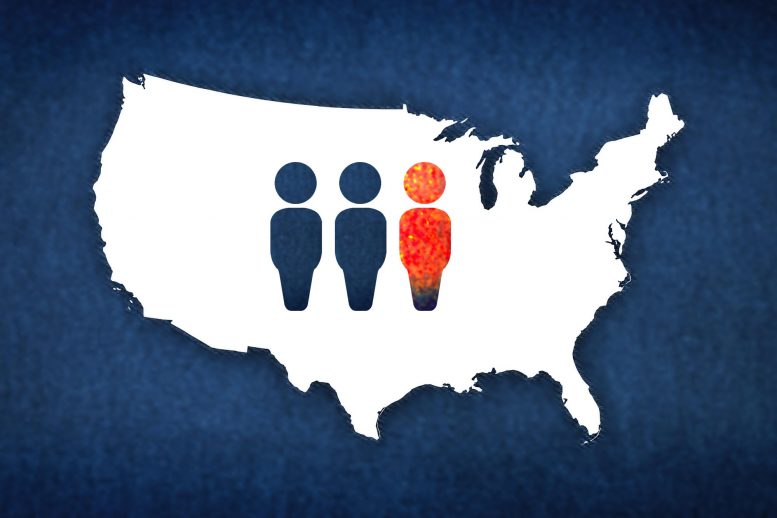
Undocumented infections accounted for estimated three-quarters of infections last year.
A new study published in the journal Nature estimates that 103 million Americans, or 31 percent of the U.S. population, had been infected with SARS-CoV-2 by the end of 2020. Columbia University Mailman School of Public Health researchers modeled the spread of the coronavirus, finding that fewer than one-quarter of infections (22%) were accounted for in cases confirmed through public health reports based on testing.
The study is the first to comprehensively quantify the overall burden and characteristics of COVID-19 in the U.S. during 2020. The researchers simulated the transmission of SARS-CoV-2 within and between all 3,142 U.S. counties using population, mobility, and confirmed case data.
Infections were more widespread in some areas of the country. In areas of the upper Midwest and Mississippi valley, including the Dakotas, Minnesota, Wisconsin, and Iowa, more than 60 percent of the population is estimated to have been infected by the end of 2020. In five metropolitan areas the researchers examined, 48 percent of residents of Chicago, 52 percent of Los Angeles, 42 percent of Miami, 44 percent of New York City, and 27 percent of people in Phoenix, had been infected in the same timeframe.
Testing picked up on a growing number of infections but offered an incomplete picture. The portion of confirmed cases reflected in the study’s estimates, i.e. the ascertainment rate, rose from 11 percent in March to 25 percent in December, reflecting improved testing capacity, a relaxation of initial restrictions on test usage, and increasing recognition, concern, and care-seeking among the public. However, the ascertainment rate remained well below 100 percent, as individuals with mild or asymptomatic infections, who could still spread the virus, were less likely to be tested.
“The vast majority of infectious were not accounted for by the number of confirmed cases,” says Jeffrey Shaman, PhD, professor of environmental health sciences at Columbia University Mailman School of Public Health. “It is these undocumented cases, which are often mild or asymptomatic infectious, that allow the virus to spread quickly through the broader population.”
One in 130 Americans was contagious at year’s end. Roughly 1 in 130 Americans (0.77%) was contagious with SARS-CoV-2 on December 31, 2020. A similar percentage (0.83%) was estimated to be latently infected, i.e. infected but not yet contagious. In some metropolitan areas, the percentage of individuals who was contagious at year’s end was much higher.
Fatality rates fell with strengthening treatments and public health measures. The percentage of people with infections who died from COVID-19 fell from 0.8 percent during the spring wave to 0.3 percent by year’s end. Urban areas like New York City that peaked in the spring saw the worst numbers for reasons that include delays in testing availability and masking mandates, overwhelmed hospitals, and lack of effective treatments.
Cities peaked at different times of the year. New York and Chicago experienced strong spring and fall/winter waves but little activity during summer; Los Angeles and Phoenix underwent summer and fall/winter waves; and Miami experienced all three waves. Los Angeles County, the largest county in the U.S. with a population of more than 10 million people, was particularly hard-hit during the fall and winter and had a community infection rate of 2.4 percent on December 31.
A new pandemic landscape for 2021. Looking ahead, the authors write that several factors will alter population susceptibility to infection. The virus will continue to spread to those who haven’t yet been infected. While vaccines protect against severe and fatal disease, breakthrough infections, including those that are mild or asymptomatic, will contribute to the spread of the virus. The current study does account for the possibility of reinfection, although there is evidence of waning antibodies and reinfection. New more contagious variants make reinfection and breakthrough infections more likely.
“While the landscape has changed with the availability of vaccines and the spread of new variants, it is important to recognize just how dangerous the pandemic was in its first year,” concludes Sen Pei, PhD, assistant professor of environmental health sciences at Columbia University Mailman School of Public Health.
Reference: “Burden and characteristics of COVID-19 in the United States during 2020” by Sen Pei, Teresa K. Yamana, Sasikiran Kandula, Marta Galanti and Jeffrey Shaman, 26 August 2021, Nature.
DOI: 10.1038/s41586-021-03914-4
Additional authors include Teresa K. Yamana, Sasikiran Kandula, and Marta Galanti at Columbia Mailman School.
The study was supported by funding from the National Science Foundation (DMS-2027369) and a gift from the Morris-Singer Foundation. Human mobility data was provided by SafeGraph. Shaman and Columbia University disclose partial ownership of SK Analytics. Shaman discloses consulting for Business Network International (BNI).
Never miss a breakthrough: Join the SciTechDaily newsletter.
Follow us on Google and Google News.