
Close Menu
    Facebook X (Twitter) Instagram
    SciTechDaily
    • Biology
    • Chemistry
    • Earth
    • Health
    • Physics
    • Science
    • Space
    • Technology
    Facebook X (Twitter) Pinterest YouTube RSS
    SciTechDaily
    Home»Technology»1,000 Times Smaller Than a Grain of Sand – Newest Optical Fiber Technology Could Supercharge Internet Speeds
    Technology

    1,000 Times Smaller Than a Grain of Sand – Newest Optical Fiber Technology Could Supercharge Internet Speeds

    By KTH, Royal Institute of TechnologyMay 20, 20241 Comment3 Mins Read
    Facebook Twitter Pinterest Telegram LinkedIn WhatsApp Email Reddit
    Share
    Facebook Twitter LinkedIn Pinterest Telegram Email Reddit
    Set Up for 3D Printing Microsensors and Nanogratings
    Swedish researchers have innovated 3D printing by developing silica glass micro-optics on optical fibers, promising faster internet, improved sensors, and advanced imaging systems, while avoiding high-temperature damage to fiber coatings. Credit: David Callahan

    Swedish researchers have 3D-printed silica glass micro-optics on optical fibers, enhancing internet speed and connectivity. This technique, more resilient and precise, could revolutionize remote sensing, pharmaceuticals, and photonics.

    In a first for communications, Swedish scientists have successfully 3D printed silica glass micro-optics directly onto the tips of optical fibers, areas as tiny as the cross-section of a human hair. This breakthrough could lead to faster internet speeds and enhanced connectivity, along with the development of smaller sensors and more compact imaging systems.

    Reporting recently in the journal ACS Nano, researchers at KTH Royal Institute of Technology in Stockholm say integrating silica glass optical devices with optical fibers enables multiple innovations, including more sensitive remote sensors for the environment and healthcare.

    The printing techniques they report also could prove valuable in the production of pharmaceuticals and chemicals.

    Setup To Print Silica Glass Microstructures
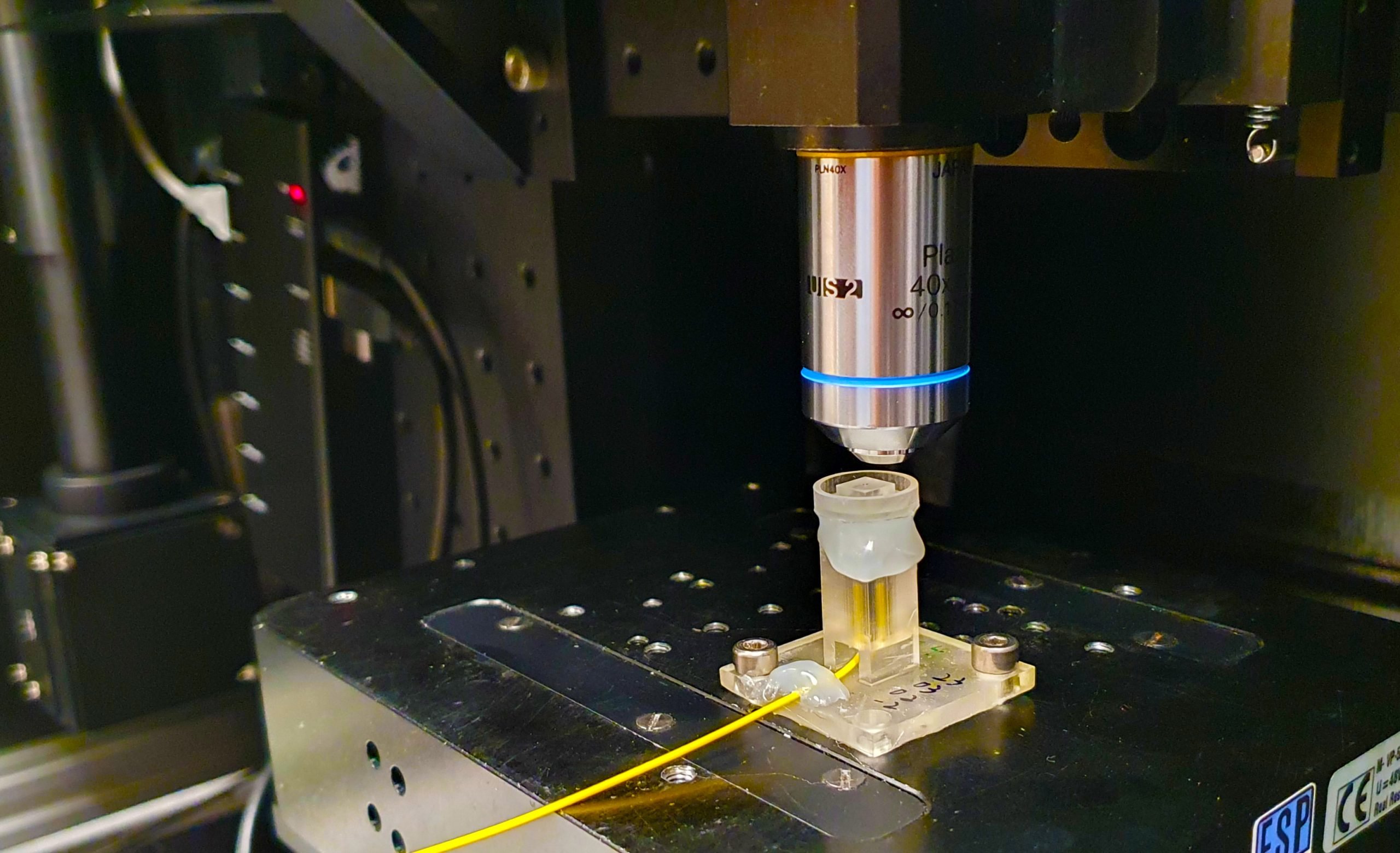
    Lee-Lun Lai demonstrates the setup to print silica glass microstructures on an optical fiber. Credit: Lee-Lun Lai demonstrates the setup to print silica glass microstructures on an optical fiber.

    Advancements in Printing Techniques

    KTH Professor Kristinn Gylfason says the method overcomes longstanding limitations in structuring optical fiber tips with silica glass, which he says often require high-temperature treatments that compromise the integrity of temperature-sensitive fiber coatings. In contrast to other methods, the process begins with a base material that doesn’t contain carbon. That means high temperatures are not needed to drive out carbon in order to make the glass structure transparent.

    The study’s lead author, Lee-Lun Lai, says the researchers printed a silica glass sensor that proved more resilient than a standard plastic-based sensor after multiple measurements.
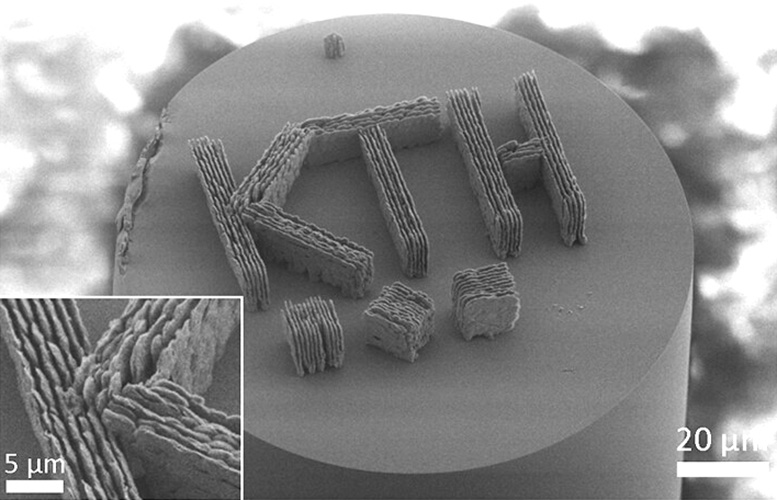
    Microscopic Image of a Printed Glass Demonstration Structure on Tip of Optical Fiber
    Microscopic image of a printed glass demonstration structure on tip of optical fiber. Credit: David Callahan

    “We demonstrated a glass refractive index sensor integrated into the fiber tip that allowed us to measure the concentration of organic solvents. This measurement is challenging for polymer-based sensors due to the corrosiveness of the solvents,” Lai says.

    “These structures are so small you could fit 1,000 of them on the surface of a grain of sand, which is about the size of sensors being used today,” says the study’s co-author, Po-Han Huang.

    The researchers also demonstrated a technique for printing nanogratings, ultra-small patterns etched onto surfaces at the nanometer scale. These are used to manipulate light in precise ways and have potential applications in quantum communication.

    Gylfason says the ability to 3D print arbitrary glass structures directly on fiber tip opens new frontiers in photonics. “By bridging the gap between 3D printing and photonics, the implications of this research are far-reaching, with potential applications in microfluidic devices, MEMS accelerometers, and fiber-integrated quantum emitters,” he says.

    Reference: “3D Printing of Glass Micro-Optics with Subwavelength Features on Optical Fiber Tips” by Lee-Lun Lai, Po-Han Huang, Göran Stemme, Frank Niklaus and Kristinn B. Gylfason, 29 March 2024, ACS Nano.
    DOI: 10.1021/acsnano.3c11030

    The study was funded by the Sweden Taiwan Research Projects 2019 and the Swedish Foundation for Strategic Research.

    Never miss a breakthrough: Join the SciTechDaily newsletter.
    Follow us on Google and Google News.

    3D Printing Fiber Optics KTH Royal Institute of Technology Nanophotonics Popular
    Share. Facebook Twitter Pinterest LinkedIn Email Reddit

    Related Articles

    First 3D-Printed High-Performance Nanostructured Alloy That’s Both Ultrastrong and Ductile

    High-Speed Ionic Synaptic Memory: Simulating Brain Synapses in Computers With 2D Materials

    Binding Polymer Discovery Gives 3D-Printed Sand Super Strength

    MIT Engineers Create 3D-Printed Objects That Sense How a User Is Interacting With Them

    Secret to Building Superconducting Quantum Computers With Massive Processing Power

    3D-Printed Nanosatellite Thruster Emits Pure Ions for Propulsion

    Mighty Morphing 3D Printing: New Shape-Changing Nozzle That Could Revolutionize “4D Printing”

    “Cold Spray” Technology: 3D-Printing Biomedical Parts With Supersonic Speed

    Human Bone Structure Key to Stronger 3D-Printed Lightweight Materials [Video]

    1 Comment

    1. Tips & Trik on March 3, 2026 8:08 pm

      How does the new optical fiber technology, which is 1,000 times smaller than a grain of sand, improve internet speed compared to existing fibers?

      Reply
    Leave A Reply Cancel Reply

    • Facebook
    • Twitter
    • Pinterest
    • YouTube

    Don't Miss a Discovery

    Subscribe for the Latest in Science & Tech!

    Trending News

    First-of-Its-Kind Discovery: Homer’s Iliad Found Embedded in a 1,600-Year-Old Egyptian Mummy

    Beyond Inflammation: Scientists Uncover New Cause of Persistent Rheumatoid Arthritis

    A Simple Molecule Could Unlock Safer, Easier Weight Loss

    Scientists Just Built a Quantum Battery That Charges Almost Instantly

    Researchers Unveil Groundbreaking Sustainable Solution to Vitamin B12 Deficiency

    Millions of People Have Osteopenia Without Realizing It – Here’s What You Need To Know

    Researchers Discover Boosting a Single Protein Helps the Brain Fight Alzheimer’s

    World-First Study Reveals Human Hearts Can Regenerate After a Heart Attack

    Follow SciTechDaily
    • Facebook
    • Twitter
    • YouTube
    • Pinterest
    • Newsletter
    • RSS
    SciTech News
    • Biology News
    • Chemistry News
    • Earth News
    • Health News
    • Physics News
    • Science News
    • Space News
    • Technology News
    Recent Posts
    • New Research Challenges Long-Held Beliefs About How the Brain Makes Decisions
    • Breakthrough Technology Reveals New Treatment Targets for Cancer
    • Scientists Discover New Way To Make Drug-Resistant Cancer Treatable Again
    • This Simple Exercise Trick Builds Muscle With Less Effort, Study Finds
    • Middle Age Is Becoming a Breaking Point in America, Study Reveals
    Copyright © 1998 - 2026 SciTechDaily. All Rights Reserved.
    • Science News
    • About
    • Contact
    • Editorial Board
    • Privacy Policy
    • Terms of Use

    Type above and press Enter to search. Press Esc to cancel.