
As the global population continues to grow, innovative solutions are needed to ensure food security. With limited land and nutrients available, researchers at the Technical University of Munich (TUM) are exploring ways to boost crop yields using continuous directed evolution. Leading this effort, Dr. Ulschan Bathe explains the project’s goals, its potential impact on food security, and the role of TUM’s Weihenstephan campus in advancing this research.
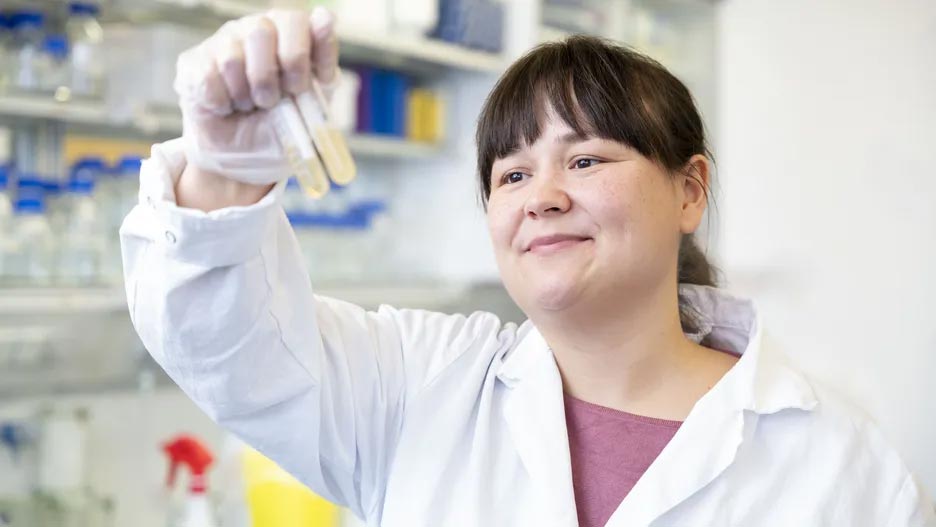
Dr. Ulschan Bathe, you are working on directed evolution in plants, what exactly are you targeting?
My team and I are researching plant enzymes that are short-lived. Due to their short lifespan, these enzymes must be replaced frequently, consuming many of the plant’s resources. We aim to lengthen these enzymes’ lifespans through directed evolution, which involves targeted modification. This may result in fewer resources being used to renew these enzymes, allowing more energy to be directed towards plant growth. In this way, we hope to increase crop yields and contribute to food security.
This is referred to as “continuous directed evolution” – that almost sounds like science fiction. What exactly does this process encompass?
What we are doing is essentially evolution in a very compressed timeframe. In nature, DNA changes continuous through gene mutations, which occur at a low frequency, though. If these mutations provide an advantage in the competition for resources and survival, the organism with the mutated genome will prevail, known as “survival of the fittest.” We use “survival of the fittest” for our purposes in the laboratory, specifically for short-lived enzymes. We induce higher mutation rates in our target genes and test how the resulting mutations fare in resource competition.
To speed up the process, we will not introduce these modifications in plants but in rapidly reproducing model organisms, in our case, yeast. This allows us to complete 120,000 years of plant evolution in the laboratory in just a few days.
And the modified genes are then transferred into plants?
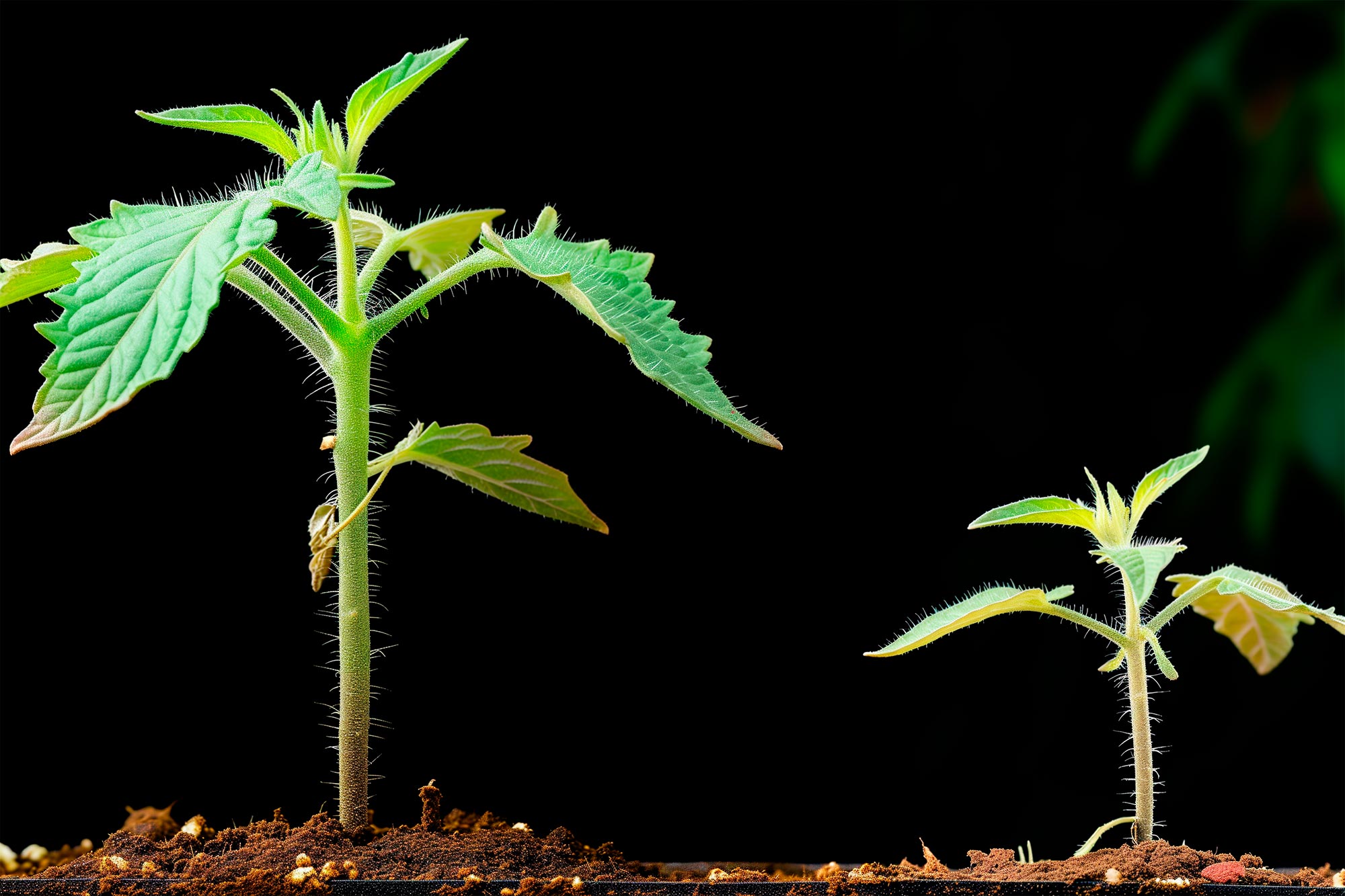
Exactly, once we have evolved the plant enzymes in yeasts through mutations, we will reintroduce the edited gene sequences into crop plants. For this step, we will use tomato plants because they are very easy to manipulate genetically. We will investigate these plants that carry slightly altered gene sequences and check whether the mutations introduced actually have the desired effect. Through suitable experiments, we can test whether the edited enzymes are long-lived in plants, as well, potentially leading to an increased yield.
Why did you choose TUM and the Hans Eisenmann Forum for this project?
While searching for locations, I noticed that Prof. Brigitte Poppenberger’s professorship at TUM was the best fit. We share research interests, and the infrastructure on-site including the equipment in the research laboratories is ideal for the project. The academic environment is also beneficial to set up the research group which is funded by the Elite Network of Bavaria. We have recruited members from TUM, but also from China and South America. If you are looking for excellence, one must think globally, which is possible here. TUM attracts researchers from all over the world so we can conduct research at the highest level with our international team.
How does funding a Junior Research Group by the Elite Network of Bavaria support you?
The financial support from the Elite Network of Bavaria and the connection to the doctoral college make building such a large team possible. Thanks to the funding, we have more positions in the group, which, of course, makes research easier. However, the funding goes beyond financial support. Soft skills also play an essential role in an academic career. It can be challenging to navigate the many requirements, such as international research visits, a clear scientific profile, and publications. As part of the funding program, the doctoral college offers PhD students a good opportunity to exchange ideas and spend time abroad.
About Ulschan Bathe:
Ulschan Bathe studied in Halle-Wittenberg and did her PhD at the Leibniz Institute of Plant Biochemistry. After a research stay at the University of Florida, she joined Prof. Brigitte Poppenberger’s Professorship Biotechnology of Horticultural Crops with funding from the Elite Network of Bavaria.
Never miss a breakthrough: Join the SciTechDaily newsletter.
Follow us on Google and Google News.
1 Comment
A nice advancement.