

Inspired by the humble deep-sea sponge, RMIT University engineers have developed a new material with remarkable compressive strength and stiffness that could improve architectural and product designs.
Inspired by the deep-sea sponge Venus’ flower basket, engineers at RMIT University have developed a new material with exceptional compressive strength and stiffness, offering potential improvements in architectural and product design.
The material’s double-lattice structure mimics the intricate skeleton of this Pacific Ocean sponge, known for its resilience.
According to Dr. Jiaming Ma, lead author of the latest RMIT study, extensive testing and optimization confirmed that this design not only enhances strength and stiffness but also allows the material to contract under compression, making it highly adaptable for various applications.
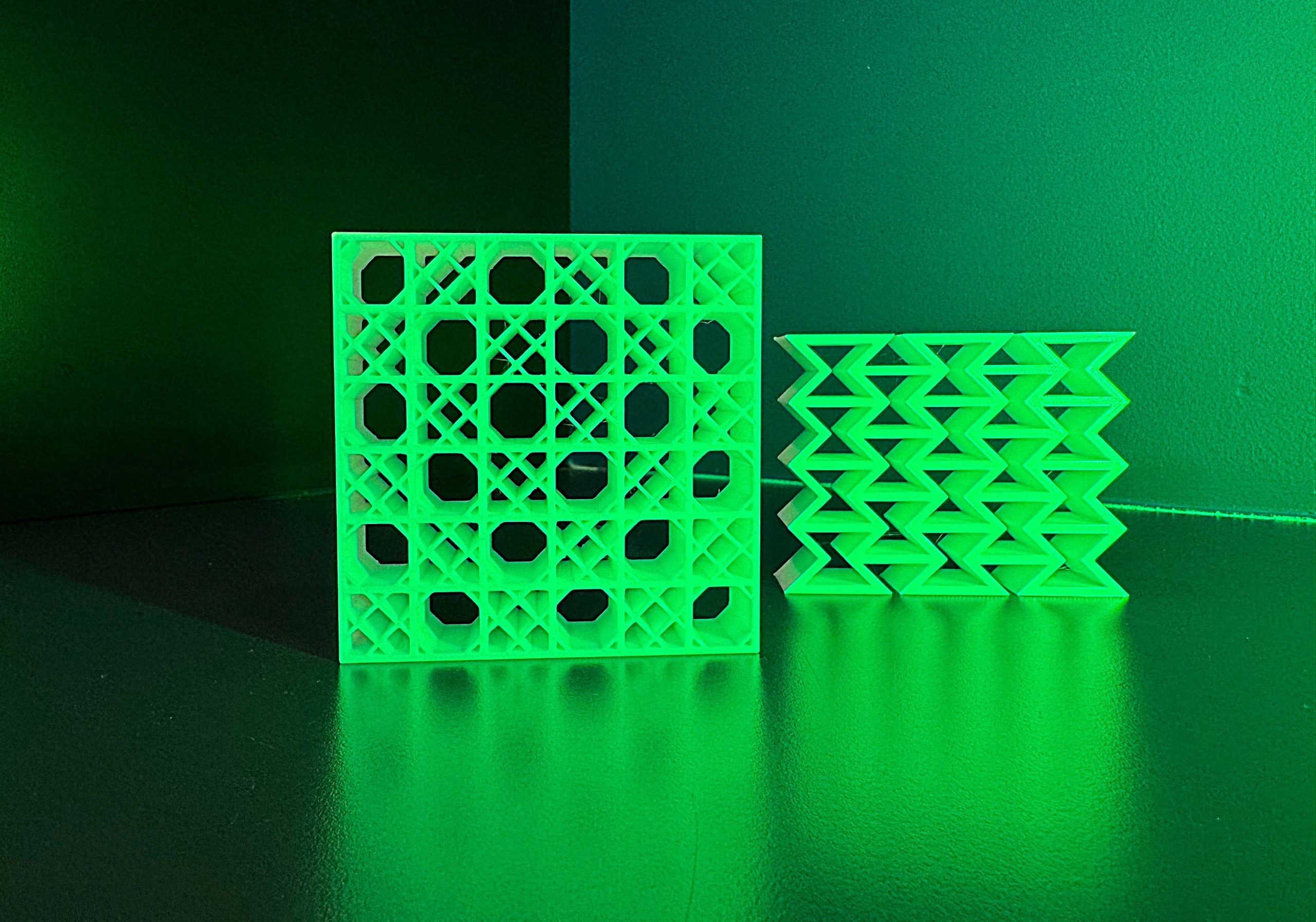
It’s this last aspect – known as auxetic behavior – that opens a whole range of possibilities to apply the design across structural engineering and other applications.
“While most materials get thinner when stretched or fatter when squashed, like rubber, auxetics do the opposite,” Ma said.
“Auxetics can absorb and distribute impact energy effectively, making them extremely useful.”
Overcoming the Limitations of Auxetic Materials
Natural auxetic materials include tendons and cat skin, while synthetic ones are used to make heart and vascular stents that expand and contract as required.
But while auxetic materials have useful properties, their low stiffness and limited energy absorption capacity limit their applications. The team’s nature-inspired double lattice design is significant because it overcomes these main drawbacks.
“Each lattice on its own has traditional deformation behavior, but if you combine them as nature does in the deep-sea sponge, then it regulates itself and holds its form and outperforms similar materials by quite a significant margin,” Ma said.
This video depicts the team’s double lattice structure. Credit: RMIT University
Results published in Composite Structures show that with the same amount of material usage, the lattice is 13 times stiffer than existing auxetic materials, which are based on re-entrant honeycomb designs.
It can also absorb 10% more energy while maintaining its auxetic behavior with a 60% greater strain range compared to existing designs.
Practical Applications in Construction and Safety
Dr. Ngoc San Ha said the unique combination of these properties opened several exciting applications for their new material.
“This bioinspired auxetic lattice provides the most solid foundation yet for us to develop next-generation sustainable building,” he said.
“Our auxetic metamaterial with high stiffness and energy absorption could offer significant benefits across multiple sectors, from construction materials to protective equipment and sports gear or medical applications,” he said.
The bioinspired lattice structure could work as a steel building frame, for example, allowing less steel and concrete to be used to achieve similar results as a traditional frame.
The structure could also form the basis of lightweight sports protective equipment, bulletproof vests, or medical implants.
Honorary Professor Mike Xie said the project highlighted the value in taking inspiration from nature.
“Not only does biomimicry create beautiful and elegant designs like this one, but it also creates smart designs that have been optimized through millions of years of evolution that we can learn from,” Xie said.
Next steps
The team at RMIT’s Centre for Innovative Structures and Materials has tested the design using computer simulations and lab testing on a 3D-printed sample made from thermoplastic polyurethane.
They now plan to produce steel versions of the design to use along with concrete and rammed earth structures – a construction technique using compacted natural raw materials.
“While this design could have promising applications in sports equipment, PPE, and medical applications, our main focus is on the building and construction aspect,” Ma said.
“We’re developing a more sustainable building material by using our design’s unique combination of outstanding auxeticity, stiffness, and energy absorption to reduce steel and cement usage in construction.
“Its auxetic and energy-absorbing features could also help dampen vibrations during earthquakes.”
The team is also planning to integrate this design with machine learning algorithms for further optimization and to create programmable materials.
Reference: “Auxetic behavior and energy absorption characteristics of a lattice structure inspired by deep-sea sponge” by Jiaming Ma, Hongru Zhang, Ting-Uei Lee, Hongjia Lu, Yi Min Xie and Ngoc San Ha, 27 December 2024, Composite Structures.
DOI: 10.1016/j.compstruct.2024.118835
Funding: Australian Research Council
Never miss a breakthrough: Join the SciTechDaily newsletter.
Follow us on Google and Google News.
2 Comments
I’ve never heard of auxetic materials before and didn’t quite understand at first. Here’s an overview from ChatGPT:
Key Characteristics
Negative Poisson’s Ratio (NPR): The defining feature of auxetic materials is their ability to expand in all directions when subjected to tensile forces.
Enhanced Mechanical Properties: Auxetic materials often exhibit improved toughness, energy absorption, impact resistance, and fracture resistance compared to conventional materials.
Structural Variability: They can be designed using different microstructural configurations, such as re-entrant honeycombs, rotating rigid units, and chiral structures.
Mechanisms Behind Auxetic Behavior
The auxetic effect arises from specific microstructural designs, which allow the material’s internal structure to undergo transformations when force is applied. Some common structural mechanisms include:
Re-entrant Structures: These feature angled or inwardly notched cell structures that expand outward when stretched.
Rotating Rigid Units: Some auxetic materials consist of rigid units connected by flexible hinges that rotate upon deformation.
Chiral Structures: Composed of circular elements with connecting ligaments, these structures twist and expand when tension is applied.
Applications of Auxetic Materials
Due to their exceptional properties, auxetic materials have a wide range of applications, including:
Biomedical Engineering: Used in medical implants, tissue scaffolds, and artificial muscles.
Protective Equipment: Applied in body armor, helmets, and blast-resistant materials due to enhanced energy absorption.
Aerospace and Automotive Industries: Employed for lightweight, high-strength components with improved impact resistance.
Smart Textiles: Used in flexible and adaptive clothing, footwear, and cushioning.
Filtration and Sensors: Their ability to change porosity makes them useful in filters and sensors that require dynamic response capabilities.
Challenges and Future Directions
While auxetic materials offer numerous advantages, challenges such as complex fabrication methods, scalability, and material limitations need to be addressed. Research continues to explore new synthetic and natural auxetic structures, along with additive manufacturing techniques to enhance their applicability.
Overall, auxetic materials represent an exciting frontier in material science with promising applications across multiple industries.
Looks remarkably like rose ground in bobbin lacemaking. Perhaps the scientists will find something of use in that ancient technique to aid in new methods of construction for these new lattices. Or perhaps the lacemakers will devise lace grounds in three dimensions inspired from them.