
Tonga’s Hunga Volcano eruption set records for volcanic lightning, revealing new insights into eruption timelines, extreme atmospheric turbulence, and aviation hazard detection.
The eruption produced 2,600 flashes per minute at peak intensity. Scientists used the lightning to peer into the ash cloud, teasing out new details of the eruption’s timeline.
- The January 15 eruption lasted at least 11 hours, several hours longer than previously known
- The plume produced the highest-altitude lightning flashes ever measured, 20 to 30 kilometers (12 to 19 miles) above sea level
- Lightning “surfed” giant waves that rippled through volcanic plume
- Lightning data reveal previously unknown phases of the eruption, inform future volcanic hazard monitoring
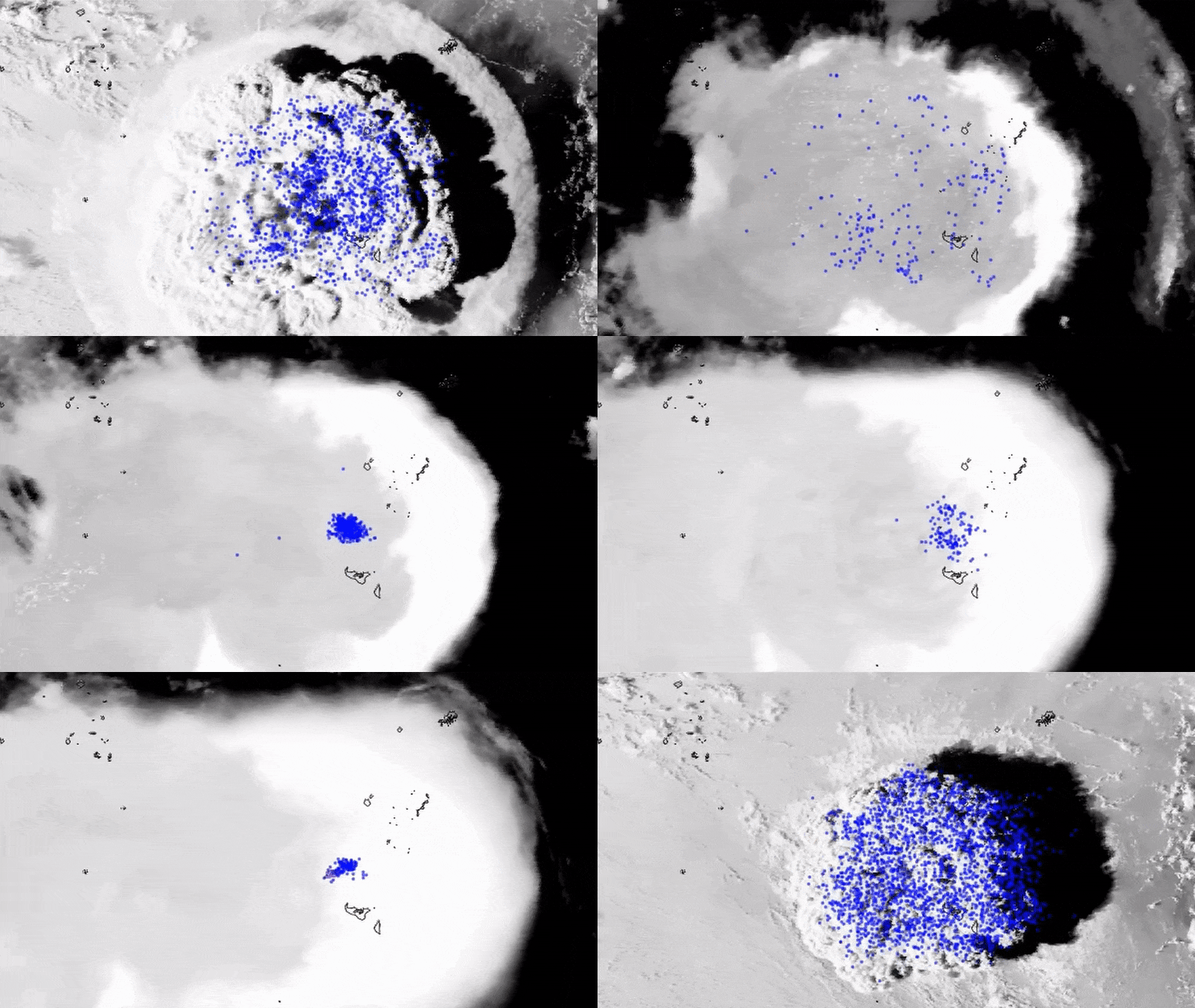
The January 15, 2022, eruption of Hunga Volcano in Tonga continues to break records. According to a new study, the eruption created a “supercharged” thunderstorm that produced the most intense lightning ever recorded. There were nearly 200,000 lightning flashes in the volcanic plume throughout the eruption, peaking at more than 2,600 flashes every minute, the researchers found.
When the submarine volcano erupted in the southern Pacific Ocean, it generated a plume of ash, water, and magmatic gas at least 58 kilometers (36 miles) high. The towering plume gave scientists useful information about the scale of the eruption, but it also obscured the vent from satellite view, making it more difficult to track changes in the eruption as it progressed.
High-resolution lightning data from four separate sources — never previously used all together — have now let scientists peer into that plume, teasing out new phases of the eruption’s life cycle and gaining insights into the weird weather it created.
“This eruption triggered a supercharged thunderstorm, the likes of which we’ve never seen,” said Alexa Van Eaton, a volcanologist at the United States Geological Survey who led the study. “These findings demonstrate a new tool we have to monitor volcanoes at the speed of light and help the USGS’s role to inform ash hazard advisories to aircraft.”
The study was published in Geophysical Research Letters, which publishes high-impact, short-format reports with immediate implications spanning all Earth and space sciences.
The storm developed because the highly energetic expulsion of magma happened to blast through the shallow ocean, Van Eaton said. Molten rock vaporized the seawater, which rose up into the plume and eventually formed electrifying collisions between volcanic ash, supercooled water, and hailstones. The perfect storm for lightning.
More than 200,000 lightning flashes, shown as blue dots, occurred throughout the duration of the eruption at Tonga’s Hunga Volcano on January 15, 2022. New analyses of the eruption’s lightning intensity revealed the volcanic storm was the most intense ever recorded and provided new insights into the eruption’s progression. Credit: Van Eaton et al. (2023), Geophysical Research Letters, doi: 10.1029/2022GL102341
Tracking the Eruption’s Phases Through Lightning Data
Combining data from sensors that measure light and radio waves, the scientists tracked lightning flashes and estimated their heights. The eruption produced just over 192,000 flashes (made up of nearly 500,000 electrical pulses), peaking at 2,615 flashes per minute. Some of this lightning reached unprecedented altitudes in Earth’s atmosphere, between 20 to 30 kilometers (12 to 19 miles) high.
“With this eruption, we discovered that volcanic plumes can create the conditions for lightning far beyond the realm of meteorological thunderstorms we’ve previously observed,” Van Eaton said. “It turns out, volcanic eruptions can create more extreme lightning than any other kind of storm on Earth.”
The lightning provided insight into not only the duration of the eruption, but also its behavior over time.
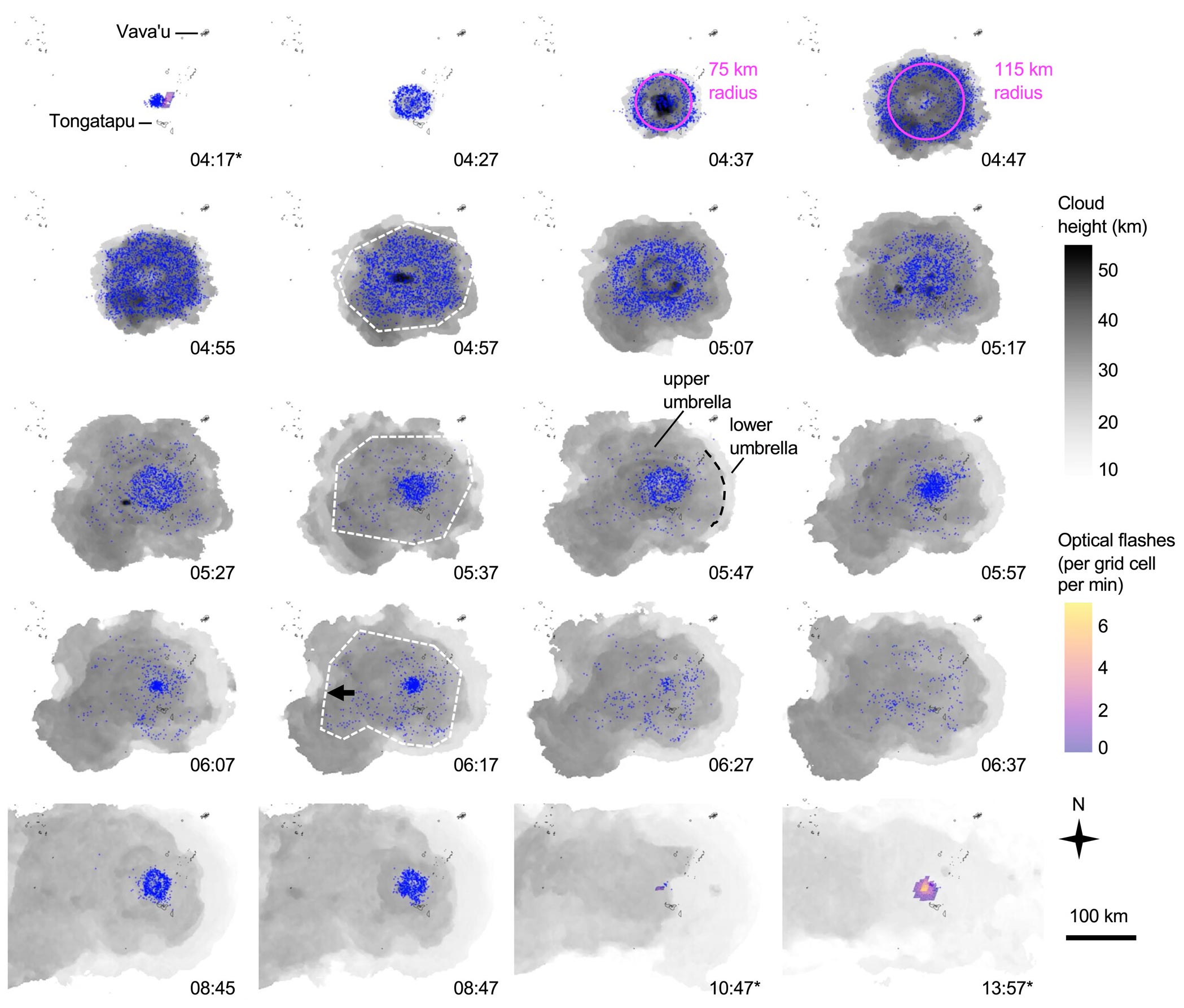
“The eruption lasted much longer than the hour or two initially observed,” Van Eaton said. “The January 15 activity created volcanic plumes for at least 11 hours. It was really only from looking at the lightning data that we were able to pull that out.”
The researchers saw four distinct phases of eruptive activity, defined by plume heights and lightning rates as they waxed and waned. The insights gained from linking lightning intensity to eruptive activity can provide better monitoring and nowcasting of aviation-related hazards during a large volcanic eruption, including ash cloud development and movement, Van Eaton said. It’s a significant challenge to get reliable information about volcanic plumes at the beginning of an eruption, especially for remote, submarine volcanoes. Harnessing all the long-range observations available, including lightning, improves early detection to keep aircraft and people out of harm’s way.
The Mystery of Expanding Lightning Rings
“It wasn’t just the lightning intensity that drew us in,” Van Eaton said. She and her colleagues were also puzzled by the concentric rings of lightning, centered on the volcano, which expanded and contracted over time. “The scale of these lightning rings blew our minds. We’ve never seen anything like that before, there’s nothing comparable in meteorological storms. Single lightning rings have been observed, but not multiples, and they’re tiny by comparison.”
Intense, high-altitude turbulence was again responsible. The plume injected so much mass into the upper atmosphere that it sent out ripples in the volcanic cloud, like dropping pebbles in a pond. The lightning appeared to ‘surf’ these waves and move outward as 250-kilometer-wide (155-mile-wide) rings.
As if all that wasn’t enough to make this eruption fascinating, it represents a style of volcanism known as phreatoplinian, which occurs when a large volume of magma erupts through water. Previously, this eruption style was only known from the geological record and had never been observed with modern instrumentation. The Hunga eruption changed all that.
“It was like unearthing a dinosaur and seeing it walk around on four legs,” Van Eaton said. “Sort of takes your breath away.”
Reference: “Lightning Rings and Gravity Waves: Insights Into the Giant Eruption Plume From Tonga’s Hunga Volcano on 15 January 2022” by Alexa R. Van Eaton, Jeff Lapierre, Sonja A. Behnke, Chris Vagasky, Christopher J. Schultz, Michael Pavolonis, Kristopher Bedka and Konstantin Khlopenkov, 20 June 2023, Geophysical Research Letters.
DOI: 10.1029/2022GL102341
Never miss a breakthrough: Join the SciTechDaily newsletter.
Follow us on Google and Google News.
1 Comment
Isn’t it amazing how interesting facts about the Hunga Tonga Hunga Ha’apai eruption continue to be uncovered months later? Without modern satellite technology we would be none the wiser. Perhaps other geological events in history have contained many significant things within them that simply passed us by, because we did not have recording or measuring devices to capture their significance.