
Physicists manipulate energy valleys in tungsten disulfide, with potential applications in quantum computing.
New research on two-dimensional tungsten disulfide (WS2) could open the door to advances in quantum computing.
In a paper published September 13, 2019, in Nature Communications, scientists report that they can manipulate the electronic properties of this super-thin material in ways that could be useful for encoding quantum data.
The study deals with WS2’s energy valleys, which University at Buffalo physicist Hao Zeng, co-lead author of the paper, describes as “the local energy extrema of the electronic structure in a crystalline solid.”
Valleys correspond with specific energies that electrons can have in a material, and the presence of an electron in one valley versus another can be used to encode information. An electron in one valley can represent a 1 in binary code, while an electron in the other can represent a 0.
The ability to control where electrons might be found could yield advances in quantum computing, enabling the creation of qubits, the basic unit of quantum information. Qubits have the mysterious quality of being able to exist not just in a state of 1 or 0, but in a “superposition” related to both states.
The paper in Nature Communications marks a step toward these future technologies, demonstrating a novel method of manipulating valley states in WS2.
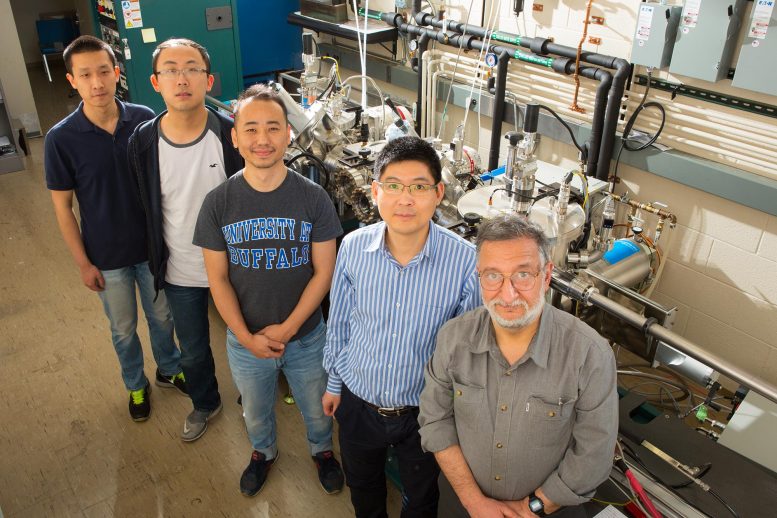
Zeng, Ph.D., professor of physics in the UB College of Arts and Sciences, led the project with Athos Petrou, Ph.D., UB Distinguished Professor of Physics, and Renat Sabirianov, Ph.D., chair of physics at the University of Nebraska Omaha. Additional co-authors included UB physics graduate students Tenzin Norden, Chuan Zhao, and Peiyao Zhang. The research was funded by the National Science Foundation.
Shifting tungsten disulfide’s energy valleys
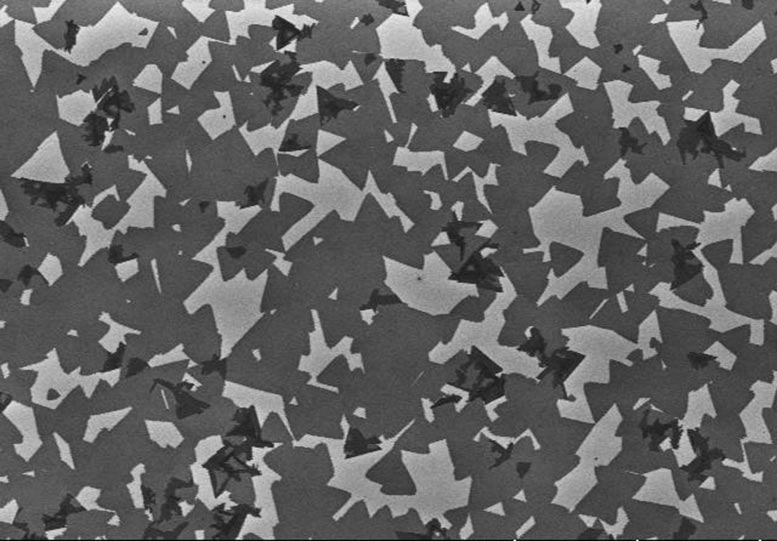
Two-dimensional tungsten disulfide is a single layer of the material that’s three atoms thick. In this configuration, WS2 has two energy valleys, both with the same energy.
Past research has shown that applying a magnetic field can shift the energy of the valleys in opposite directions, lowering the energy of one valley to make it “deeper” and more attractive to electrons, while raising the energy of the other valley to make it “shallower,” Zeng says.
The new study builds on this prior work by adding another innovation.
“We show that the shift in the energy of the two valleys can be enlarged by two orders of magnitude if we place a thin layer of magnetic europium sulfide under the tungsten disulfide,” Zeng says. “When we then apply a magnetic field of 1 Tesla, we are able to achieve an enormous shift in the energy of the valleys — equivalent to what we might hope to achieve by applying a magnetic field of about a hundred Tesla if the europium sulfide were not present.”
“The size of the effect was very large — it was like using a magnetic field amplifier,” Petrou says. “It was so surprising that we had to check it several times to make sure we didn’t make mistakes.”
The end result? The ability to manipulate and detect electrons in the valleys is greatly enhanced, qualities that could facilitate the control of qubits for quantum computing.
Valley states as qubits for quantum computing
Like other forms of quantum computing, valley-based quantum computing would rely on the quirky qualities of subatomic particles — in this case electrons — to perform powerful calculations.
Electrons behave in ways that may seem odd — they can be in multiple places at once, for instance. As a result, 1 and 0 are not the only possible states in systems that use electrons in valleys as qubits. A qubit can also be in any superposition of these states, allowing quantum computers to explore many possibilities simultaneously, Zeng says.
“This is why quantum computing is so powerful for certain special tasks,” Zeng says. “Due to the probabilistic and random nature of quantum computing, it is particularly suitable for applications such as artificial intelligence, cryptography, financial modeling, and quantum mechanical simulations for designing better materials. However, a lot of obstacles need to be overcome, and we are likely many years away if scalable universal quantum computing ever becomes a reality.”
The new study builds on Zeng and Petrou’s prior work, in which they used europium sulfide and magnetic fields to alter the energy of two valleys in another 2D material: tungsten diselenide (WSe2).
Though WS2 and WSe2 are similar, they responded differently to the “valley splitting” exercise. In WS2, the valley that got “deeper” was analogous to the valley in WSe2 that became “shallower,” and vice versa, creating opportunities to explore how this distinction could provide flexibility in applications of the technology.
One characteristic that both materials share could benefit quantum computing: In both WS2 and WSe2, electrons populating the two energy valleys have opposite spins, a form of angular momentum. While this trait is not necessary for creating a qubit, it “provides certain protection of the quantum states, making them more robust,” Zeng says.
Reference: “Giant valley splitting in monolayer WS2 by magnetic proximity effect” by Tenzin Norden, Chuan Zhao, Peiyao Zhang, Renat Sabirianov, Athos Petrou and Hao Zeng, 13 September 2019, Nature Communications.
DOI: 10.1038/s41467-019-11966-4
Never miss a breakthrough: Join the SciTechDaily newsletter.
Follow us on Google and Google News.