
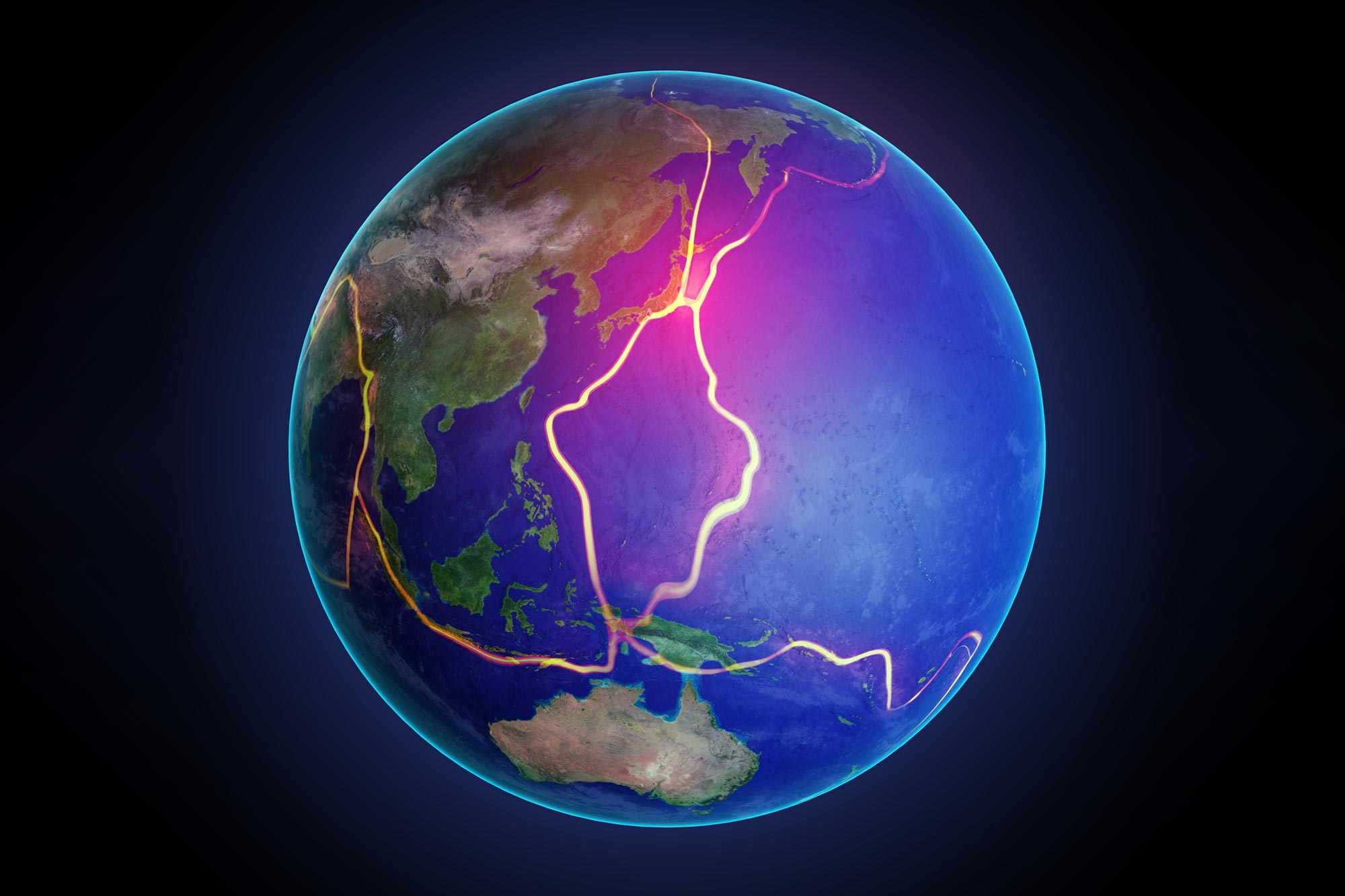
Ancient Australian rocks suggest Earth’s continents formed later than expected and share a common origin with the Moon.
A study of feldspar crystals preserved in Australia’s oldest magmatic rocks is shedding new light on the early evolution of Earth’s mantle and continents, as well as the origins of the Moon.
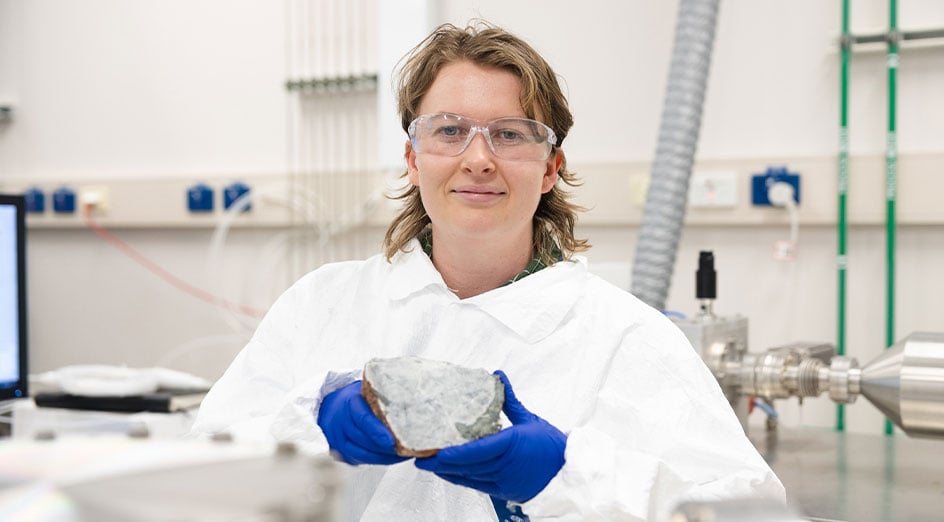
The research was led by PhD student Matilda Boyce, who worked with scientists from UWA’s School of Earth and Oceans, the University of Bristol, the Geological Survey of Western Australia, and Curtin University. Their findings were published in the journal Nature Communications.
To carry out the study, the team analyzed 3.7-billion-year-old anorthosites from the Murchison region of Western Australia. These rocks are the oldest known on the Australian continent and rank among the most ancient rocks ever identified on Earth.
Tracing mantle history through feldspar
“The timing and rate of early crustal growth on Earth remains contentious due to the scarcity of very ancient rocks,” Ms Boyce said.
“We used fine-scale analytical methods to isolate the fresh areas of plagioclase feldspar crystals, which record the isotopic ’fingerprint’ of the ancient mantle.”
The results suggested the continents began to grow relatively late in Earth’s history, from around 3.5 billion years ago, which is one billion years after the planet formed.
Earth and Moon share origins
The study also compared the results with measurements of lunar anorthosites collected during NASA’s Apollo program.
“Anorthosites are rare rocks on Earth but very common on the Moon,” Ms Boyce said.
“Our comparison was consistent with the Earth and Moon having the same starting composition of around 4.5 billion years ago.
“This supports the theory that a planet collided with early Earth and the high-energy impact resulted in the formation of the Moon.”
Reference: “Coupled strontium-calcium isotopes in Archean anorthosites reveal a late start for mantle depletion” by Matilda Boyce, Anthony Kemp, Chris Fisher, Dan Bevan, Aleksey Sadekov, Jamie Lewis, Simon Wilde, Tim Ivanic and Tim Elliott, 31 October 2025, Nature Communications.
DOI: 10.1038/s41467-025-64641-2
This work was supported by Australian Research Council grant DP200103208 (T.K., T.E., S.W.). Strontium isotope analyses at UWA were conducted with instrumentation funded by the Australian Research Council (LE100100203 and LE150100013).
Never miss a breakthrough: Join the SciTechDaily newsletter.
Follow us on Google and Google News.
2 Comments
Rather strong conclusion, but the data synthesis seems good: “We find no evidence for an early (>4 Ga) depleted mantle reservoir in the available data. This is consistent with previous Rb/Sr modelling that suggests juvenile crust production in the early Archaean was small in volume and predominantly mafic in composition, resulting in limited Rb/Sr fractionation in the Eoarchean mantle7.”
Now we need to estimate the Earth-Moon impact with 4 significant digits! “Although many ferroan anorthosite samples are heavily reworked and isotopically disturbed by repeated impacts, making isochron dating challenging, relict primary plagioclase from ferroan anorthosite 60025 returned a precise Pb–Pb age of 4.51 ± 0.01 Ga51 and an unradiogenic 87Sr/86Srinitial of 0.699062 ± 115. This age is consistent with the KREEP zircon Lu-Hf model age of 4.51 ± 0.01 Ga52 and is taken here to represent the primary crystallisation age of this anorthosite derived from the lunar magma ocean. Based on Hf-W constraints and lunar magma ocean crystallisation models, the age of the Moon is likely to be several million years older, assumed here to be ca. 4.515 Ga20,50,53,54.”
“… and an unradiogenic 87Sr/86Srinitial of 0.699062 ± 115.”
Are you missing a decimal point and some leading zeros in the uncertainty?