
Close Menu
    Facebook X (Twitter) Instagram
    SciTechDaily
    • Biology
    • Chemistry
    • Earth
    • Health
    • Physics
    • Science
    • Space
    • Technology
    Facebook X (Twitter) Pinterest YouTube RSS
    SciTechDaily
    Home»Science»3-Million-Year-Old Fossils Expose Surprising Ocean Connections
    Science

    3-Million-Year-Old Fossils Expose Surprising Ocean Connections

    By Kumamoto UniversityMarch 21, 2026No Comments3 Mins Read
    Facebook Twitter Pinterest Telegram LinkedIn WhatsApp Email Reddit
    Share
    Facebook Twitter LinkedIn Pinterest Telegram Email Reddit
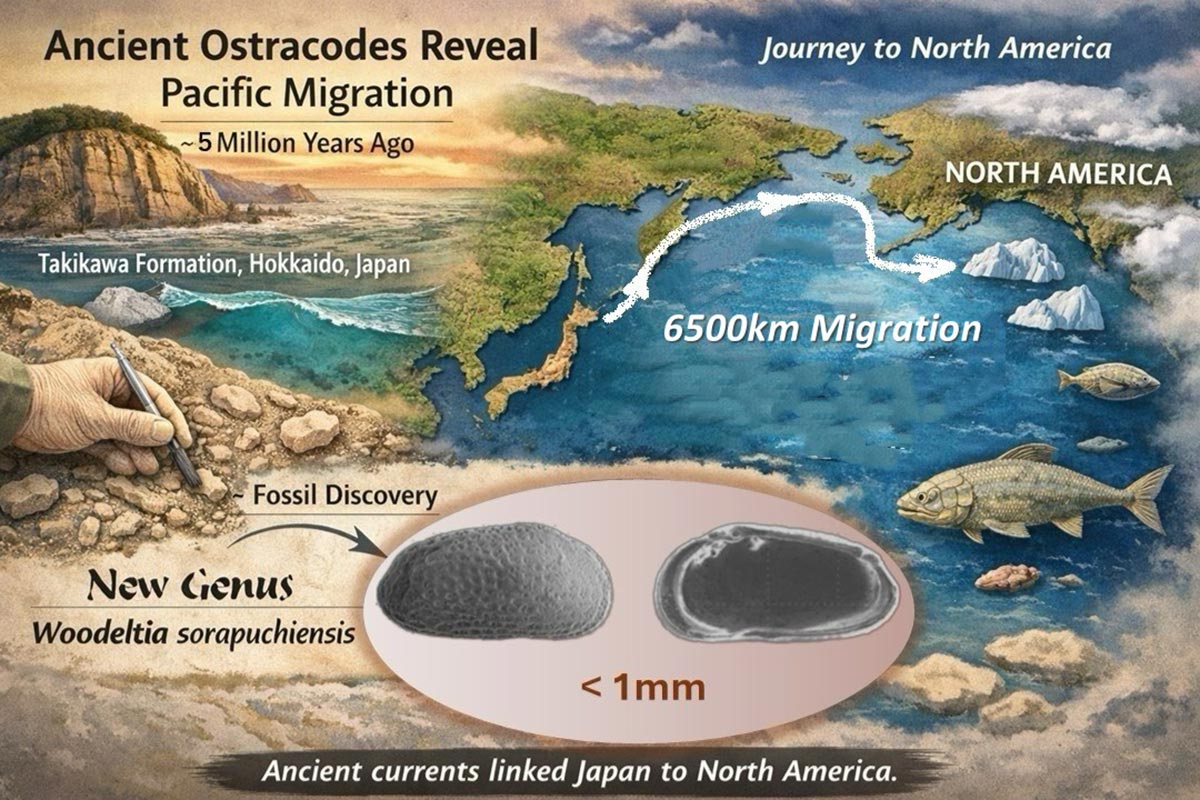
    One New Genus Woodeltia sorapuchiensis
    Woodeltia sorapuchiensis gen. et sp. nov. A newly described species from early-Miocene Japan that later adapted to cold Pliocene environments in Hokkaido, providing insights into the genus’s cold-climate adaptation and migration to the North American coast. Credit: Mukai et al.

    Tiny fossils from Hokkaido are revealing a surprisingly mobile ancient ocean during a warmer world.

    A team led by researchers at Kumamoto University has identified a new genus of microscopic crustaceans in northern Japan, providing fresh insight into how North Pacific ocean currents changed during an important phase of Earth’s climate history.

    The study examines fossil ostracodes, tiny shrimp-like crustaceans with hard shells, preserved in Early Pliocene sediments (about 3–4 million years old) from the Takikawa Formation in Hokkaido. By analyzing their shapes and where they were found, the scientists determined that these specimens belong to a previously unknown genus, which they named Woodeltia.

    Despite measuring only a few millimeters (less than 0.2 inches), ostracodes are valuable indicators of ancient marine environments. Different species thrive in specific water temperatures and depths, so their fossils help scientists reconstruct past ocean conditions.

    Clues to an Ancient North Pacific

    Woodeltia stands out because it is closely related to species previously found only in distant parts of the North Pacific. This link suggests that marine organisms were able to travel across large ocean distances during the Early Pliocene, when global temperatures were higher than today.

    “Our findings indicate that ocean circulation patterns in the North Pacific were more dynamic than previously thought,” said Associate Professor Gengo Tanaka from Center for Water Cycle, Marine Environmental and Disaster Management (CWMD), Kumamoto University. “These tiny fossils provide direct biological evidence that marine pathways linking the northern Pacific regions were already active several million years ago.”

    Why the Early Pliocene Matters

    Scientists often study the Early Pliocene as a comparison for future climate conditions because atmospheric carbon dioxide levels were similar to those expected in the coming decades. Examining ocean behavior during that warmer period can improve predictions about how modern marine ecosystems may respond to climate change.

    The discovery also underscores the importance of Japan’s fossil-rich sedimentary formations. The Takikawa Formation, known for its abundance of marine fossils, continues to produce new species that expand knowledge of Earth’s environmental history.

    This research shows how close examination of even microscopic fossils can reveal large-scale patterns such as ocean circulation and climate change. Through studies like this, Kumamoto University is contributing to global efforts to reconstruct Earth’s past and better anticipate the future of the oceans.

    Reference: “Early Pliocene ostracodes from the Takikawa Formation in Hokkaido, northern Japan, and the new genus Woodeltia moving in the North Pacific Ocean” by Kazumasa Mukai and Gengo Tanaka, 26 November 2025, Journal of Paleontology.
    DOI: 10.1017/jpa.2025.10178

    Never miss a breakthrough: Join the SciTechDaily newsletter.
    Follow us on Google and Google News.

    Climate Change Fossils Oceanography Paleontology
    Share. Facebook Twitter Pinterest LinkedIn Email Reddit

    Related Articles

    Frozen in Time: Scientists Discover 45-Million-Year-Old Ancient Walnuts on Remote Arctic Island

    “There’s Nothing Like Them” – Bizarre New Fossils Offer Glimpse Into Earth’s Ancient Oceans

    Gondwana’s Secret: 390-Million-Year-Old Marine Mystery Unraveled

    Scientists Discover “Ghost” Fossils – “Completely Unexpected”

    240-Million-Year-Old Ichthyosaur – Besanosaurus – Was an 26 Foot Long Marine Snapper

    Genetic Evidence From Fossilized Remains Show Climate Change Drove Mastodons Vast Distances Across North America

    Global Warming, Ocean Acidification: Earth Was Stressed Before Dinosaur Extinction

    New Research: Abrupt Climate Warming Killed Mammoths

    Sediment-Bound Fossil Specimens Suggest Effects of Ocean Acidification

    Leave A Reply Cancel Reply

    • Facebook
    • Twitter
    • Pinterest
    • YouTube

    Don't Miss a Discovery

    Subscribe for the Latest in Science & Tech!

    Trending News

    Largest-Ever Study Finds Medicinal Cannabis Ineffective for Anxiety, Depression, PTSD

    250-Million-Year-Old Egg Solves One of Evolution’s Biggest Mysteries

    Living With Roommates Might Be Changing Your Gut Microbiome Without You Knowing

    Century-Old Cleaning Chemical Linked to 500% Increased Risk of Parkinson’s Disease

    What if Your Memories Never Happened? Physicists Take a New Look at the Boltzmann Brain Paradox

    One of the Universe’s Largest Stars May Be Getting Ready To Explode

    Scientists Discover Enzyme That Could Supercharge Ozempic-Like Weight Loss Drugs

    Popular Sweetener Linked to DNA Damage – “It’s Something You Should Not Be Eating”

    Follow SciTechDaily
    • Facebook
    • Twitter
    • YouTube
    • Pinterest
    • Newsletter
    • RSS
    SciTech News
    • Biology News
    • Chemistry News
    • Earth News
    • Health News
    • Physics News
    • Science News
    • Space News
    • Technology News
    Recent Posts
    • Black Hole Jets Pack Power of 10,000 Suns, Stunning New Study Reveals
    • A Cosmic Crash Turned This Nearby Galaxy Into Chaos
    • This Alien Solar System Doesn’t Follow the Rules – and Scientists Are Intrigued
    • What Did Prehistoric Europeans Eat? Scientists Uncover Surprising Answers
    • Scientists Say This Overlooked Organ Could Hold the Key to Longer Life
    Copyright © 1998 - 2026 SciTechDaily. All Rights Reserved.
    • Science News
    • About
    • Contact
    • Editorial Board
    • Privacy Policy
    • Terms of Use

    Type above and press Enter to search. Press Esc to cancel.