
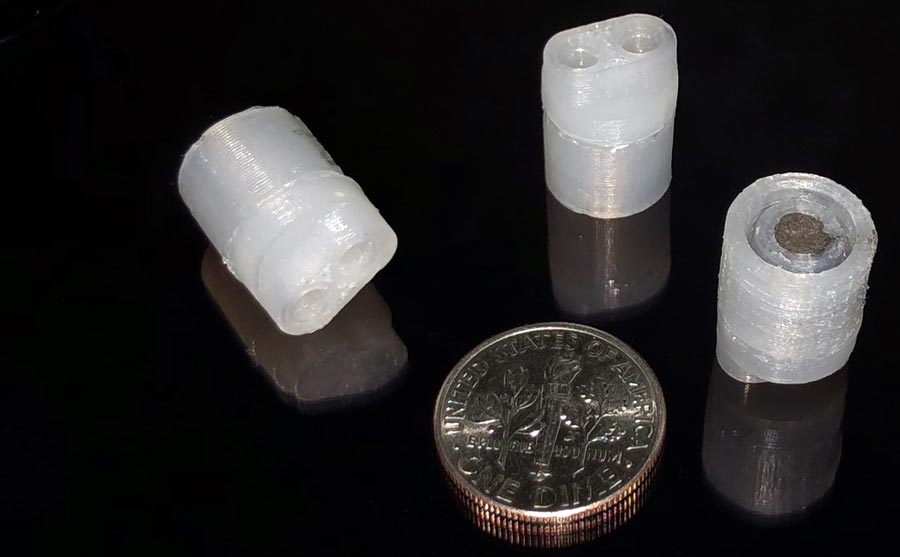
Design is the first demonstration of a magnetic, multi-material pump 3D printed all in one piece.
A new miniature pump — compact, valveless, and operated magnetically — demonstrates the broad capabilities of devices manufactured by 3D printing.
Measuring only 1 centimeter in volume, the pump was fabricated in 75 minutes in a single process using multiple materials that cost less than $3.89 per unit. It can move both liquids and gases using less power and experiencing less clogging than standard manufactured pumps of this size. One of the pump designs is the first demonstration of a magnetic, multi-material pump 3D printed monolithically — all in one piece.
Luis Fernando Velásquez-García, principal research scientist at MIT’s Microsystems Technology Laboratories (MTL), led the team that built the pump. He says the efficient and portable pump could be used in applications “from fuel cells to power generation to heat exchangers” that cool computer chips.
Additive manufacturing offers a way to craft miniaturized devices that contain multiple materials with new capabilities, and that are designed on demand for more personalized applications, he suggests.
Velásquez-García hopes that the proof-of-principle pump will inspire others to look more closely at the potential of layer-by-layer, computer-aided additive manufacturing, compared to the “cleanroom” mass-production style set by the semiconductor industry.
While researchers have been trying to emulate that industry’s successes to develop new miniature devices, “you come to the conclusion that, in some cases, the manufacturing methods cannot be the same, the materials cannot be the same, and the specific embodiments of the solutions are very different,” he says.
Velásquez-García, along with MTL postdoc Javier Izquierdo Reyes, sponsored by the Monterrey Tec-MIT Nanotechnology program, and Anthony Taylor at Edwards Vacuum, describe the new pump in the August 27, 2020, issue of the Journal of Physics D: Applied Physics.

Portable and powerful
The pumps, each slightly less than the diameter of a dime, are shaped as small cylinders crowned by a membrane. On top of the membrane is the fluid chamber, with two valveless ports at the top to attach tubes. The researchers printed the pump in two ways, using Nylon 12 as the structural material in both. In the first pump, a magnet is press-fitted into the structure of the enclosing piston. With the second monolithic pump, the researchers used Nylon 12 embedded with neodymium magnet (NdFeB) microparticles to create the pump’s magnetic core.
Nylon 12 is an excellent structural material that can easily absorb large amounts of the magnetic particles, and is sturdy enough to hold still the NdFeB microparticles during the initial magnetization, which makes possible to create strong permanent magnets, says Velásquez-García. “In a softer material, the particles would wobble, resulting in no net magnetization of the magnetic composite.”
The pump is driven by an outside rotating magnet, which interacts with the internal magnet to move the piston and deform the membrane, propelling the liquid or gas from one port to the other. The piston is only constrained by the membrane, so it can move in multiple ways at the same time when activated by the external magnet. Since it is magnetically driven, the new device is more portable than pneumatic pumps, for instance, which need to be physically coupled to an outside source of pressurized fluid.
Fourteen million cycles later, the new pumps showed no signs of leaking, and their performance surpassed that of state-of-the-art 3D-printed miniature liquid pumps and compared well with miniature commercial vacuum pumps, the researchers concluded.
“Not about copy-and-pasting”
Although the pump wasn’t designed with any specific applications in mind, Velásquez-García says the device demonstrates the opportunities available through monolithic, multi-material 3D printing.
For instance, the researchers were able to increase the new pump’s stroke capacity beyond that of a pump classically manufactured in silicon by altering printing methods to make a more deformable membrane while keeping a more rigid piston body — all using the same Nylon 12 material.
“It’s not about copy-and-pasting what people have done before, it’s really exploiting the advantages of printing,” says Velásquez-García. “I think there is a real opportunity to make a difference if we revisit problems that we couldn’t quite solve before and now we can because of this umbrella of additive manufacturing.”
The new magnetic pump “is a very clever implementation of the principle that ‘complexity is free’ in digital and additive manufacturing,” says Albert Folch, a professor of bioengineering at the University of Washington who was not involved in the MIT study. “Because these pumps are made of several components of different materials and complex shapes, traditional manufacturing and assembly tends to be expensive.”
“The possibilities of how to process energy and information are far greater if you can monolithically create devices that are made of a plurality of materials,” Velásquez-García agrees.
As a next step, Velásquez-García and his colleagues may use lessons learned from the pump to monolithically build a miniature electrical motor. But he hopes that people around the world will be inspired by the pump to design and manufacture their own devices, especially since they can be created using relatively inexpensive and widely available printers. “Maybe this can play a part in democratizing technology,” he says.
Reference: “Compact, magnetically actuated, additively manufactured pumps for liquids and gases” by Anthony P Taylor, Javier Izquierdo Reyes and Luis Fernando Velásquez-García, 15 June 2020, Journal of Physics D: Applied Physics.
DOI: 10.1088/1361-6463/ab8de8
Never miss a breakthrough: Join the SciTechDaily newsletter.
Follow us on Google and Google News.