

How Four Small DNA Changes Helped Shape the Human Brain
A tiny sliver of our genome may hold the key to what makes us human. Duke scientists have zeroed in on “Human Accelerated Regions,” mysterious stretches of DNA that don’t code for proteins but play a crucial role in brain development.
Unlocking the Genetic Secrets That Set Humans Apart
While humans share 98.8% of their DNA with chimpanzees, it’s the tiny remaining difference that holds the key to what sets us apart. Now, scientists at Duke University are uncovering how small genetic changes help shape the human brain in powerful ways. Their findings were recently published in Nature.
Led by Dr. Debby Silver, a professor of molecular genetics and microbiology, and senior research associate Dr. Jing Liu, the team zeroed in on mysterious stretches of DNA known as Human Accelerated Regions, or HARs. These parts of our genome don’t code for proteins, but they’re located near genes that play crucial roles in brain development.
Small Genetic Tweaks, Big Brain Effects
There are about 3,000 HARs scattered throughout the human genome. The researchers focused on just one of them and discovered that it plays a surprising role in how brain cells are formed. Specifically, they found that this tiny DNA region can influence how neural progenitor cells—early-stage cells that later become neurons—multiply and develop.
This is important because the human cerebral cortex, the outer layer of the brain responsible for higher thinking, is both larger and more intricately folded than in other primates. That extra space allows for more neurons, which support complex brain functions like abstract thinking, emotional control, language, and creativity.
Mouse Models Reveal the Power of HARs
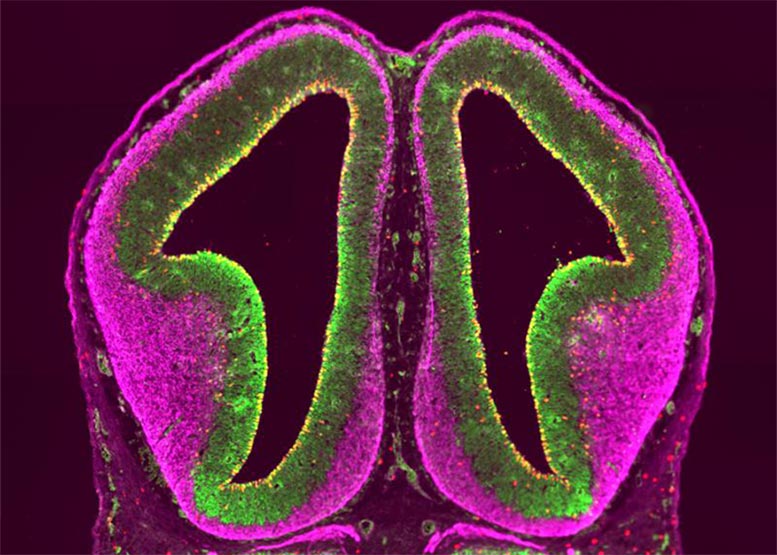
Using a genetically engineered mouse model with this human HAR, they observed that these mice had slightly larger cerebral cortexes and more neurons than the control mice. These changes trace back to activity in the Wnt signaling pathway – a key regulator of progenitor cell proliferation and neuronal differentiation.
They also edited human stem cells to include the chimpanzee version of the HAR, which differs by just four nucleotides, and saw less neural progenitor proliferation. But if they put the human nucleotide sequence into chimpanzee stem cells, neural progenitor proliferation increased.
The Price of Cognitive Evolution
“We’re exposing one of the mysteries,” Silver said, “of how these small differences in our DNA can contribute to known anatomical differences.”
There is a downside, though, to having bigger brains. “Over the course of evolution,” Silver said, “we’ve acquired changes that have helped to collectively contribute to making us human, but with those changes, there also becomes an increased propensity for disease.”
Liu and colleagues observed there are gene variants associated with autism in this HAR sequence. “This reinforces the importance of studying this locus in particular,” said Silver. “These comparative approaches can tell us about the molecular mechanisms that make us human and can tell us about molecular features that may make us more prone to diseases.”
One Tiny Region, Four Changes, Big Insights
This is just one piece of the puzzle. “We’re studying just four changes in one transcriptional enhancer, Silver said, “so the changes we are seeing are subtle.” The more pieces of the puzzle you can fit together, the broader picture you can get on exactly what makes us human.
Reference: “A human-specific enhancer fine-tunes radial glia potency and corticogenesis” by Jing Liu, Federica Mosti, Hanzhi T. Zhao, Davoneshia Lollis, Jesus E. Sotelo-Fonseca, Carla F. Escobar-Tomlienovich, Camila M. Musso, Yiwei Mao, Abdull J. Massri, Hannah M. Doll, Nicole D. Moss, Andre M. M. Sousa, Gregory A. Wray, Ewoud R. E. Schmidt and Debra L. Silver, 14 May 2025, Nature.
DOI: 10.1038/s41586-025-09002-1
Never miss a breakthrough: Join the SciTechDaily newsletter.
Follow us on Google and Google News.