
Genetic changes enabled animals to repeatedly adapt from water to land, reshaping life on Earth.
The question of how life first moved from water onto land continues to fascinate scientists. Early organisms would have faced entirely new environmental pressures outside aquatic habitats, raising the question of how they managed this transition.
In a 2025 study, my colleagues and I tried to understand the genetic basis of adapting to life on land by comparing the genetic material of 150 living animals. We discovered that some adaptations to land are universal, while others are found only in a few lineages.
Multiple transitions reshaped life on land
Animal life began in aquatic environments more than 600 million years ago. Around 500 million years ago, during the Cambrian period, some animals began moving onto land. This marked one of the most significant evolutionary events in Earth’s history and laid the groundwork for the ecosystems that exist today.
Unlike plants, which made a single transition onto land, animals moved onto land multiple times in separate evolutionary events. This pattern is a clear example of “convergent evolution,” where unrelated groups independently develop similar solutions to the same challenges. Each transition created new ecological opportunities and influenced global systems such as the atmosphere and water cycle, ultimately shaping the modern environment.
Gene turnover enabled land adaptation
In our Nature paper, my colleagues and I explored these habitat transitions from a genetic perspective. First, we compared the genomes of more than 150 species across the animal kingdom to identify which genes are shared by different lineages. Then, using the evolutionary tree of animals, we mapped which branches of the tree those genes emerged or were lost in.
We found that most transitions to land were accompanied by a large gene turnover, with many gene gains and reductions happening at the same time. The ability of genomes to gain and lose genes played a key role in animal adaptation to new habitats.
This discovery led us to ask what these genes do and wonder why some were retained while others disappeared. Using analytical techniques and powerful computer tools, we found that genes repeatedly gained across distantly related land-based lineages were involved in functions related to dehydration. They were also often related to stress response (such as temperature, UV radiation, contaminants found on land, and toxic compounds from plants). The genes that were lost or diminished were often linked to regeneration, diet, and biological clocks, such as day and night cycles.
Land colonization transformed Earth systems
Life’s move from water to land profoundly reshaped the planet itself. As life ventured onto land, it changed Earth’s cycles, removing CO2 from the atmosphere and increasing the amount of oxygen in the atmosphere. Land-based life also weathered rocks, which made them release more minerals like calcium into the ecosystem.
These findings suggest that genetic changes drove shifts in biological functions, which in turn became key drivers of the transition from water to land.
Evolution followed diverse and repeated paths
Some animals still need humid surroundings to thrive. For example, earthworms live in moist soil. In contrast, insects and mammals can live entirely on dry land. Interestingly, we found that semi-terrestrial species (mostly tiny invertebrates) tend to share more adaptations. For example, functions related to blood circulation and nutrient absorption that help them survive in soil.
Fully land-based animals seemed to evolve a wider diversity of adaptation strategies. We discovered gene innovations specific to certain lineages, such as genes for shell formation and mucus secretion in land snails and innate immunity genes in land vertebrates. Land-based animals evolved more reinforced and specialized barrier defenses for life on land. These distinct traits reveal the unique evolutionary histories shaped by ecology, physiology, and chance.
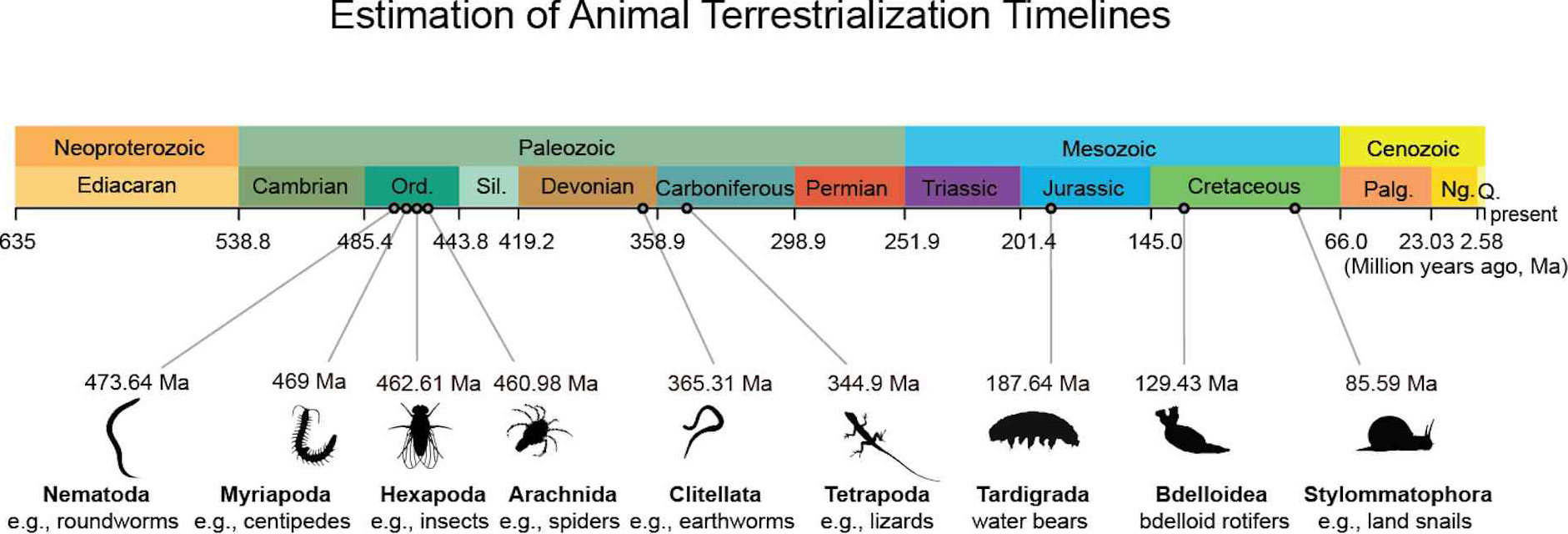
Our study also sheds light on when these transitions happened. We identified three major waves of water to land transitions over the past 500 million years, during the Ordovician (485–443 million years ago), Devonian–Carboniferous (419–298 million years ago), and Cretaceous periods (145–66 million years ago). These waves began with early land arthropods, such as insects, and ended with land snails like those found in our gardens.
These periods were probably triggered by dramatic ecological and geological shifts. For example, the rise of early land plants and the creation of seasonal habitats created new environments and opportunities for land-based animals.
Study reframes a major transition
Previous research has mostly focused on specific land animal lineages. However, our study brings these transitions together, offering the first comprehensive view of how and when animals conquered the land.
This study offers a glimpse into what might happen if we could replay the tape of life: some genetic changes seem inevitable, appearing again and again, as life adapts to land, while others are rare. Our research shows how evolution continuously finds new solutions to the challenges of life on Earth.
Reference: “Convergent genome evolution shaped the emergence of terrestrial animals” by Jialin Wei, Davide Pisani, Philip C. J. Donoghue, Marta Álvarez-Presas and Jordi Paps, 12 November 2025, Nature.
DOI: 10.1038/s41586-025-09722-4
Adapted from an article originally published in The Conversation.
Disclosure: Jialin Wei is supported by University of Bristol-China Scholarship Council joint-funded Scholarship.
Never miss a breakthrough: Join the SciTechDaily newsletter.
Follow us on Google and Google News.
4 Comments
Powerpuff girls
This is purely Wallacism. Humans ( homo sapein sapeins) did not evolve. Every physical, biological. Anatomical scientist knows the truth that We are fearfully and wonderfully made! Development was evolutionary. Because humans are adaptive not the lower rung ofcthe species.
More evolutionist propaganda out Bristol. This article is sci-fi.
If you read it and understand what they are saying, they still have no clue or proof how it happened.