
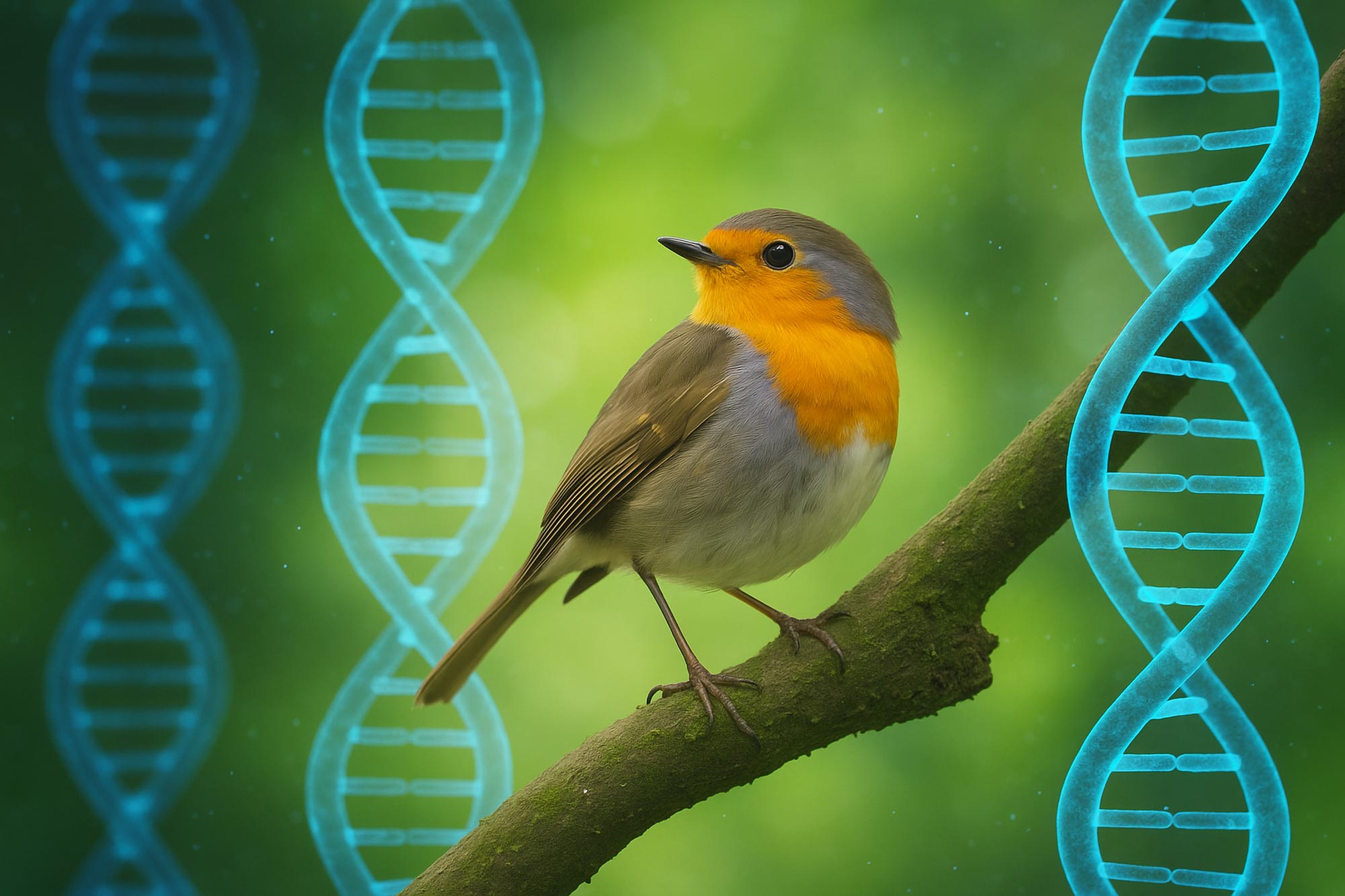
A research team has created a comprehensive evolutionary tree of all bird species, integrating data from hundreds of studies into the Open Tree of Life, a project that continuously updates with new genomic insights.
Professor Emily Jane McTavish and her team at the Cornell Lab of Ornithology have successfully mapped the evolutionary relationships of every known bird species. This ambitious project has resulted in the most complete bird evolutionary tree to date.
To build this comprehensive phylogenetic tree, the researchers integrated data on 9,239 bird species from nearly 300 scientific studies published between 1990 and 2024. They supplemented this with curated information on an additional 1,000 species. The resulting dataset is designed for easy sharing and continuous updates as new research becomes available.
“People love birds, and a lot of people work on birds. People publish scientific papers about birds’ evolutionary relationships all the time,” McTavish said. “We synthesized all the data to have unified information all in one place.”
The methodology and findings are detailed in a paper published in the Proceedings of the National Academy of Sciences. According to the authors, this synthesized evolutionary tree has broad potential applications for studying bird evolution and ecology. Moreover, the approach used to build the tree can be adapted to study other groups of animals and plants.
The project started about four years ago when Eliot Miller, then with the Cornell lab, reached out to McTavish, who has been working on software for the Open Tree of Life (OpenTree) project for about a decade.
“Many dozens of bird phylogenies (studies of evolutionary histories using genetics) get published every year, yet their findings — with implications for everything from taxonomy to our understanding of ancestral characters — aren’t necessarily being used for downstream research,” Miller said. “Our project should help to close this research loop so that these studies and their findings are better incorporated into follow-up research.”
Collaboration Through Shared Passion
McTavish said that though she hadn’t met Miller before he asked her to collaborate, this project dovetailed perfectly with her continuing work.
“Eliot is really into birds, and the lab is full of bird experts, and they also develop birding apps such as Merlin and Ebird, so that was their side of it, and I’ve been working on this software to combine evolutionary trees, so that was my side of it,” she explained.
OpenTree is a collaborative project that brings together evolutionary biologists and taxonomy experts to build an accurate, comprehensive evolutionary tree that describes how every named species on Earth is related to every other. It works on a wiki-like model, allowing users to manually upload data to update the tree’s evolutionary relationships.
McTavish explained that as new understandings of relationships emerge, users can add that information to the Tree of Life to ensure that it reflects the most current understanding of evolutionary relationships between species.
Continual Updates in a Growing Tree of Life
With more than 2.5 million species now represented in the Open Tree of Life — and new data constantly streaming in thanks to advances in genome sequencing — McTavish, a biologist with the Department of Life and Environmental Sciences in the School of Natural Sciences, and a collaborator have been writing software that automatically updates the tree as data emerges.
She said the bird species synthesis fills one more gap in the Open Tree.
Like the new study, the Open Tree project is supported by funding from the National Science Foundation, which McTavish said has been crucial for establishing collaborations, gathering data from hundreds of published authors, and sharing information across disciplines and institutions.
“This open science and collaborative environment really made this possible,” she said.
Reference: “A complete and dynamic tree of birds” by Emily Jane McTavish, Jeff A. Gerbracht, Mark T. Holder, Marshall J. Iliff, Denis Lepage, Pamela C. Rasmussen, Benjamin D. Redelings, Luna L. Sánchez Reyes and Eliot T. Miller, 29 April 2025, Proceedings of the National Academy of Sciences.
DOI: 10.1073/pnas.2409658122
Never miss a breakthrough: Join the SciTechDaily newsletter.
Follow us on Google and Google News.