
Close Menu
    Facebook X (Twitter) Instagram
    SciTechDaily
    • Biology
    • Chemistry
    • Earth
    • Health
    • Physics
    • Science
    • Space
    • Technology
    Facebook X (Twitter) Pinterest YouTube RSS
    SciTechDaily
    Home»Space»Mysterious Dark Rays Spotted in Nearby Galaxy
    Space

    Mysterious Dark Rays Spotted in Nearby Galaxy

    By ESA/HubbleNovember 23, 20203 Comments2 Mins Read
    Facebook Twitter Pinterest Telegram LinkedIn WhatsApp Email Reddit
    Share
    Facebook Twitter LinkedIn Pinterest Telegram Email Reddit
    Galaxy IC 5063
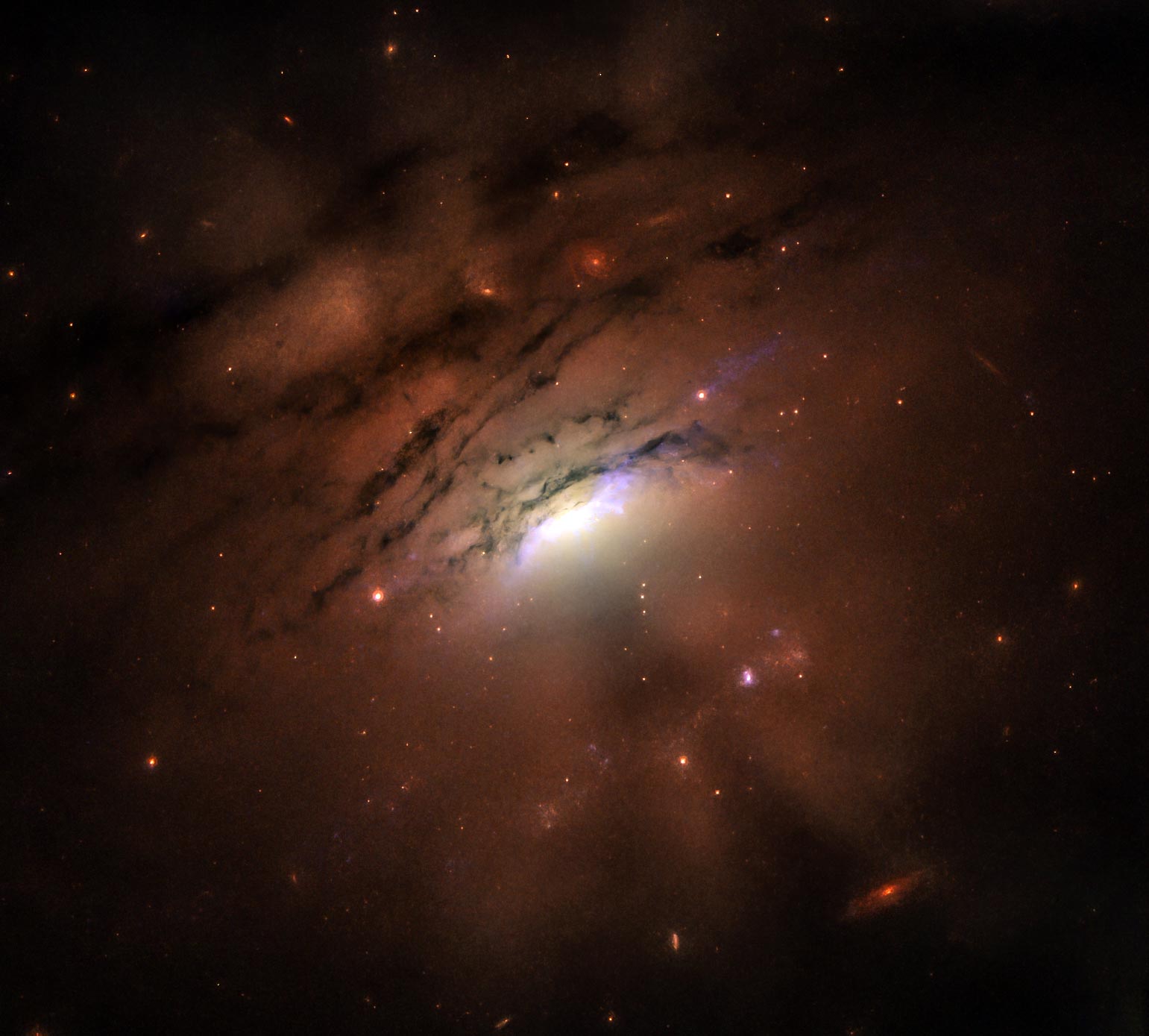
    Hubble Space Telescope image of nearby galaxy IC 5063. A collection of narrow bright rays and dark shadows is seen beaming out of the blazingly bright center of the active galaxy, shooting across at least 36,000 light-years. IC 5063 resides 156 million light-years from Earth. Credit: NASA, ESA, and W.P. Maksym (CfA)

    Some of the most stunning views of our sky occur at sunset, when sunlight pierces the clouds, creating a mixture of bright and dark rays formed by the clouds’ shadows and the beams of light scattered by the atmosphere. Astronomers studying the nearby galaxy IC 5063 are tantalized by a similar effect in this new image from the NASA/ESA Hubble Space Telescope. In this case, a collection of narrow bright rays and dark shadows is seen beaming out of the blazingly bright center of the active galaxy, shooting across at least 36,000 light-years.

    Astronomers have traced the rays back to the galaxy’s core, the location of an active supermassive black hole. The black hole is feeding on infalling material, producing a powerful gusher of light from superheated gas near it. Although the researchers have developed several plausible theories for the lightshow, the most intriguing idea suggests that the shadows are being cast into space by an inner tube-shaped ring, or torus, of dusty material surrounding the black hole.

    IC 5063 resides 156 million light-years from Earth.

    Never miss a breakthrough: Join the SciTechDaily newsletter.
    Follow us on Google and Google News.

    Astronomy European Space Agency Hubble Space Telescope NASA
    Share. Facebook Twitter Pinterest LinkedIn Email Reddit

    Related Articles

    Hubble’s Newest Discovery Isn’t a Star, It’s a Window Into the Dark Universe

    This Nearby Galaxy Shows How Frozen Clouds Ignite Into Stars

    This Chaotic Spiral Galaxy Is Still Recovering From a Cosmic Collision

    This Strange Spiral Galaxy Is Hiding a Massive Black Hole

    Hubble Zooms In on a Galaxy That Maps the Universe’s Expansion

    Hubble Captures a Dazzling Spiral Galaxy Alive With Birth and Destruction

    Hubble Spots a Glowing “Ring of Fire” in a Distant Spiral Galaxy

    Dust, Light & Ancient Collisions: The Sombrero Galaxy Like You’ve Never Seen It

    Star Formation in Motion: Hubble Reveals Spiraling Stars and Sculpted Nebulae

    3 Comments

    1. Ivan Batinic on November 23, 2020 7:59 am

      It seems there are dark clouds of dust casting shadows; it also seems the astronomers know this; the “mystery” is why are they talking about a tube being the source of light when the center of the galaxy appears to suffice — what am I missing here?

      Reply
      • Irvin Smoot on November 23, 2020 9:05 am

        You need to read more carefully. The source of the light is the “blazingly bright center of the active galaxy”. The “tube or torus” is probably the accretion disc or discs that surround the black hole.

        Reply
      • Laurie Bennett on November 23, 2020 9:27 am

        “Although the researchers have developed several plausible theories for the lightshow, the most intriguing idea suggests that the shadows are being cast into space by an inner tube-shaped ring, or torus, of dusty material surrounding the black hole.”
        The way I understood that statement was that the shadows are thought to be cast the light shining through this ‘tube- shaped ring’ formed of dust.

        Reply
    Leave A Reply Cancel Reply

    • Facebook
    • Twitter
    • Pinterest
    • YouTube

    Don't Miss a Discovery

    Subscribe for the Latest in Science & Tech!

    Trending News

    These Toads Are Surviving a Deadly Fungus – Scientists May Finally Know Why

    These Brain Cells May Explain Why We Eventually Have To Sleep

    Tomatoes Contain an Invisible Ingredient With Surprising Effects on Liver Health

    World’s First Heat-Powered Cooling System Turns Waste Heat Into Cold

    Antarctica Gained a Record 695 Billion Tons of Ice in Just Two Years

    Don’t Miss: A Brilliant Venus and Glowing Harvest Moon Light Up the Sky

    New Twist on the Einstein Problem Reveals Unexpected Physics

    JWST Captures Stunning Evidence of How Supermassive Black Holes Feed

    Follow SciTechDaily
    • Facebook
    • Twitter
    • YouTube
    • Pinterest
    • Newsletter
    • RSS
    SciTech News
    • Biology News
    • Chemistry News
    • Earth News
    • Health News
    • Physics News
    • Science News
    • Space News
    • Technology News
    Recent Posts
    • Scientists Discover a Hidden Defect That Could Explain Why IBD Keeps Coming Back
    • Millions Take Blood Pressure Drugs, but Many May Be Missing Their Heart-Protective Benefits
    • Could Alien Life Be Conscious in Ways We Can’t Imagine?
    • Scientists Develop a Fruit Wash That Removes Pesticide Residues and Keeps Produce Fresh Longer
    • Scientists May Have Finally Explained Why Astronauts Get Constipated in Space
    Copyright © 1998 - 2026 SciTechDaily. All Rights Reserved.
    • Science News
    • About
    • Contact
    • Editorial Board
    • Privacy Policy
    • Terms of Use

    Type above and press Enter to search. Press Esc to cancel.