
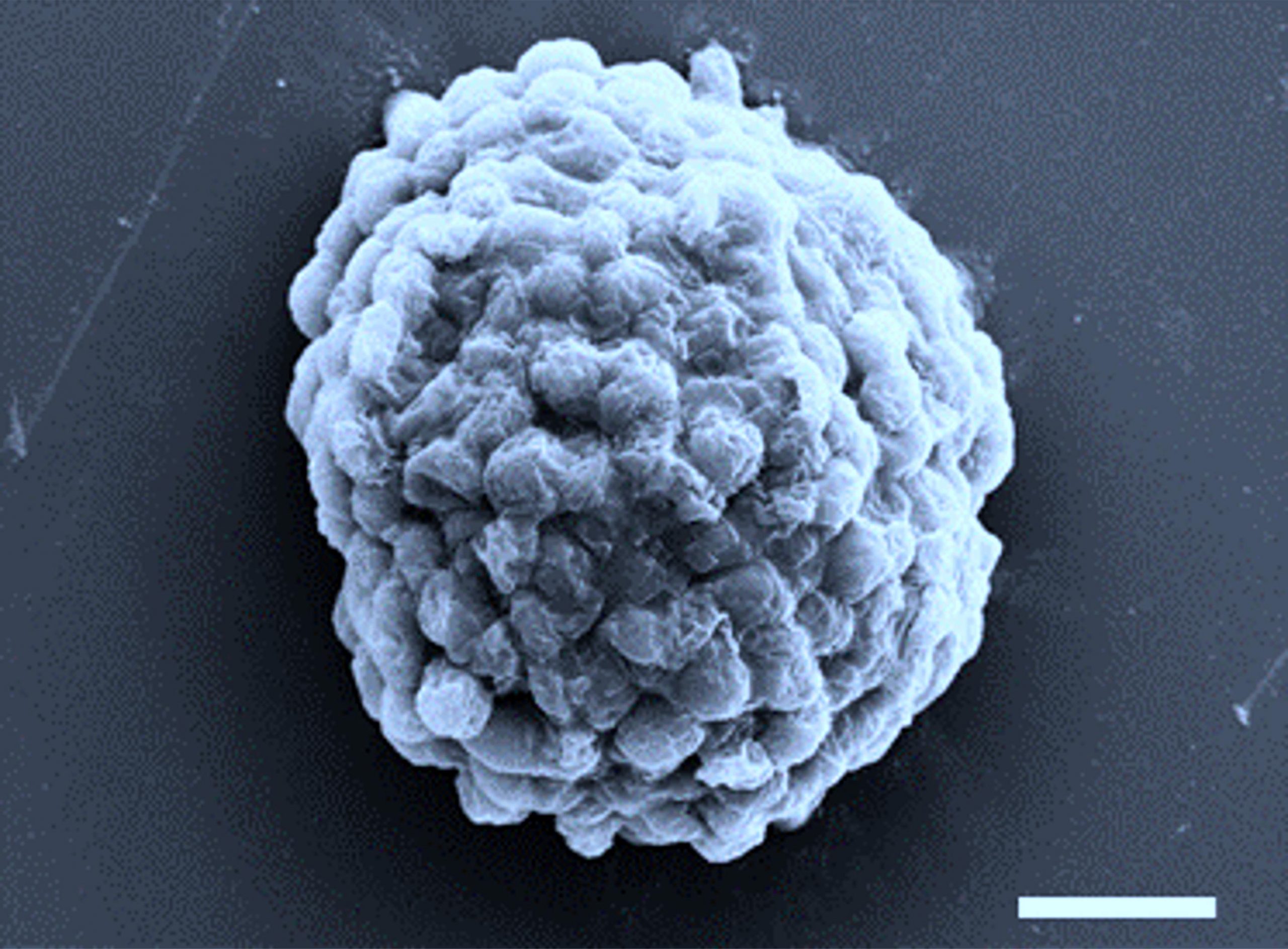
Scientists have built tiny droplet-based microbial factories that produce hydrogen, instead of oxygen, when exposed to daylight in air.
The findings of the international research team based at the University of Bristol and Harbin Institute of Technology in China, are published today (November 25, 2020) in Nature Communications.
Normally, algal cells fix carbon dioxide and produce oxygen by photosynthesis. The study used sugary droplets packed with living algal cells to generate hydrogen, rather than oxygen, by photosynthesis.
Hydrogen is potentially a climate-neutral fuel, offering many possible uses as a future energy source. A major drawback is that making hydrogen involves using a lot of energy, so green alternatives are being sought and this discovery could provide an important step forward.
The team, comprising Professor Stephen Mann and Dr. Mei Li from Bristol’s School of Chemistry together with Professor Xin Huang and colleagues at Harbin Institute of Technology in China, trapped ten thousand or so algal cells in each droplet, which were then crammed together by osmotic compression. By burying the cells deep inside the droplets, oxygen levels fell to a level that switched on special enzymes called hydrogenases that hijacked the normal photosynthetic pathway to produce hydrogen. In this way, around a quarter of a million microbial factories, typically only one-tenth of a millimeter in size, could be prepared in one milliliter of water.
To increase the level of hydrogen evolution, the team coated the living micro-reactors with a thin shell of bacteria, which were able to scavenge for oxygen and therefore increase the number of algal cells geared up for hydrogenase activity.
Although still at an early stage, the work provides a step towards photobiological green energy development under natural aerobic conditions.
Professor Stephen Mann, Co-Director of the Max Planck Bristol Centre for Minimal Biology at Bristol, said: “Using simple droplets as vectors for controlling algal cell organization and photosynthesis in synthetic micro-spaces offers a potentially environmentally benign approach to hydrogen production that we hope to develop in future work.”
Professor Xin Huang at Harbin Institute of Technology added: “Our methodology is facile and should be capable of scale-up without impairing the viability of the living cells. It also seems flexible; for example, we recently captured large numbers of yeast cells in the droplets and used the microbial reactors for ethanol production.”
Reference: “Photosynthetic hydrogen production by droplet-based microbial micro-reactors under aerobic conditions” by Zhijun Xu, Shengliang Wang, Chunyu Zhao, Shangsong Li, Xiaoman Liu, Lei Wang, Mei Li, Xin Huang and Stephen Mann, 25 November 2020, Nature Communications.
DOI: 10.1038/s41467-020-19823-5
Never miss a breakthrough: Join the SciTechDaily newsletter.
Follow us on Google and Google News.
5 Comments
This is a poster child of crappy reporting. As it stands it is just arm waving.
What is the chemical reaction? Where is the hydrogen coming from?
Some basic who, what, when and where should be in every report. Otherwise don’t bother.
You clearly didn’t read this article.
This quote:”…generate hydrogen, rather than oxygen, by photosynthesis.”,from the third sentence, answers both of your questions, simply.
Sorry, I did read the article. Maybe you believe in magic as you don’t understand chemistry. Photosynthesis does not create hydrogen atoms (or any other atoms for that matter). It only catalyzes a chemical reaction. Chemicals are molecules (or elements), that consists of atoms. The hydrogen atoms that are released/extracted by the reaction have to come from some other compound.
My question was (and still is): what is the source of the hydrogen atoms? A good answer would include a description of the chain of chemical reactions.
Interesting research! The article made me want to learn more.
Tip#1: The news article mentions sugar, composed of certain molecules and atoms worthy of contemplation in this context.
Tip #2: The identified and publicly available research paper can be accessed online in less time than it takes to send two carping posts. It even draws a picture for those who need one. Have a great day!
Can I buy shares?