
A breakthrough in renewable energy research has led to the development of a cost-effective and highly efficient iron-based catalyst for water oxidation.
This innovation mimics natural photosynthesis while overcoming the limitations of expensive metal catalysts. The newly developed polymerized iron complex, poly-Fe5-PCz, boasts exceptional stability and near-perfect Faradaic efficiency, making it a game-changer for hydrogen production. By leveraging abundant materials, the study paves the way for scalable, sustainable energy solutions that could transform clean energy storage and industrial hydrogen generation.
Harnessing Water Oxidation for Renewable Energy
Water oxidation is a key process in renewable energy, particularly for hydrogen production and artificial photosynthesis. By splitting water into oxygen and hydrogen, it offers a clean and sustainable energy source. However, replicating the efficiency and stability of natural photosynthesis in artificial catalysts — especially in water-based environments — remains a major challenge. While catalysts made from rare metals like ruthenium are highly effective, their high cost and limited supply make them impractical for large-scale applications.
To overcome this, a research team led by Professor Mio Kondo from the Institute of Science Tokyo (Science Tokyo), Japan, developed a more sustainable and affordable catalytic system using widely available metals. Their study, published today (March 5) in Nature Communications, presents a promising alternative for advancing clean energy technology.
Introducing the Pentanuclear Iron Catalyst
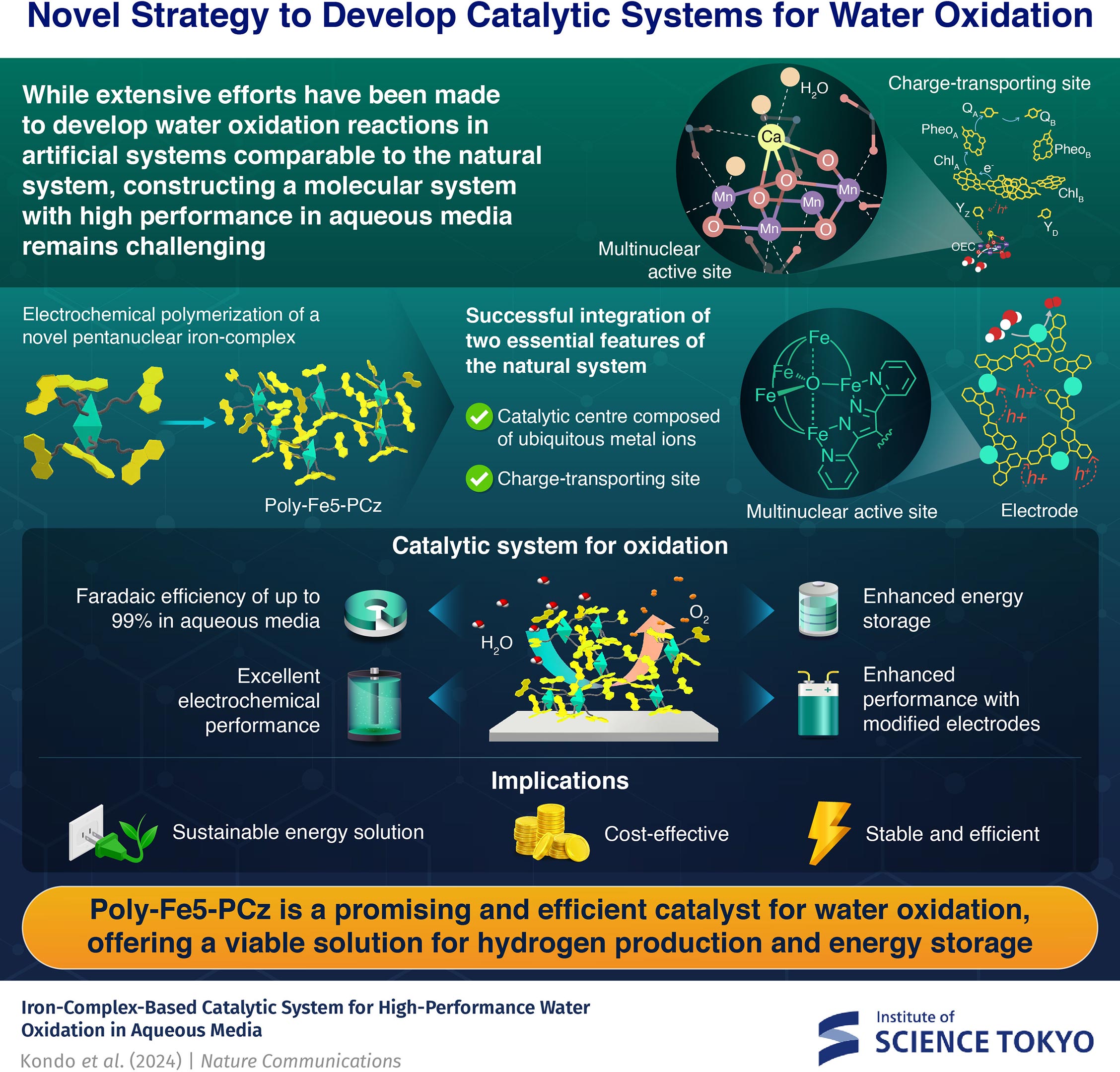
The study introduces a novel pentanuclear iron complex, Fe5-PCz(ClO₄)₃, which possesses a multinuclear-complex-based catalytically active site and precursor moieties for charge transfer sites. Kondo explains, “By electrochemically polymerizing this multinuclear iron complex, we create a polymer-based material that enhances electrocatalytic activity and long-term stability. This approach combines the benefits of natural systems with the flexibility of artificial catalysts, paving the way for sustainable energy solutions.”
Synthesizing and Characterizing the Catalyst
The researchers synthesized the Fe5-PCz(ClO₄)₃ complex using organic reactions like bromination, nucleophilic substitution, Suzuki coupling reactions, and subsequent complexation reactions. The synthesized complex was characterized by mass spectrometry, elemental analysis, and single-crystal X-ray structural analysis.
The researchers then modified glassy carbon and indium tin oxide electrodes by polymerizing Fe5-PCz using cyclic voltammetry and controlled potential electrolysis to afford a polymer-based catalyst, poly-Fe5-PCz.
The charge transfer ability and electrocatalytic performance of poly-Fe5-PCz were evaluated through electrochemical impedance spectroscopy and oxygen evolution reaction (OER) experiments with oxygen production quantified by gas chromatography, respectively.
Outstanding Performance and Stability
The results were highly promising. Kondo explains, “Poly-Fe5-PCz achieved up to 99% Faradaic efficiency in aqueous media, meaning nearly all the applied current contributed to the OER. The system also exhibited superior robustness and a reaction rate under rigorous testing conditions compared to relevant systems.
Additionally, poly-Fe5-PCz demonstrated enhanced energy storage potential and improved electrode compatibility, making it suitable for a wide range of renewable energy applications.” Its high stability was further confirmed by long-term controlled potential experiments, a key advantage for hydrogen production and energy storage technologies.
Implications for Sustainable Energy
The study’s findings have significant implications for sustainable energy. The use of iron — an abundant, non-toxic metal — ensures the system is both eco-friendly and cost-effective, offering a viable alternative to precious metal-based catalysts. Its stability under operational conditions addresses a major challenge in artificial catalytic systems, where long-term catalyst degradation often limits performance. Moreover, the system’s performance in aqueous environments makes it suitable for applications in water splitting.
Toward Scalable Hydrogen Production
“Optimizing poly-Fe5-PCz synthesis and scalability could further enhance its performance, paving the way for industrial-scale hydrogen production and energy storage. Our study opens new possibilities for integrating the system into broader energy technologies, paving the way to a more sustainable future,” concludes Kondo.
Reference: “Iron-complex-based catalytic system for high-performance water oxidation in aqueous media” by Takumi Matsuzaki, Kento Kosugi, Hikaru Iwami, Tetsuya Kambe, Hisao Kiuchi, Yoshihisa Harada, Daisuke Asakura, Taro Uematsu, Susumu Kuwabata, Yutaka Saga, Mio Kondo and Shigeyuki Masaoka, 5 March 2025, Nature Communications.
DOI: 10.1038/s41467-025-57169-y
Never miss a breakthrough: Join the SciTechDaily newsletter.
Follow us on Google and Google News.
2 Comments
“Poly-Fe5-PCz achieved up to 99% Faradaic efficiency in aqueous media, meaning nearly all the applied current contributed to the OER. The system also exhibited superior robustness and a reaction rate under rigorous testing conditions compared to relevant systems. Additionally, poly-Fe5-PCz demonstrated enhanced energy storage potential and improved electrode compatibility, making it suitable for a wide range of renewable energy applications.” — Mio Kondo
It don’t get better than that.
Faradaic efficiency is only half of the equation. I heard nothing about the over potential. Power is amps times volts.