
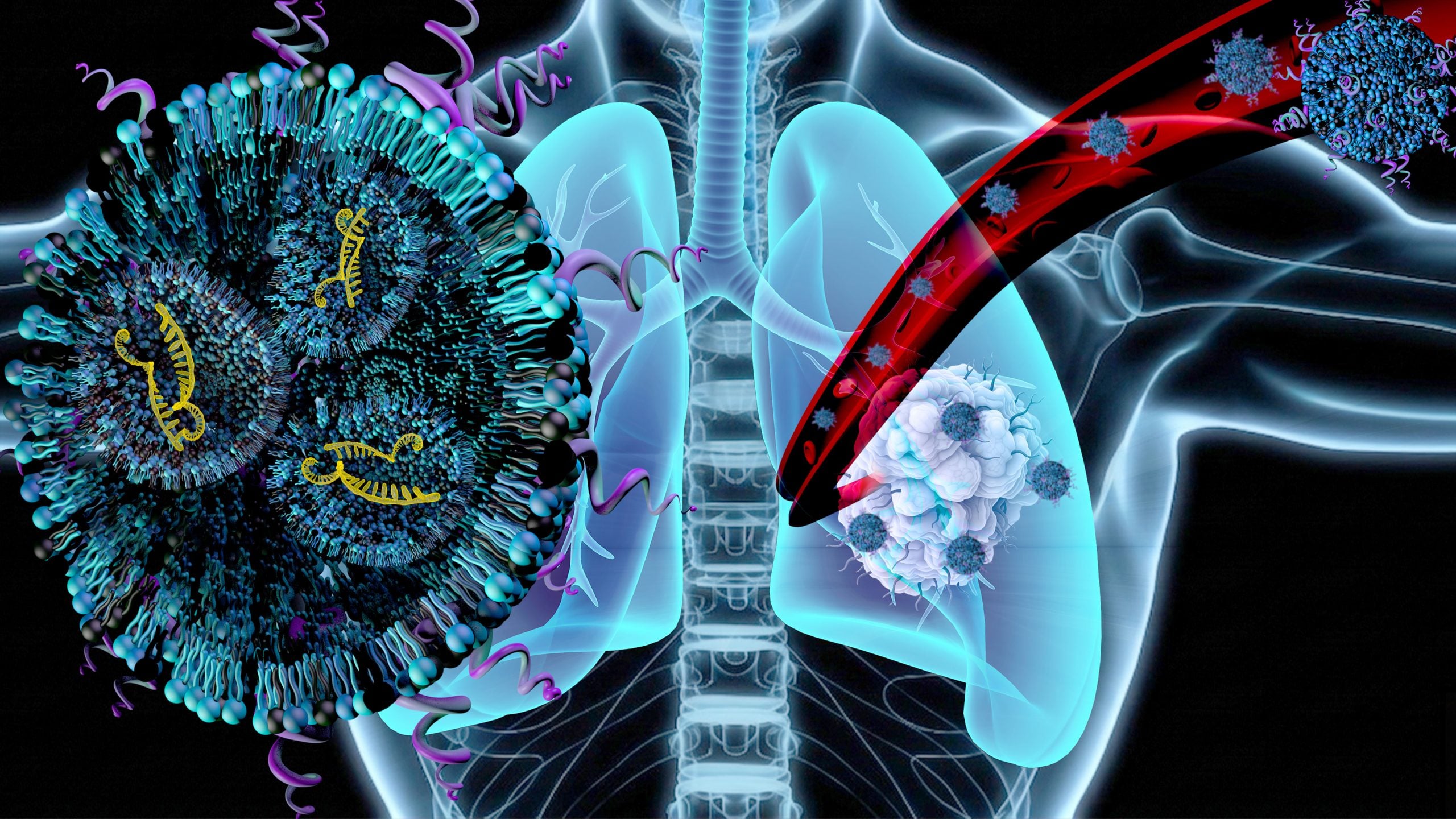
A new approach using lipid nanoparticles to deliver genetic material is showing promise in tackling two major challenges in lung cancer at once.
Researchers at Oregon State University have designed a new way to tackle two of the most devastating effects of lung cancer at the same time: tumor growth and severe muscle loss.
Their study, published in the Journal of Controlled Release, explores how tiny fat-based particles can be used to deliver genetic instructions straight to cancer cells in the lungs.
In tests using mice, the research team, led by Oleh Taratula and Yoon Tae Goo of the OSU College of Pharmacy, engineered lipid nanoparticles to carry follistatin messenger RNA. Once inside a tumor, this genetic material directs cells to produce follistatin, a protein known for its dual role in slowing tumor progression and supporting muscle growth.
Targeting Tumors With Lipid Nanoparticles
These lipid nanoparticles, or LNPs, are given through the bloodstream and make their way to the lungs with the help of vitronectin, a protein found in blood serum. Lipids are fatty compounds that include substances such as natural oils and waxes. Nanoparticles are extremely small, measuring between one and 100 billionths of a meter.
“We found that these LNPs bind vitronectin in the bloodstream, which then directs them to lung cancer tumors by interacting with integrin receptors that are overexpressed on the tumor surface,” Taratula said.
Integrin receptors act like connectors that help cells sense and respond to their environment.
Overcoming Delivery Challenges
“Systemic delivery of mRNA therapeutics to lung cancer tumors has been a significant challenge in our field, and this work offers a promising solution,” Taratula said. “Compared to conventional LNPs, which tend to accumulate in the liver upon systemic administration, our approach achieved an approximately 2.5-fold greater reduction in tumor burden.”
Lung cancer is the third most common cancer in the United States and the leading cause of cancer deaths (skin cancer is the most common, followed by prostate cancer in men and breast cancer in women).
According to the American Cancer Society, about 230,000 new lung cancer cases and roughly 125,000 deaths are expected in the U.S. this year. Overall, about 5% of people will develop lung cancer, with smokers facing a higher risk.
Addressing Cancer-Related Muscle Loss
Lung cancer is frequently linked to cachexia, a serious condition that causes extreme muscle wasting and contributes to up to 30% of cancer-related deaths among affected patients. People with cachexia lose weight even when they continue eating, including significant losses in both fat and muscle.
“By loading our LNPs with follistatin mRNA, we developed a therapy that simultaneously targets lung cancer and cancer cachexia, all without adverse effects,” Taratula said. “More preclinical work is necessary, but we’re very encouraged by what we’ve seen so far and hope that testing in humans is down the road.”
Reference: “Endogenous targeting lipid nanoparticles for systemic mRNA delivery to lung cancer tumors” by Yoon Tae Goo, Vladislav Grigoriev, Tetiana Korzun, Ammar Salem, Kongbrailatpam Shitaljit Sharma, Prem Singh, Chrissa Kioussi, Olena R. Taratula, Daniel L. Marks and Oleh Taratula, 26 March 2026, Journal of Controlled Release.
DOI: 10.1016/j.jconrel.2026.114870
The College of Pharmacy’s Vladislav Grigoriev, Tetiana Korzun, Ammar Salem, Kongbrailatpam Shitaljit Sharma, Prem Singh, Chrissa Kioussi and Olena Taratula also contributed to the research, as did Daniel Marks of Endevica Bio, a company that develops peptide therapies.
Supporting the study were the National Cancer Institute, the Eunice Kennedy Shriver National Institute of Child Health and Human Development and the National Research Foundation of Korea.
Never miss a breakthrough: Join the SciTechDaily newsletter.
Follow us on Google and Google News.