
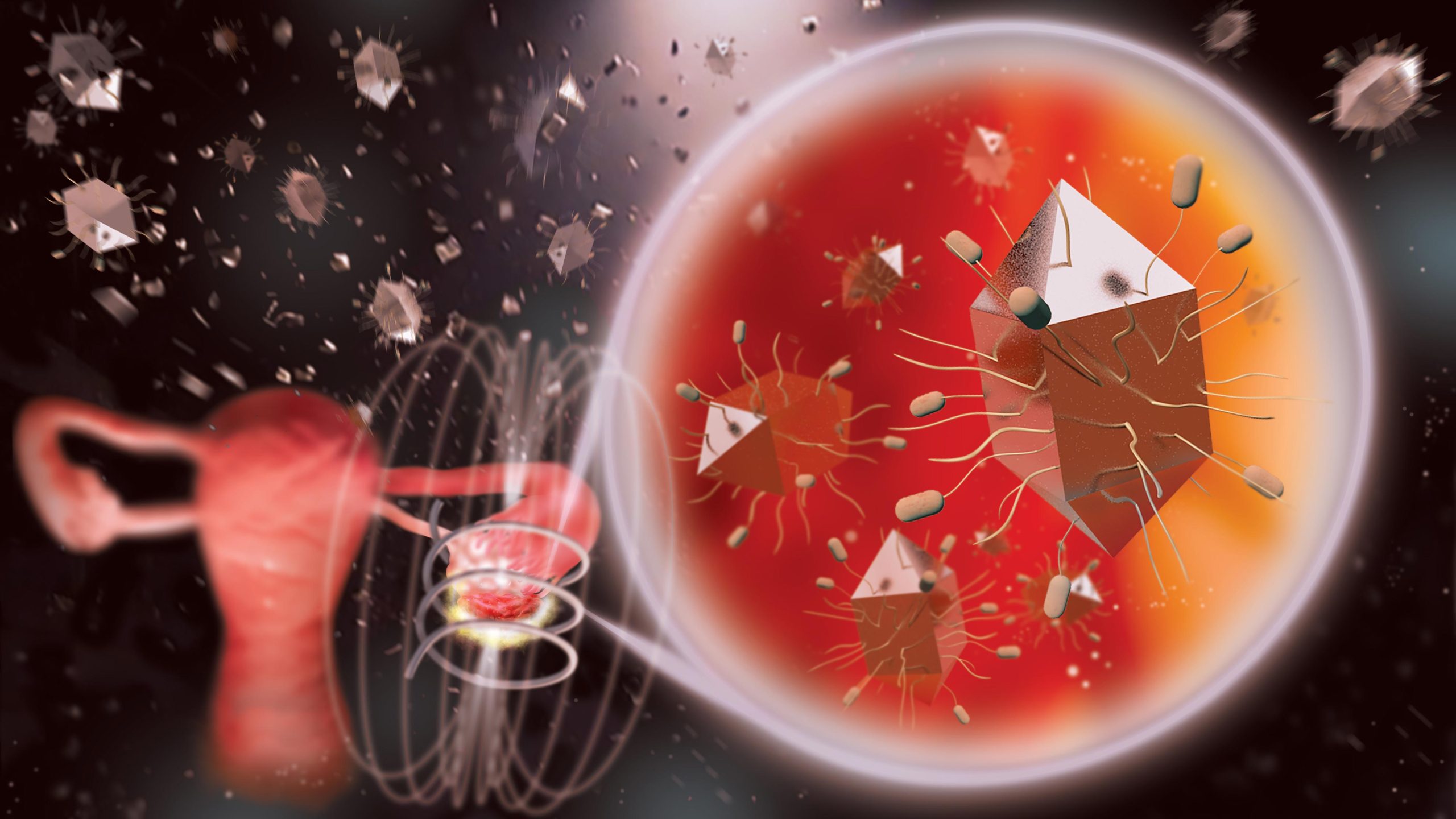
Oregon State University scientists have developed a highly efficient, uniquely shaped magnetic nanoparticle that could enable non-invasive, targeted heat-based cancer therapy for hard-to-reach tumors.
Researchers at Oregon State University have developed a new type of magnetic nanoparticle with a unique shape (a cube sandwiched between two pyramids) that could significantly improve treatment for ovarian tumors and potentially other cancers.
The study highlights the critical role that particle shape plays in the design of magnetic nanoparticles. The researchers believe their findings could lead to major advances in cancer therapies that use heat to destroy cancer cells, a technique known as magnetic hyperthermia.
Composed of iron oxide and enhanced with cobalt—a process known as doping to modify material properties—the nanoparticles demonstrate exceptional heating efficiency when subjected to an alternating magnetic field.
When the particles accumulate in cancerous tissue after intravenous injection, they’re able to quickly rise to temperatures that weaken or destroy cancer cells.
Study Details and Background
The mouse model study, published in Advanced Functional Materials, is part of ongoing nanomedicine research by scientists in the OSU College of Pharmacy.
Nanoparticles are bits of matter as tiny as one-billionth of a meter that have special properties because of their small size and high ratio of surface area to volume.
Magnetic nanoparticles have shown anticancer potential for years, the scientists say, but at present, magnetic hyperthermia can typically only be used for patients whose tumors are accessible by a hypodermic needle – that is, if the particles can be injected right into the cancer.
“With currently available magnetic nanoparticles, the required therapeutic temperatures – above 44 degrees Celsius – can only be achieved by direct injection,” said Oleh Taratula, professor of pharmaceutical sciences. “And those nanoparticles have only moderate heating efficiency, which means you need a high concentration of them in the tumor – higher than systemic administration can usually achieve – to generate enough heat.”
Innovative Design and Superior Performance
Taratula and collaborators at Oregon State, Oregon Health & Science University and the Indian Institute of Technology Mandi used a novel thermal decomposition method – a two-step process they call seed and growth – to make cobalt-doped iron oxide nanoparticles in a cubical bipyramid form. Their paper is the first report of that type of nanoparticle with that specific shape.
“These nanoparticles exhibit a remarkable ability to heat up fast, raising temperatures by 3.73 degrees Celsius per second under an alternating magnetic field,” said Prem Singh, a postdoctoral researcher in the College of Pharmacy. “That’s double the heating performance of our previously published cobalt-doped iron oxide nanoparticles.”
That means an ovarian cancer patient could receive an intravenous injection and have her tumor stop growing following one 30-minute, non-invasive magnetic field session. Short treatment sessions enhance patient comfort and compliance, the researchers note.
A cancer-targeting peptide helps the nanoparticles accumulate in the tumor, and because the particles’ heating efficiency is so strong, the necessary concentration of nanoparticles can be achieved without a high dosage, limiting toxicity and side effects.
“This is the first time systemically injected nanoparticles have been shown to heat tumors beyond 50° C, significantly surpassing the therapeutic threshold of 44° C for effective treatment at a clinically relevant dose,” said Olena Taratula, associate professor of pharmaceutical sciences at OSU. “There is now a lot of potential for expanding the application of magnetic hyperthermia to a variety of hard-to-reach tumors, making the treatment more versatile and widely used.”
Reference: “Precision-Engineered Cobalt-Doped Iron Oxide Nanoparticles: From Octahedron Seeds to Cubical Bipyramids for Enhanced Magnetic Hyperthermia” by Prem Singh, Karthickraja Duraisamy, Constanze Raitmayr, Kongbrailatpam Shitaljit Sharma, Tetiana Korzun, Khushal Singh, Abraham S Moses, Kentaro Yamada, Vladislav Grigoriev, Ananiya A. Demessie, Youngrong Park, Yoon Tae Goo, Babak Mamnoon, Ana Paula Mesquita Souza, Kenkichi Michimoto, Khashayar Farsad, Amit Jaiswal, Olena R Taratula and Oleh Taratula, 16 March 2025, Advanced Functional Materials.
DOI: 10.1002/adfm.202414719
Oregon State’s Karthickraja Duraisamy, Constanze Raitmayr, Shitaljit Sharma, Tetiana Korzun, Abraham Moses, Vladislav Grigoriev, Ananiya Demessie, Youngrong Park, Yoon Tae Goo, Babak Mamnoon and Ana Paula Mesquita Souza also contributed to the study.
The National Cancer Institute of the National Institutes of Health and the Eunice Kennedy Shriver National Institute of Child Health and Human Development supported this research.
Never miss a breakthrough: Join the SciTechDaily newsletter.
Follow us on Google and Google News.