
Close Menu
    Facebook X (Twitter) Instagram
    SciTechDaily
    • Biology
    • Chemistry
    • Earth
    • Health
    • Physics
    • Science
    • Space
    • Technology
    Facebook X (Twitter) Pinterest YouTube RSS
    SciTechDaily
    Home»Earth»Cyclone Gati Makes Historic Landfall in Somalia – More Than a Year’s Worth of Rain in Two Days
    Earth

    Cyclone Gati Makes Historic Landfall in Somalia – More Than a Year’s Worth of Rain in Two Days

    By Kasha Patel, NASA Earth ObservatoryNovember 25, 2020No Comments2 Mins Read
    Facebook Twitter Pinterest Telegram LinkedIn WhatsApp Email Reddit
    Share
    Facebook Twitter LinkedIn Pinterest Telegram Email Reddit
    Cyclone Gati Somalia Annotated
    November 22, 2020

    On November 22, 2020, Cyclone Gati became the strongest storm to hit Somalia since satellite records began five decades ago. Gati made landfall with maximum sustained winds of 170 kilometers (105 miles) per hour, a category 2 storm on the Saffir-Simpson scale. The storm brought more than a year’s worth of rain to the region in two days. Local authorities report at least eight people were killed and thousands have been displaced.

    The natural-color image above shows Gati before making landfall over Ras Hafun (the easternmost point in Africa) on November 22. The image was acquired by the Visible Infrared Imaging Radiometer Suite (VIIRS) on the Suomi NPP satellite.

    In 12 hours, Gati’s winds intensified from 65 kilometers (40 miles) to 185 kilometers (115 miles) per hour—the largest 12-hour increase for any tropical storm ever recorded in the Indian Ocean. The storm rapidly intensified due to its small size, warm Indian Ocean waters, and low wind shear. Although the storm slightly weakened before landfall, Gati brought exceptional amounts of rain to northern Somalia.
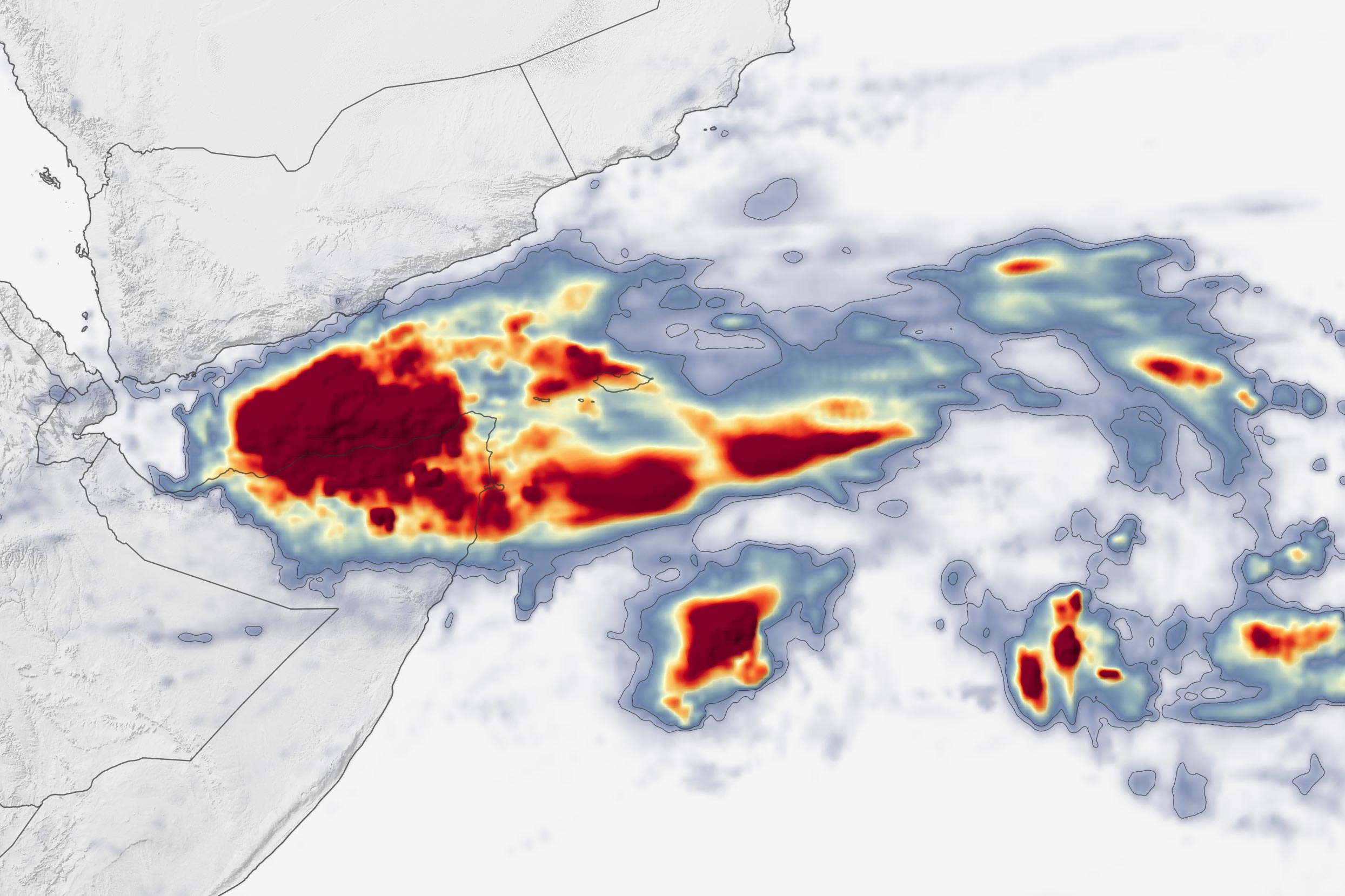
    Somalia Rainfall Accumulation November 2020 Annotated
    November 21 – 23, 2020

    The map above shows rainfall accumulation from November 21-23, 2020. These data are remotely-sensed estimates that come from the Integrated Multi-Satellite Retrievals for GPM (IMERG), a product of the Global Precipitation Measurement (GPM) mission. Local rainfall amounts can be significantly higher when measured from the ground.

    Much of northern Somalia, which typically receives about 10 centimeters (four inches) of rain in an entire year, received at least that much in two days. The city of Bosaso reported 12.8 centimeters (5 inches) in 24 hours. Heavy rains and strong winds caused flash floods along coastal and inland areas and destroyed buildings. Villages in the Iskushuban district, which includes Ras Hafun, were hit hardest. Gati has since weakened and moved into the Gulf of Aden.

    NASA Earth Observatory images by Lauren Dauphin, using IMERG data from the Global Precipitation Mission (GPM) at NASA/GSFC and VIIRS data from NASA EOSDIS/LANCE and GIBS/Worldview and the Suomi National Polar-orbiting Partnership.

    Never miss a breakthrough: Join the SciTechDaily newsletter.
    Follow us on Google and Google News.

    Cyclone NASA NASA Earth Observatory Weather
    Share. Facebook Twitter Pinterest LinkedIn Email Reddit

    Related Articles

    Bomb Cyclone Batters the Pacific Northwest Leaving 600,000 in the Dark

    Filipo’s Fury: Unleashing Nature’s Wrath on Mozambique

    Cyclone Jasper’s Fury: From Roaring Category-4 to Queensland’s Doorstep

    Unprecedented Wonder: Tropical Cyclone Freddy’s Record-Breaking Month-Long Journey Across the Indian Ocean

    Typhoon Hinnamnor: First Category 5 Cyclone on Earth in 2022

    Intense Extratropical “Bomb Cyclones” Drench US West Coast

    Tauktae: An Unusually Powerful Tropical Cyclone Strikes India

    Cyclone Seroja Slams Australia, Causing Significant Damage to Coastal Towns

    Severe Tropical Cyclone Yasa Bearing Down on Island Nation of Fiji

    Leave A Reply Cancel Reply

    • Facebook
    • Twitter
    • Pinterest
    • YouTube

    Don't Miss a Discovery

    Subscribe for the Latest in Science & Tech!

    Trending News

    Don’t Miss: August Brings Two Eclipses and the Perseid Meteor Shower

    Brain Waves Once Dismissed As Noise May Help Build Our Reality

    Perseverance Finds Organic Carbon Preserved Just Beneath the Martian Surface

    Tick Found in Austin Apartment Linked to Rare Relapsing Fever

    Ozempic Changes Your Body, but Does It Change Your Life? A New Study Suggests Not

    Ancient Super-Eruptions May Have Frozen Earth for Centuries

    A Common Sugar May Loosen Cancer Cells and Help Them Spread

    Scientists Discover a Major Brain Change That Starts Around Age 50

    Follow SciTechDaily
    • Facebook
    • Twitter
    • YouTube
    • Pinterest
    • Newsletter
    • RSS
    SciTech News
    • Biology News
    • Chemistry News
    • Earth News
    • Health News
    • Physics News
    • Science News
    • Space News
    • Technology News
    Recent Posts
    • Researchers Map the Hidden 3D Geometry of a Quantum Wavefunction
    • Lost in Space: Rare Cosmic Flare Exposes a Wandering Black Hole Far From Its Galaxy’s Center
    • Dark Matter May Be Leaving a Signal in Earth’s Atmosphere
    • Scientists Find Remarkable New Snail Species in Montenegro’s Mountains
    • Scientists Discover a 300-Million-Year-Old Geological Time Capsule Inside Fossilized Wood
    Copyright © 1998 - 2026 SciTechDaily. All Rights Reserved.
    • Science News
    • About
    • Contact
    • Editorial Board
    • Privacy Policy
    • Terms of Use

    Type above and press Enter to search. Press Esc to cancel.