
Close Menu
    Facebook X (Twitter) Instagram
    SciTechDaily
    • Biology
    • Chemistry
    • Earth
    • Health
    • Physics
    • Science
    • Space
    • Technology
    Facebook X (Twitter) Pinterest YouTube RSS
    SciTechDaily
    Home»Space»A Hard Look at Obscured Seyfert Galaxies
    Space

    A Hard Look at Obscured Seyfert Galaxies

    By Harvard-Smithsonian Center for AstrophysicsDecember 12, 2020No Comments3 Mins Read
    Facebook Twitter Pinterest Telegram LinkedIn WhatsApp Email Reddit
    Share
    Facebook Twitter LinkedIn Pinterest Telegram Email Reddit
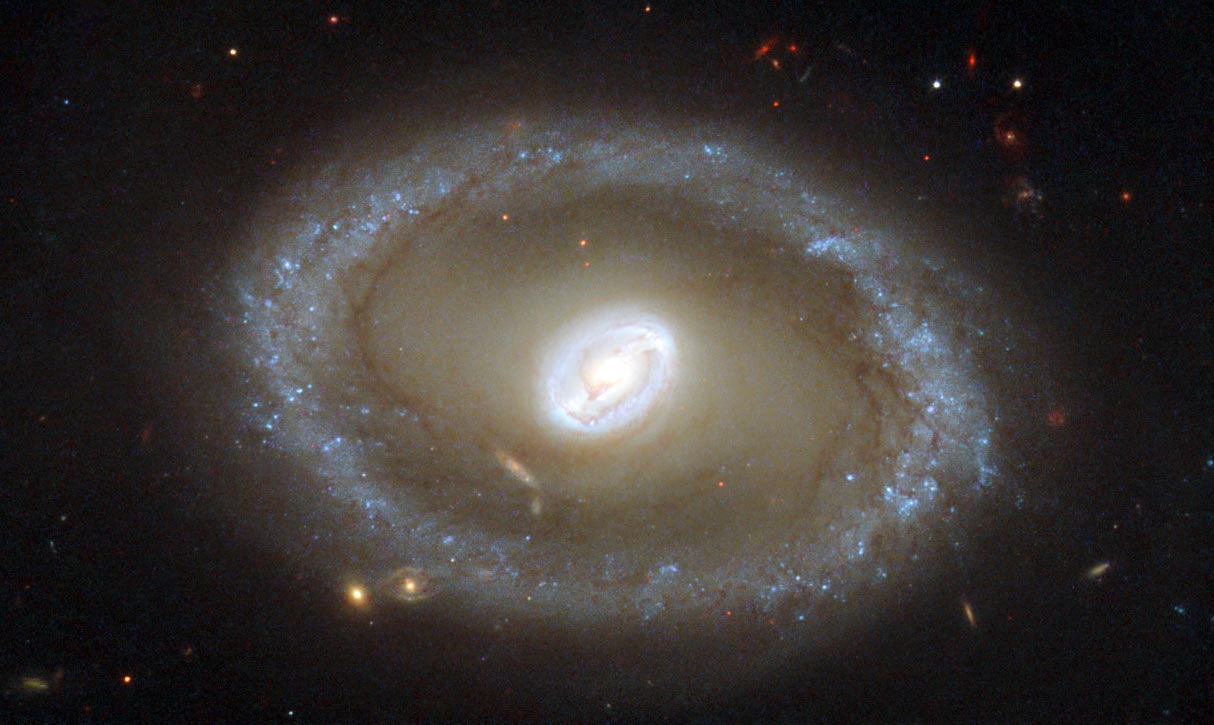
    Type II Seyfert Galaxy NGC 3081
    An optical image of the face-on Seyfert galaxy NGC 3081. The bright nuclei of Seyferts are powered by accretion onto their supermassive balckholes, but circumnuclear dust torii can block our line of sight to optical light. A new study uses hard X-ray emission scattered or reflected from surrounding nuclear structures to analyze the circumnuclear properties of obscured Seyfert nuclei. Credit: NASA/Hubble

    Seyfert galaxies are distinguished by their bright nuclei and radiation from highly ionized atoms. Seyferts look much like quasars, but unlike point-like quasars the Seyfert host galaxies are clearly seen.

    Astronomers think that the luminous nuclei of Seyferts are powered by accretion of material onto supermassive black holes via a circumnuclear disk, with a dusty torus around them farther away. Different orientations of the disk and obscuring torus to our line of sight are thought to account for the apparent differences seen in Seyfert types, but the morphology and composition of torii are still uncertain and could also play significant roles.

    For example, some scientists have proposed that the torus is a homogeneous structure, while others argue that it is a clumpy distribution of dense clouds. The accretion of material onto the black hole produces X-ray emission that reflects or scatters off of local structures. This feature can be used to help diagnose the properties of the environment, but much of the X-ray emission, especially at lower energies, is absorbed by obscuring material.

    CfA astronomer Laura Brenneman was a member of a team that used the NuSTAR X-ray satellite to study a sample of nineteen optically selected Seyfert galaxies known to have obscuring material along the line of sights to their nuclei. The singular advantage of NuSTAR is its ability to detect high energy X-ray emission that is not blocked. The team additionally used archival observations from several other X-ray missions including Chandra to complete their analysis.

    They modeled the optical data with conventional techniques to estimate the black hole masses from the motions of the gas, and used that to model the scattered and reflected X-rays produced by the accretion process to derive the gas densities.

    They conclude that between 80-90% of the galaxies in their sample have some dense material capable of obscuring the optical light entirely. They also conclude that radiation pressure produced in the accretion processes regulates the distribution of the circumnuclear material, as the less dense material is swept away when accretion rate increases, thereby making the nuclear region less obscured.

    This new paper represents the first study made of a large controlled sample of Seyferts using hard X-rays to probe the conditions in the heart of Seyfert nuclei.

    Reference: “A Hard Look at Local, Optically Selected, Obscured Seyfert Galaxies” by E. S. Kammoun, J. M. Miller, M. Koss, K. Oh, A. Zoghbi, R. F. Mushotzky, D. Barret, E. Behar, W. N. Brandt, L. W. Brenneman, J. S. Kaastra, A. M. Lohfink, D. Proga and D. Stern, 6 October 2020, The Astrophysical Journal.
    DOI: 10.3847/1538-4357/abb29f

    Never miss a breakthrough: Join the SciTechDaily newsletter.
    Follow us on Google and Google News.

    Astronomy Astrophysics Harvard-Smithsonian Center for Astrophysics
    Share. Facebook Twitter Pinterest LinkedIn Email Reddit

    Related Articles

    X-Ray Emission From Mysterious Dark Matter

    Analyzing Dust Storm Sequences on Mars

    Intriguing Remains of a Rare Stellar Explosion Discovered in Milky Way Center

    Puzzling Astrophysics of Quasars in the Early Universe

    Four Exoplanets – Including a Super-Earth Planet – Discovered by High School Students

    Massive Rotating Stars in the Pleiades Cluster

    Astronomers Discover First Cloudless, Jupiter-Like Planet – “Smoking Gun Evidence”

    Chandra X-ray Observatory Studies Extraordinary Magnetar [Video]

    Chandra Studies Extraordinary Magnetar: Fastest Spinning and Possibly the Youngest Magnetar Known

    Leave A Reply Cancel Reply

    • Facebook
    • Twitter
    • Pinterest
    • YouTube

    Don't Miss a Discovery

    Subscribe for the Latest in Science & Tech!

    Trending News

    Scientists Recreate a Nuclear Fireball and Uncover Fallout’s Hidden Chemistry

    These Tiny Gut Particles Could Be Accelerating Aging Throughout the Body

    Doctors Changed One Thing and Weight Gain Stopped

    Magnetic Fields May Solve a Longstanding Binary Star Mystery

    The Probiotic Breakthrough for Natural Anxiety Relief and Better Mental Health

    Animal vs. Plant Protein: Scientists Found a Surprising Nutritional Difference

    According to Scientists, This Simple Dietary Change Is Linked to Lower Depression Scores

    Researchers Discover a Hidden Vitamin D Problem That Persists Year-Round

    Follow SciTechDaily
    • Facebook
    • Twitter
    • YouTube
    • Pinterest
    • Newsletter
    • RSS
    SciTech News
    • Biology News
    • Chemistry News
    • Earth News
    • Health News
    • Physics News
    • Science News
    • Space News
    • Technology News
    Recent Posts
    • Scientists Tracked 4,500 Animals During COVID – What They Discovered Was Surprising
    • Hidden Phase of Matter Finally Captured After Decades of Predictions
    • The Strange “Spacetime Crystal” That Can Suddenly Turn Into a Black Hole
    • A Hidden Gut Signal May Be Driving Sleep Apnea’s Deadly Heart Risks
    • This AI-Designed “Universal Vaccine” Could Stop Future Pandemics Before They Start
    Copyright © 1998 - 2026 SciTechDaily. All Rights Reserved.
    • Science News
    • About
    • Contact
    • Editorial Board
    • Privacy Policy
    • Terms of Use

    Type above and press Enter to search. Press Esc to cancel.