
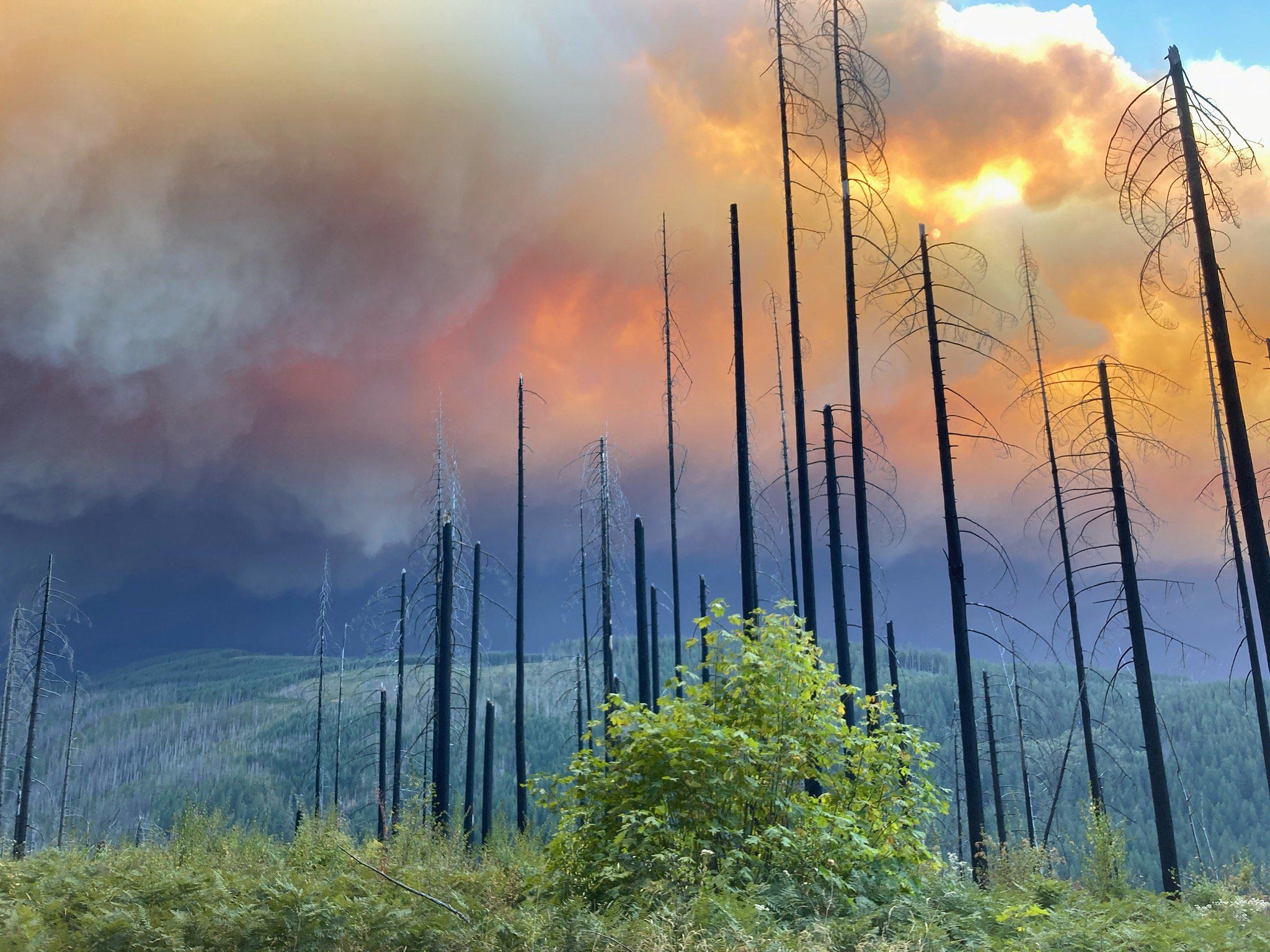
The Clackamas Basin rarely experiences the intense fire activity that burned in the watershed during the Labor Day fires, but new research out of Portland State University shows that wildfires like the Riverside Fire, which grew to 138,000 acres within days, could become more common under a warming climate, even under non-extreme wind conditions.
The study found that wildfire hazard in the Clackamas Basin, which is the second largest source of drinking water for the Portland metro area, will likely increase by mid-century. Projected changes in temperature and relative humidity are expected to lead to longer fire seasons and more severe fire weather in Oregon’s Western Cascade mountains, which in turn will result in larger, more frequent fires.
“Because of shifts in climate, the scenarios that would create extreme fire events all become a little more plausible,” said Andy McEvoy, the study’s lead author and a graduate student in environmental science and management. “There will be that many more days under which those components of a fire — ignition, weather and fuel — can align in a terrible way.”
The group of researchers simulated four climate scenarios from 2040-2069, representing a range of plausible changes in temperature and humidity.
The simulations showed that the fire season increased from as little as eight days to as much as 32 days. The projected annual average area burned increased significantly by 50% under the least impactful scenario (the coolest and wettest of the four) and as much as 540% under the most extreme scenario (the hottest and driest of the four).
“We don’t make the case that one future is more likely than the other, but it helps bracket the plausible outcomes for planning purposes,” said McEvoy, who works as a research fellow in the U.S. Forest Service’s Pacific Northwest Research Station. “The future is very uncertain and if land and resource managers plan just for the average case, their plans are not going to be robust in the face of those worst-case scenarios.”
The researchers, who worked closely with the Clackamas River Water Providers and Clackamas Water Environment Services, said the findings provide regional managers and planners with a tool to develop climate adaptation and risk mitigation strategies. Given the wide range of plausible future wildfire hazards, robust adaptation plans will be ones that maintain essential ecosystem services across the broadest range of scenarios by balancing land use management, fire suppression, and community preparedness strategies.
These efforts could range from designing and testing the effectiveness of fuel breaks — breaks in vegetation that can help firefighters control the spread of fire and protect homes and resources — to identifying susceptible communities and planning evacuations in the event of future extreme wildfires. In those cases, like the Riverside Fire, fuel breaks would not be successful and the only sensible strategy would be timely, safe evacuations.
“They’re planning for an uncertain future,” McEvoy said. “They have to plan using all available tools and adapt to events as they occur.”
Reference: ” Projected Impact of Mid-21st Century Climate Change on Wildfire Hazard in a Major Urban Watershed outside Portland, Oregon USA” by Andy McEvoy, Max Nielsen-Pincus, Andrés Holz, Arielle J. Catalano and Kelly E. Gleason, 8 December 2020, Fire.
DOI: 10.3390/fire3040070
The study’s findings are published in the journal Fire. Co-authors include Max Nielsen-Pincus, associate professor of environmental science and management; Andrés Holz, associate professor of geography; Arielle Catalano, a former postdoctoral scholar in PSU’s geography department; and Kelly Gleason, assistant professor of environmental science and management.
Never miss a breakthrough: Join the SciTechDaily newsletter.
Follow us on Google and Google News.
1 Comment
There is a disconnect between the mast headline, “… Watershed to Experience Larger, More Frequent Fires …”, and the body of the article, which says, “… wildfires … COULD become more common …” It would seem the that editor of ‘scitechdaily’ is editorializing!
Have the models been vetted, and if so, how? Did the models take into account that after each wildfire there is less acreage to burn and that the fire scars create natural fire breaks? The modeler(s) make no judgment about the likelihood of any of the four scenarios, which differ by about an order of magnitude in their potential impact. That seems to me to be irresponsible. For planning purposes, modelers should provide a quantitative estimate of the probability of each of the scenarios!
I can forecast with great certainty that someday there will be another significant meteor impact. However, the money spent to prepare for such an event should be determined by when it is expected to happen and the expected severity. Just saying it COULD happen is another example of subjective hand waving resulting from a numeric model. What passes for science these days isn’t much different from a witch doctor tossing chicken bones!
There is little historical data to support the idea of increasing heat wave frequency:
https://wattsupwiththat.com/2019/09/06/the-gestalt-of-heat-waves/