
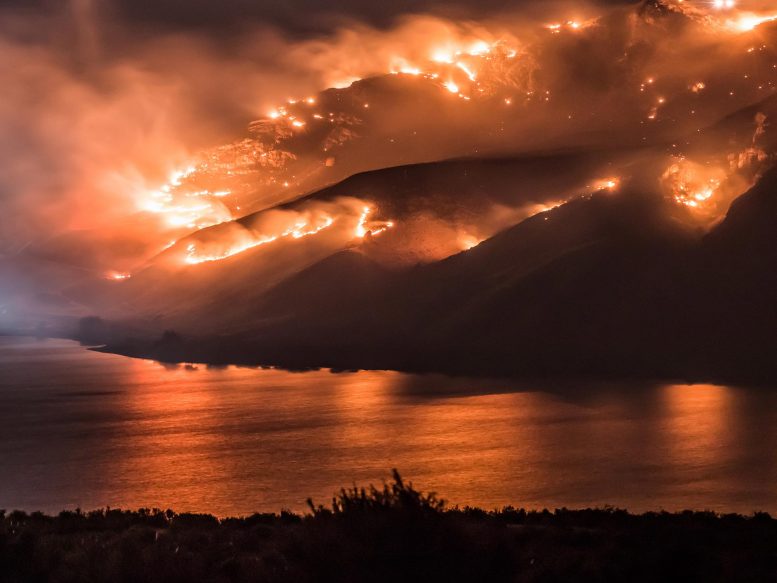
The extent to which rivers transport burned carbon to oceans — where it can be stored for tens of millennia — is revealed in new research led by the University of East Anglia (UEA).
The study, published today (June 3, 2020) in Nature Communications, calculates how much burned carbon is being flushed out by rivers and locked up in the oceans.
Oceans store a surprising amount of carbon from burned vegetation, for example as a result of wildfires and managed burning. The research team describe it as a natural — if unexpected — quirk of the Earth system.
The international interdisciplinary team, including collaborators from the Universities of Exeter, Swansea, Zurich, Oldenburg, and Florida International, studied the amount of dissolved carbon flowing through 78 rivers on every continent except Antarctica.
Lead researcher Dr. Matthew Jones, of the Tyndall Centre for Climate Change Research at UEA, said: “Fires leave behind carbon-rich materials, like charcoal and ash, which break down very slowly in soils. We care about this burned carbon because it is essentially ‘locked out’ of the atmosphere for the distant future — it breaks down to greenhouse gases extremely slowly in comparison to most unburned carbon.
“We know that this burned carbon takes about 10 times longer to break down in the oceans than on land. Rivers are the conveyor belts that shift carbon from the land to the oceans, so they determine how long it takes for burned carbon to break down. So, we set out to estimate how much burned carbon reaches the oceans via rivers.”
Based on a large dataset of 409 observations from 78 rivers around the world, the researchers analyzed how the burned fraction of dissolved carbon in rivers varies at different latitudes and in different ecosystems. They then upscaled their findings to estimate that 18 million tonnes of dissolved burned carbon are transported annually by rivers. When combined with the burned carbon that is exported with sediments, the estimate rises to 43 million tonnes of burned carbon per year.
Dr. Jones said: “We found that a surprising amount — around 12% percent — of all carbon flowing through rivers comes from burned vegetation.
“While fires emit two billion tonnes of carbon each year, they also leave behind around 250 million tonnes of carbon as burned residues, like charcoal and ash. Around half of the carbon in these residues is in the particularly long-lived form of ‘black carbon’, and we show that about one-third of all black carbon reaches the oceans.”
“This is a good thing because that carbon gets locked up and stored for very long periods — it takes tens of millennia for black carbon to degrade to carbon dioxide in the oceans. By comparison, only about one percent of carbon taken up by land plants ends up in the ocean.
“With wildfires anticipated to increase in the future because of climate change, we can expect more burned carbon to be flushed out by rivers and locked up in the oceans.
“It’s a natural quirk of the Earth system — a moderating ‘negative feedback’ of the warming climate that could trap some extra carbon in a more fire-prone world.”
Reference: “Fires prime terrestrial organic carbon for riverine export to the global oceans” by Matthew W. Jones, Alysha I. Coppola, Cristina Santín, Thorsten Dittmar, Rudolf Jaffé, Stefan H. Doerr and Timothy A. Quine, 3 June 2020, Nature Communications.
DOI: 10.1038/s41467-020-16576-z
This study was principally funded by the Natural Environmental Research Council (NE/L002434/1), with other financial support from the Tyndall Centre for Climate Change Research and the Swiss National Science Foundation (PZ00P2_185835).
‘Fires prime terrestrial organic carbon for riverine export to the global oceans’ is published in the journal Nature Communications on Wednesday, June 3, 2020.
Never miss a breakthrough: Join the SciTechDaily newsletter.
Follow us on Google and Google News.