
Close Menu
    Facebook X (Twitter) Instagram
    SciTechDaily
    • Biology
    • Chemistry
    • Earth
    • Health
    • Physics
    • Science
    • Space
    • Technology
    Facebook X (Twitter) Pinterest YouTube RSS
    SciTechDaily
    Home»Technology»New Cathode Design Significantly Improves Performance of Next-Generation Battery
    Technology

    New Cathode Design Significantly Improves Performance of Next-Generation Battery

    By Hong Kong University of Science and TechnologyDecember 26, 2020No Comments3 Mins Read
    Facebook Twitter Pinterest Telegram LinkedIn WhatsApp Email Reddit
    Share
    Facebook Twitter LinkedIn Pinterest Telegram Email Reddit
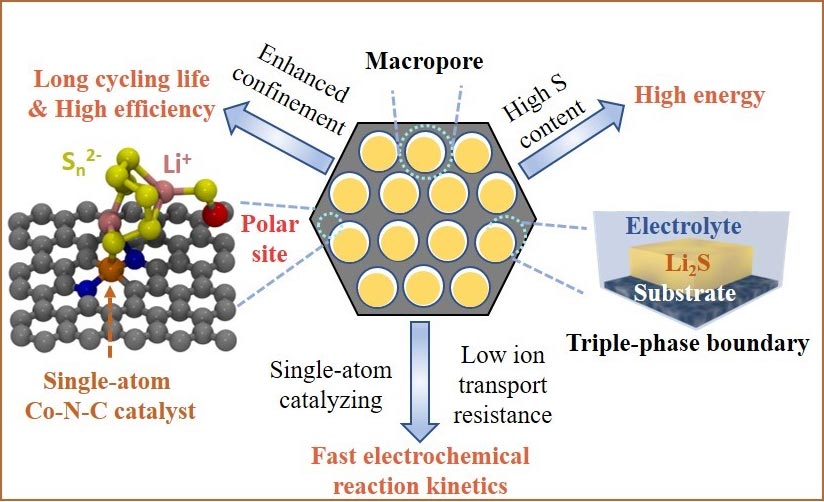
    Macroporous Host With Double-End Binding Sites
    An all-in-one solution for the design strategy of macroporous host with double-end binding sites. Credit: HKUST

    A team led by Cheong Ying Chan Professor of Engineering and Environment Prof. Zhao Tianshou, Chair Professor of Mechanical and Aerospace Engineering and Director of HKUST Energy Institute, has proposed a novel cathode design concept for lithium–sulfur (Li–S) battery that substantially improves the performance of this kind of promising next-generation battery.

    Li–S batteries are regarded as attractive alternatives to lithium-ion (Li-ion) batteries that are commonly used in smartphones, electric vehicles, and drones. They are known for their high energy density while their major component, sulfur, is abundant, light, cheap, and environmentally benign.

    Li–S batteries can potentially offer an energy density of over 500 Wh/kg, significantly better than Li-ion batteries that reach their limit at 300 Wh/kg. The higher energy density means that the approximate 400 km (250 mi) driving range of an electric vehicle powered by Li-ion batteries can be substantially extended to 600-800 km (370-500 mi) if powered by Li–S batteries.

    While exciting results on Li–S batteries have been achieved by researchers worldwide, there is still a big gap between lab research and commercialization of the technology on an industrial scale. One key issue is the polysulfide shuttle effect of Li-S batteries that causes progressive leakage of active material from the cathode and lithium corrosion, resulting in a short life cycle for the battery. Other challenges include reducing the amount of electrolyte in the battery while maintaining stable battery performance.

    To address these issues, Prof. Zhao’s team collaborated with international researchers to propose a cathode design concept that could achieve good Li–S battery performance.

    The highly oriented macroporous host can uniformly accommodate the sulfur while abundant active sites are embedded inside the host to tightly absorb the polysulfide, eliminating the shuttle effect and lithium metal corrosion. By bringing up a design principle for sulfur cathode in Li–S batteries, the joint team increased the batteries’ energy density and made a big step towards the industrialization of the batteries.

    “We are still in the middle of basic research in this field,” Prof. Zhao said. “However, our novel electrode design concept and the associated breakthrough in performance represent a big step towards the practical use of a next-generation battery that is even more powerful and longer-lasting than today’s lithium-ion batteries.”

    Their research work was recently published in Nature Nanotechnology.

    Reference: “A high-energy and long-cycling lithium–sulfur pouch cell via a macroporous catalytic cathode with double-end binding sites” by Chen Zhao, Gui-Liang Xu, Zhou Yu, Leicheng Zhang, Inhui Hwang, Yu-Xue Mo, Yuxun Ren, Lei Cheng, Cheng-Jun Sun, Yang Ren, Xiaobing Zuo, Jun-Tao Li, Shi-Gang Sun, Khalil Amine and Tianshou Zhao, 3 December 2020, Nature Nanotechnology.
    DOI: 10.1038/s41565-020-00829-5

    Team members from HKUST include Prof. Zhao and his current PhD students Zhao Chen, Zhang Leicheng, and former PhD student Ren Yuxun (2019 graduate). Other collaborators include researchers from Argonne National Laboratory and Stanford University in the US, Xiamen University in Mainland China, and Imam Abdulrahman Bin Faisal University in Saudi Arabia.

    Never miss a breakthrough: Join the SciTechDaily newsletter.
    Follow us on Google and Google News.

    Battery Technology Energy Hong Kong University of Science and Technology Nanotechnology
    Share. Facebook Twitter Pinterest LinkedIn Email Reddit

    Related Articles

    Improving Lithium-Ion Battery Performance, Cell Lifetime for Renewable Energy Applications

    New Battery Technology Enables Charging Electric Cars Up to 90% in Just 6 Minutes

    Battery Breakthrough to Give Flight to Electric Aircraft and Boost Long-Range Electric Cars

    Improved Advanced Energy Storage Using New Nano-Engineering Strategy

    First Quantum Phase “Supercurrent” Battery Ever Developed

    Fast-Charging Super-Capacitor Technology Unveiled for Clean Energy Storage

    Next-Generation Energy Storage Breakthrough: Fast-Charging, Long-Running, Flexible

    New Aqueous Lithium-Ion Battery – Low Cost & Improved Safety

    Iron-Air Batteries Promise Higher Energy Density Than Lithium-Ion Batteries

    Leave A Reply Cancel Reply

    • Facebook
    • Twitter
    • Pinterest
    • YouTube

    Don't Miss a Discovery

    Subscribe for the Latest in Science & Tech!

    Trending News

    Sitting Up Straight Could Actually Help You Make Better Decisions

    Never-Before-Seen Vortices Are Swirling Across the Sun

    This Common Amino Acid May Help the Body Fight Cancer and Viruses

    Low-Protein “Longevity Diet” Linked to Fat Loss, Muscle Preservation, and Healthy Aging

    How Prehistoric Poop Changed Earth’s Ecosystems Forever

    This Fossil Upends a Decades-Old Debate About Snake Evolution

    A Blood Test Years Before Cancer May Reveal a Hidden Warning Sign

    Starlink Satellites Reveal a Hidden Atmosphere 300 Miles Above Earth

    Follow SciTechDaily
    • Facebook
    • Twitter
    • YouTube
    • Pinterest
    • Newsletter
    • RSS
    SciTech News
    • Biology News
    • Chemistry News
    • Earth News
    • Health News
    • Physics News
    • Science News
    • Space News
    • Technology News
    Recent Posts
    • Tiny Fossil Overlooked for Decades Reveals a New Ice Age Species
    • Melting Sea Ice Could Be Changing the Clouds Above the Arctic
    • Ancient Neanderthal DNA May Give Some People More Muscle
    • These Overlooked Immune Cells Supercharge the Fight Against Cancer
    • The Surprising Reason a UTI Hurts So Much – and Why That Might Be a Good Thing
    Copyright © 1998 - 2026 SciTechDaily. All Rights Reserved.
    • Science News
    • About
    • Contact
    • Editorial Board
    • Privacy Policy
    • Terms of Use

    Type above and press Enter to search. Press Esc to cancel.