
Close Menu
    Facebook X (Twitter) Instagram
    SciTechDaily
    • Biology
    • Chemistry
    • Earth
    • Health
    • Physics
    • Science
    • Space
    • Technology
    Facebook X (Twitter) Pinterest YouTube RSS
    SciTechDaily
    Home»Science»Unusually Well-Preserved Genitalia on 50 Million-Year-Old Fossil Assassin Bug
    Science

    Unusually Well-Preserved Genitalia on 50 Million-Year-Old Fossil Assassin Bug

    By University of Illinois at Urbana-ChampaignJanuary 19, 2021No Comments4 Mins Read
    Facebook Twitter Pinterest Telegram LinkedIn WhatsApp Email Reddit
    Share
    Facebook Twitter LinkedIn Pinterest Telegram Email Reddit
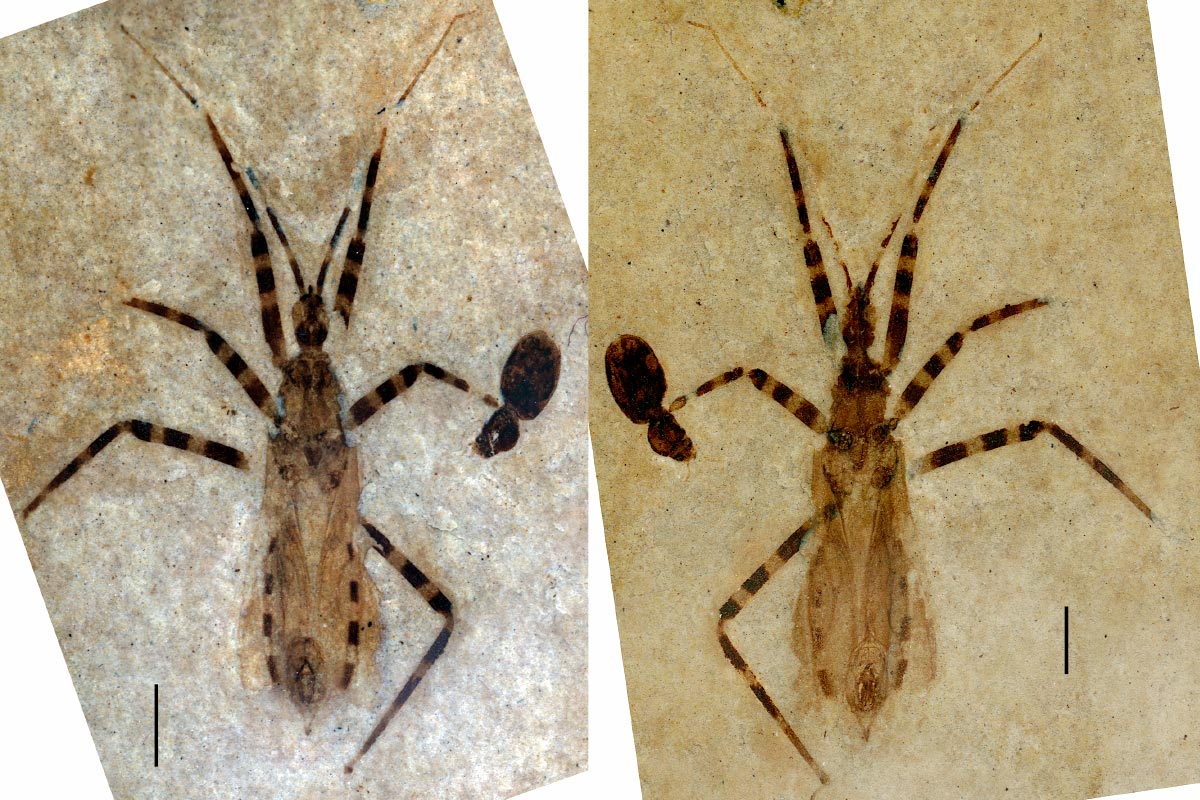
    Assassin Bug Fossil
    Recovered from the Green River Formation in present-day Colorado, this fossil represents a new genus and species of predatory insects known as assassin bugs. Researchers named the specimen Aphelicophontes danjuddi. A small beetle was also fossilized with the specimen. Credit: Image courtesy Palaeontological Association

    A newly discovered fossil assassin bug reveals internal genitalia, offering rare insights into insect evolution.

    The fossilized insect is tiny and its genital capsule, called a pygophore, is roughly the length of a grain of rice. It is remarkable, scientists say, because the bug’s physical characteristics — from the bold banding pattern on its legs to the internal features of its genitalia — are clearly visible and well-preserved. Recovered from the Green River Formation in present-day Colorado, the fossil represents a new genus and species of predatory insects known as assassin bugs.

    The find is reported in the journal Papers in Palaeontology.

    Sam Heads
    Illinois Natural History Survey paleontologist Sam Heads co-led the study of an extraordinarily well-preserved 50 million-year-old fossil insect. Credit: Photo by L. Brian Stauffer

    Discovered in 2006 by breaking open a slab of rock, the fossilized bug split almost perfectly from head to abdomen. The fracture also cracked the pygophore in two. A fossil dealer later sold each half to a different collector, and the researchers tracked them down and reunited them for this study.

    Genitalia Key to Insect Identification

    Being able to see a bug’s genitalia is very helpful when trying to determine a fossil insect’s place in its family tree, said Sam Heads, a paleontologist at the Illinois Natural History Survey and self-described fossil insect-genitalia expert who led the research with Daniel Swanson, a graduate student in entomology at the University of Illinois Urbana-Champaign.

    Species are often defined by their ability to successfully mate with one another, and small differences in genitalia can lead to sexual incompatibilities that, over time, may result in the rise of new species, Swanson said. This makes the genitalia a good place to focus to determine an insect species.

    But such structures are often obscured in compression fossils like those from the Green River Formation.

    “To see these fine structures in the internal genitalia is a rare treat,” Swanson said. “Normally, we only get this level of detail in species that are living today.”

    The structures visible within the pygophore include the basal plate, a hardened, stirrup-shaped structure that supports the phallus, he said. The fossil also preserved the contours of the phallotheca, a pouch into which the phallus can be withdrawn.

    Daniel Swanson
    U. of I. entomology graduate student Daniel Swanson co-led the research on an ancient assassin bug fossil. Credit: Photo by L. Brian Stauffer

    New Insights into Assassin Bug Evolution

    The find suggests that the banded assassin bugs, a group to which the new specimen is thought to belong, are about 25 million years older than previously thought, Swanson said.

    “There are about 7,000 species of assassin bug described, but only about 50 fossils of these bugs are known,” he said. “This just speaks to the improbability of even having a fossil, let alone one of this age, that offers this much information.”

    This is not the oldest fossil bug genitalia ever discovered, however.

    “The oldest known arthropod genitalia are from a type of bug known as a harvestman that is 400-412 million years old, from the Rhynie Chert of Scotland,” Heads said. “And there are also numerous fossil insects in amber as old as the Cretaceous Period with genitalia preserved.

    “However, it is almost unheard of for internal male genitalia to be preserved in carbonaceous compressions like ours,” he said.

    The researchers named the new assassin bug Aphelicophontes danjuddi. The species name comes from one of the fossil collectors, Dan Judd, who donated his half of the specimen to the INHS for study.

    Reference: “A new remarkably preserved fossil assassin bug (Insecta, Heteroptera, Reduviidae) from the Eocene Green River Formation of Colorado” by Daniel R. Swanson, Sam W. Heads, Steven J. Taylor and Yinan Wang, 19 January 2021, Papers in Paleontology.
    DOI: 10.1002/spp2.1349

    The INHS is a division of the Prairie Research Institute at the U. of I.

    The National Science Foundation supported this work.

    Never miss a breakthrough: Join the SciTechDaily newsletter.
    Follow us on Google and Google News.

    Entomology Evolution Paleontology Popular University of Illinois at Urbana-Champaign
    Share. Facebook Twitter Pinterest LinkedIn Email Reddit

    Related Articles

    Preserved With Life-Like Fidelity, 100 Million-Year-Old Beetle Is Fireflies’ Missing Fossil Link

    Deadly Virus Turns Honey Bees Into Trojan Horses, Rapidly Spreading the Infection to Healthy Hives

    66-Million-Year-Old ‘Crazy Beast’ Marooned on Mesozoic Madagascar

    Fossilized Monkey Teeth Discovered in Peru Indicate Ancient Primates Crossed the Atlantic Ocean From Africa

    New Dinosaur Discovered in New Mexico Is One of the Last Known Surviving Raptors

    Earliest Interbreeding Between Ancient Human Populations Discovered – Evolutionary Puzzle Solved

    One-of-a-Kind Dinosaur Specimen Discovered in China Offers View Into Dinosaur-Bird Evolution

    It Seems There Were Too Many Meat-Eating Dinosaurs – This May Be the Explanation

    New Evidence Shows Humans Mastered Fire Earlier Than Thought

    Leave A Reply Cancel Reply

    • Facebook
    • Twitter
    • Pinterest
    • YouTube

    Don't Miss a Discovery

    Subscribe for the Latest in Science & Tech!

    Trending News

    Common Laxative May Help Reverse Depression-Related Brain Fog

    Younger Generations Are Aging Faster – and It May Be Fueling a Surge in Cancer

    New Discovery Could Unlock Quantum Computers the Size of a Coin

    Shingles Vaccine Linked to 24% Lower Dementia Risk in Older Adults

    Scientists Found a Wordle Trick That Solves 99% of Puzzles

    A Hidden Galaxy Called Shadow Blaster May Explain One of Astronomy’s Biggest Mysteries

    These 3 Common Sleep Habits May Be Aging Your Brain Faster

    Rare Goblin Shark Spotted Alive in Its Natural Habitat for the First Time

    Follow SciTechDaily
    • Facebook
    • Twitter
    • YouTube
    • Pinterest
    • Newsletter
    • RSS
    SciTech News
    • Biology News
    • Chemistry News
    • Earth News
    • Health News
    • Physics News
    • Science News
    • Space News
    • Technology News
    Recent Posts
    • New Fossils Show the Arctic Was an Evolutionary Powerhouse During the Age of Dinosaurs
    • What Happened to Australasia’s Lost Crocodiles? New Research Reveals a Dramatic Extinction Story
    • 520-Million-Year-Old Fossils Solve One of Evolution’s Biggest Mysteries
    • This Extraordinary Desert Mouse Defies Aging – and It Could Change Human Longevity
    • A Simple Blood Test Can Reveal the True Age of Your Brain, Heart, and Other Organs
    Copyright © 1998 - 2026 SciTechDaily. All Rights Reserved.
    • Science News
    • About
    • Contact
    • Editorial Board
    • Privacy Policy
    • Terms of Use

    Type above and press Enter to search. Press Esc to cancel.