
Close Menu
    Facebook X (Twitter) Instagram
    SciTechDaily
    • Biology
    • Chemistry
    • Earth
    • Health
    • Physics
    • Science
    • Space
    • Technology
    Facebook X (Twitter) Pinterest YouTube RSS
    SciTechDaily
    Home»Science»Recognizing Liars From the Sound of Their Voice? Here’s How to Sound Confident and Honest
    Science

    Recognizing Liars From the Sound of Their Voice? Here’s How to Sound Confident and Honest

    By CNRSFebruary 8, 20212 Comments2 Mins Read
    Facebook Twitter Pinterest Telegram LinkedIn WhatsApp Email Reddit
    Share
    Facebook Twitter LinkedIn Pinterest Telegram Email Reddit
    Confident Honest Voice Cues
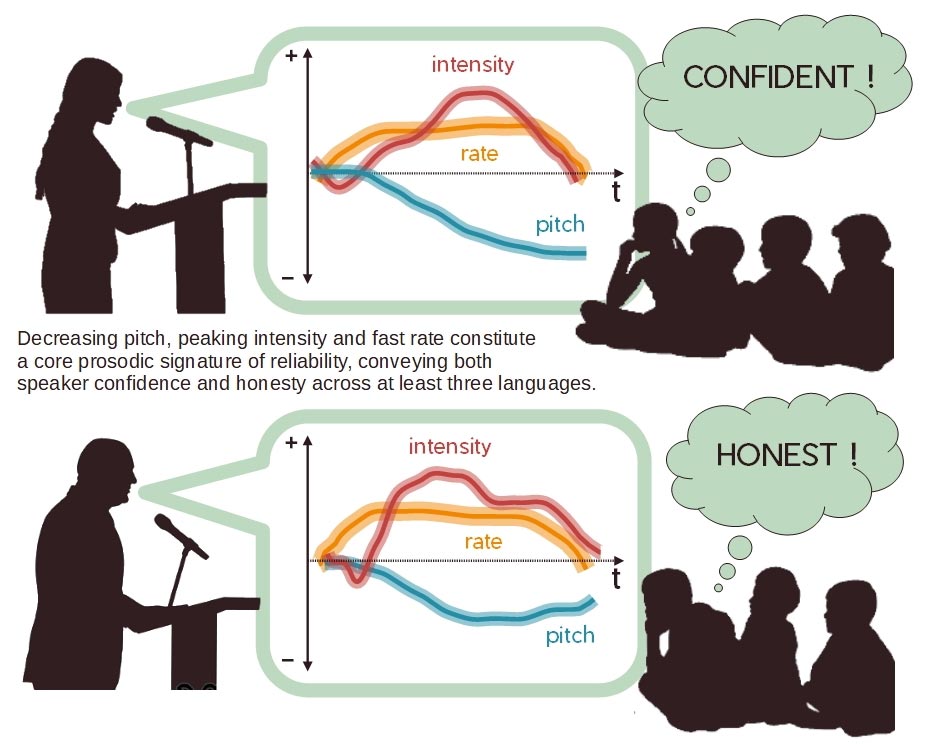
    Two types of judgments (certainty, honesty) are based on a single acoustic signature: high pitch that falls at the end of the word, intensity in the middle of the word, and fast speech rate. Above: certainty, below: honesty. Credit: © Jean-Julien Aucouturier and Louise Goupil, STMS laboratory (CNRS/Ircam/Sorbonne Université/Ministère de la Culture)

    A specific speech pattern signals honesty and confidence to listeners, regardless of language. This prosody also unconsciously shapes how we remember what’s said.

    Faster speech rate, greater intensity in the middle of the word, and falling pitch at the end of the word: that is the prosody[1] to adopt if one wants to come across as reliable and honest to one’s listeners.

    Scientists from the Science and Technology for Music and Sound laboratory (CNRS/Ircam/Sorbonne Université/Ministère de la Culture)[2] and the Perceptual Systems Laboratory (CNRS/ENS PSL) have conducted a series of experiments[3] to understand how we decide, based on the voice, whether a speaker is honest and confident, or on the contrary dishonest and uncertain.

    They have also shown that this signature was perceived similarly in a number of languages (French, English, Spanish), and that it is registered “automatically” by the brain: even when participants were not judging the speaker’s certainty or honesty, this characteristic sound impacted how they memorized the words.

    Prosody consequently conveys information on the truth-value or certainty of a proposition. Scientists are now trying to understand how speakers produce such prosody based on their intentions. This research was published today (February 8, 2021) in Nature Communications.

    Notes:

    1. Prosody refers to the “melody” of a phrase or word: its pitch, rate, and intensity.
    2. Jean-Julien Aucouturier now works at the FEMTO-ST laboratory (CNRS/Université de Bourgogne-Franche Comté/ENSMM/UTBM), and Louise Goupil at the University of East London.
    3. Scientists used vocal signal processing techniques to create random pronunciations of words (rising pitch, falling pitch, etc.), and then asked multiple groups of participants whether these words were pronounced with certainty or honesty. The software they developed as part of this effort, CLEESE, is open source: https://forum.ircam.fr/projects/detail/cleese/

    Reference: “Listeners’ perceptions of the certainty and honesty of a speaker are associated with a common prosodic signature” by Louise Goupil, Emmanuel Ponsot, Daniel Richardson, Gabriel Reyes and Jean-Julien Aucouturier, 8 February 2021, Nature Communications.
    DOI: 10.1038/s41467-020-20649-4

    Funding: CNRS; Ircam; Sorbonne Université; Ministère de la Culture; ENS PSL

    Never miss a breakthrough: Join the SciTechDaily newsletter.
    Follow us on Google and Google News.

    Behavioral Science CNRS Language
    Share. Facebook Twitter Pinterest LinkedIn Email Reddit

    Related Articles

    Answer Quickly to Be Believed – Pausing Before Replying Decreases Perceived Sincerity

    New Research Finds Lasting Benefits From Growing Up in a Bilingual Home

    How Does Our Brain Separate the Factual From the Possible?

    Infant Brain Circuitry Shaped by Language Exposure

    Researchers Use “Artificial Grammars” to Show Building Blocks of Language Evolved 30–40 Million Years Ago

    Distinctive Primal Acoustics of the Human Scream

    Researchers Link Dyslexia Gene Variants to Consonant Use Across Populations

    New Linguistic Analyses Dates Dravidian Language Family

    Body Language Is a Better Indicator of Intense Emotions Than Facial Expressions

    2 Comments

    1. Carolyn L Zaremba on February 9, 2021 1:05 pm

      As an actor, I attended voiceover school and we learned this as part of our voiceover training. Since the aim of commercial voiceover is to sell product, it is important to sound confident (in the efficacy of the product, for instance) and above all honest (to instill trust in the listener and potential purchaser).

      Reply
    2. Guy on February 10, 2021 7:48 am

      I believe that this is also a technique used by news anchors to get people to believe their fake news.

      Reply
    Leave A Reply Cancel Reply

    • Facebook
    • Twitter
    • Pinterest
    • YouTube

    Don't Miss a Discovery

    Subscribe for the Latest in Science & Tech!

    Trending News

    Black Hole Collisions May Follow a Surprisingly Simple Rule

    The Eye Has a Hidden Cleanup System and Scientists Just Discovered It

    The Truth About Vikings Is More Complicated Than Museums Admit

    New Catalyst Turns Stubborn Plant Waste Into Valuable Chemicals

    Quantum Gravity May Be Far Less Quantum Than Physicists Expected

    New Tool Supercharges Immunotherapy Against Prostate Cancer

    The Hidden Cancer Risk of Ketogenic Diets

    One Asteroid Collision May Have Rocked Earth, Mars, and the Moon

    Follow SciTechDaily
    • Facebook
    • Twitter
    • YouTube
    • Pinterest
    • Newsletter
    • RSS
    SciTech News
    • Biology News
    • Chemistry News
    • Earth News
    • Health News
    • Physics News
    • Science News
    • Space News
    • Technology News
    Recent Posts
    • World’s First Room-Temperature Quantum Material Sorts Light in an Unprecedented Way
    • Mathematician Offers New Solution to a Fundamental Cosmic Paradox
    • Scientists Turn Plastic Waste Into Clean Hydrogen Fuel
    • Scientists Reveal How Exercise May Protect the Aging Brain
    • Long COVID Brain Scans Reveal Damage to Dopamine Neurons
    Copyright © 1998 - 2026 SciTechDaily. All Rights Reserved.
    • Science News
    • About
    • Contact
    • Editorial Board
    • Privacy Policy
    • Terms of Use

    Type above and press Enter to search. Press Esc to cancel.