
Graduate student uses modal analysis to uncover new insights on transonic airfoil shocks.
Armando Collazo Garcia III got more than he expected from a graduate course he took last spring. He developed a new understanding of the physics of transonic shocks produced across a laminar flow airfoil with boundary-layer suction and added a published paper to his resume.
“When I got the assignment to do a research project, I realized I already had a good data set from my master’s thesis that I could use in a new way,” Collazo Garcia said. “I was able to apply linear algebra techniques to manipulate the flow field data and decompose the information into modes. The modes provided a snapshot of various aspects of the flow and were ranked by their energy contribution, with the higher-ranking modes showing the most important characteristics of the flow. The beauty of this technique is it takes out all of the random noise—all of the uncertainty associated with the data—and identifies the modes that are most important so we can more efficiently study the process.”
The paper was developed for the course AE 598 – Modal Analysis of Fluid Flow taught by Theresa Saxton-Fox, assistant professor in the Department of Aerospace Engineering at the University of Illinois Urbana-Champaign.
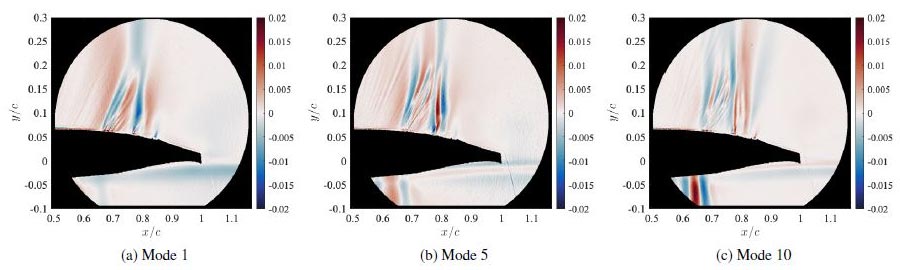
“From the class, I learned how to use modal analysis techniques, in particular, proper orthogonal decomposition, and how the technique can help me understand the dominant modes and dominant features in the flow in question,” Collazo Garcia said. “In doing the analysis, I learned how considering a reduced order model using the dominant modes allowed me to understand the dynamics and the important physics of the process without unsteadiness and noise that is present in the data.”
Exploring Shock Behavior Without Boundary-Layer Suction
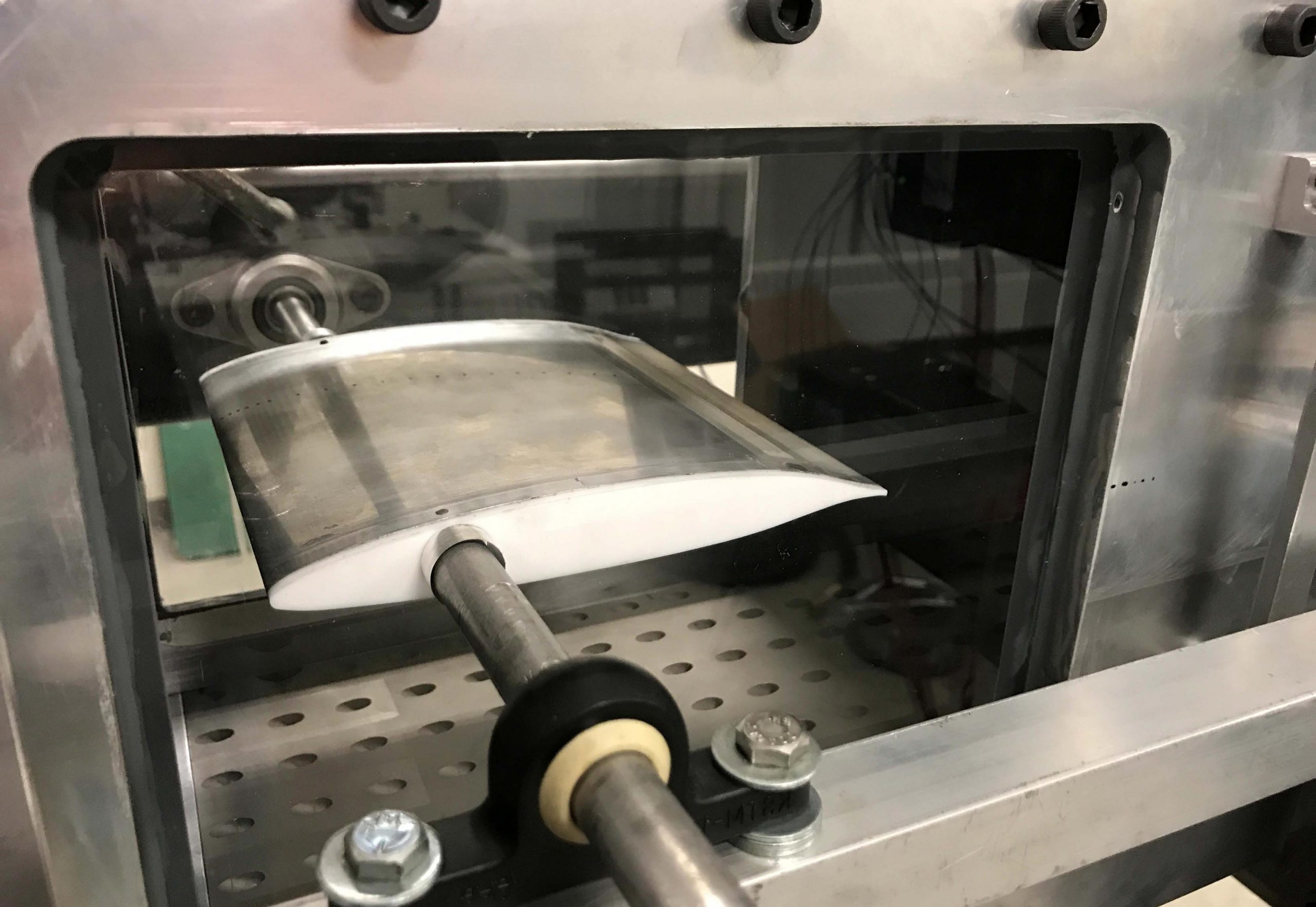
For his master’s thesis, Collazo Garcia assessed the aerodynamic performance and associated flow characteristics of a Griffith-type laminar flow airfoil in the transonic environment. Because the airfoil was designed to operate in the presence of active boundary-layer suction to assist the pressure increase across the trailing-edge region, the airfoil aerodynamic performance was hindered when this suction was not applied. A highly unsteady shock oscillation process was also observed in the absence of suction due to a complex flow interaction process. It was observed that applying suction mitigated this large variability in the shock position and unsteady motion. The work he began in Saxton-Fox’s class allowed him to use modal analysis to expand on the knowledge on this oscillatory shock process.
“We obtained the associated frequencies of each mode and were able to create a reconstruction of the process and capture the important physics by removing all the associated unsteadiness and noise in the data,” Collazo Garcia said. “We observed the Mach wave build up, which leads to the fully developed shock. After oscillation, it dissipates and then we see again the process forming.”
Collazo Garcia said the reconstruction, which assumed a single Fourier mode for each proper orthogonal decomposition mode, is a very simple technique that can be applied to other flows and other data sets with the intent of understanding the underlying physics, the most important characteristics in an unsteady process.
Reference: “Modal Analysis of the Transonic Shock Process over a Griffith-Type, Laminar-Flow Airfoil” by Armando R. Collazo Garcia III, Theresa Saxton-Fox and Phillip J. Ansell, 4 January 2021, AIAA Scitech 2021 Forum.
DOI: 10.2514/6.2021-1646
Never miss a breakthrough: Join the SciTechDaily newsletter.
Follow us on Google and Google News.
3 Comments
Let me guess: Your parents are registered Democrats and you may be graduating from junior high school if schools ever re-open.
Should you wonder how I came to the above conclusion, it is the reference to Bush and the very juvenile remarks with sexual innuendo. Surely you can find something better to do with your time! In any event, you are not making a contribution to science or this forum.
The essence of immaturity is the inability to recognize it.
Mans not hot