
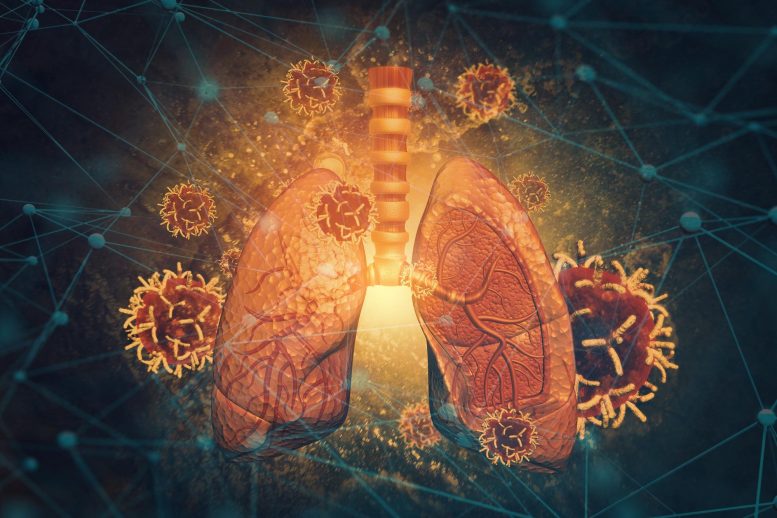
COVID-19 damages lungs by causing runaway inflammation, blocking repair, and triggering scarring. IL-1ß is a key culprit—and a promising drug target.
A new study is drawing the most detailed picture yet of SARS-CoV-2 infection in the lung, revealing mechanisms that result in lethal COVID-19, and may explain long-term complications and show how COVID-19 differs from other infectious diseases.
Led by researchers at Columbia University Vagelos College of Physicians and Surgeons and Herbert Irving Comprehensive Cancer Center, the study found that in patients who died of the infection, COVID-19 unleashed a detrimental trifecta of runaway inflammation, direct destruction and impaired regeneration of lung cells involved in gas exchange, and accelerated lung scarring.
Though the study looked at lungs from patients who had died of the disease, it provides solid leads as to why survivors of severe COVID may experience long-term respiratory complications due to lung scarring.
“It’s a devastating disease, but the picture we’re getting of the COVID-19 lung is the first step towards identifying potential targets and therapies that disrupt some of the disease’s vicious circuits. In particular, targeting cells responsible for pulmonary fibrosis early on could possibly prevent or ameliorate long-term complications in survivors of severe COVID-19,” says Benjamin Izar, MD, PhD, assistant professor of medicine, who led a group of more than 40 investigators to complete in several months a series of analyses that usually takes years.
This study and a companion paper led by researchers at Harvard/MIT, to which the Columbia investigators also contributed, were published in the journal Nature on April 29.
Study Creates Atlas of Cells in COVID Lung
The new study is unique from other investigations in that it directly examines lung tissue (rather than sputum or bronchial washes) using single-cell molecular profiling that can identify each cell in a tissue sample and record each cell’s activity, resulting in an atlas of cells in COVID lung.
“A normal lung will have many of the same cells we find in COVID, but in different proportions and different activation states,” Izar says. “In order to understand how COVID-19 is different compared to both control lungs and other forms of infectious pneumonias, we needed to look at thousands of cells, one by one.”
Izar’s team examined the lungs of 19 individuals who died of COVID-19 and underwent rapid autopsy (within hours of death)—during which lung and other tissues were collected and immediately frozen—and the lungs of non-COVID-19 patients. In collaboration with investigators at Cornell University, the researchers also compared their findings to lungs of patients with other respiratory illnesses.
Drugs Targeting IL-1ß May Reduce Inflammation
Compared to normal lungs, lungs from the COVID patients were filled with immune cells called macrophages, the study found.
Typically during an infection, these cells chew up pathogens but also regulate the intensity of inflammation, which also helps in the fight.
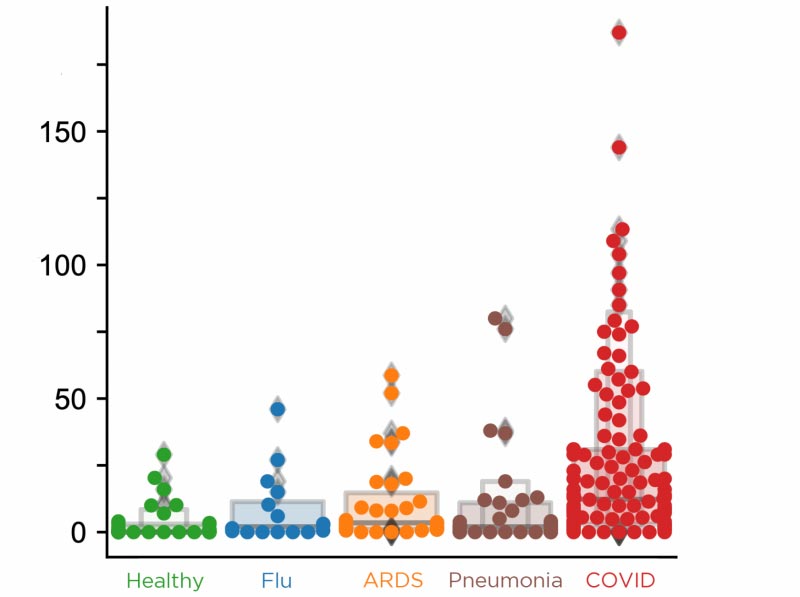
“In COVID-19, we see expansion and uncontrolled activation of macrophages, including alveolar macrophages and monocyte-derived macrophages,” Izar says. “They are completely out of balance and allow inflammation to ramp up unchecked. This results in a vicious cycle where more immune cells come in causing even more inflammation, which ultimately damages the lung tissue.”
One inflammatory cytokine in particular, IL-1ß, is produced at a high rate by these macrophages.
“Unlike other cytokines such as IL-6, which appears to be universally prevalent in various pneumonias, IL-1ß production in macrophages is more pronounced in COVID-19 compared to other viral or bacterial lung infections,” Izar says. “That’s important because drugs exist that tamp down the effects of IL-1ß.”
Some of these drugs are already being tested in clinical trials of COVID patients.
Severe COVID Also Prevents Lung Repair
In a typical infection, a virus damages lung cells, the immune system clears the pathogen and the debris, and the lung regenerates.
But in COVID, the new study found that not only does the SARS-CoV-2 virus destroy alveolar epithelial cells important for gas exchange, the ensuing inflammation also impairs the ability of the remaining cells to regenerate the damaged lung.

Though the lung still contains cells that can do the repairs, inflammation permanently traps these cells in an intermediate cell state and leaves them unable to complete the last steps of differentiation needed for replacement of mature lung epithelium.
“Among others, IL-1ß appears to be a culprit in inducing and maintaining this intermediate cell state,” says Izar, “thereby linking inflammation and impaired lung regeneration in COVID-19. This suggests that in addition to reducing inflammation, targeting IL-1ß may help take the brakes off cells required for lung repair.”
Preventing Accelerated Fibrosis
The researchers also found a large number of specific fibroblast cells, called pathological fibroblasts, that create rapid scarring in COVID-19 lungs. When the fibroblast cells fill the lung with scar tissue, a process called fibrosis, the lung has less space for cells involved in gas exchange and is permanently damaged.
Given the importance of pathological fibroblasts in the disease, Izar’s team closely analyzed the cells to uncover potential drug targets. An algorithm called VIPER, developed previously by Andrea Califano, Dr, chair of systems biology at Columbia University Vagelos College of Physicians and Surgeons, identified several molecules in the cells that play an important role and could be targeted by existing drugs.
“This analysis predicted that inhibition of STAT signaling could alleviate some of the deleterious effects caused by pathological fibroblasts,” Izar says.
“Our hope is that by sharing this analysis and massive data resource, other researchers and drug companies can begin to test and expand on these ideas and find treatments to not only treat critically ill patients, but also reduce complications in people who survive severe COVID-19.”
Team Effort by Several Columbia Labs
“Pulling this study together in such a short period of time was only possible with the help of several teams of researchers at Columbia,” Izar says.
Critically, in the first few months of the pandemic, Columbia’s Department of Pathology & Cell Biology decided to flash-freeze many tissues from deceased COVID patients to preserve the cells’ molecular state. Hanina Hibshoosh, MD, director of the department’s tissue bank, initiated the collaboration with Izar’s lab, which has expertise in conducting single-cell analyses with frozen tissue. Pathologist Anjali Saqi, MD, professor of pathology & cell biology, was also instrumental in procuring and evaluating the samples.
Jianwen Que, MD, PhD, professor of medicine, and his laboratory provided expertise in identifying and characterizing cells in the lung and their regenerative potential. Fibrosis expert Robert Schwabe, MD, associate professor of medicine, was essential in dissecting mechanisms by which COVID-19 propelled lung scarring.
“We are incredibly grateful to all the labs contributing to this effort and very fortunate to be at Columbia with all the necessary expertise at hand in one collaborative environment,” Izar says.
Reference: “A molecular single-cell lung atlas of lethal COVID-19” by Johannes C. Melms, Jana Biermann, Huachao Huang, Yiping Wang, Ajay Nair, Somnath Tagore, Igor Katsyv, André F. Rendeiro, Amit Dipak Amin, Denis Schapiro, Chris J. Frangieh, Adrienne M. Luoma, Aveline Filliol, Yinshan Fang, Hiranmayi Ravichandran, Mariano G. Clausi, George A. Alba, Meri Rogava, Sean W. Chen, Patricia Ho, Daniel T. Montoro, Adam E. Kornberg, Arnold S. Han, Mathieu F. Bakhoum, Niroshana Anandasabapathy, Mayte Suárez-Fariñas, Samuel F. Bakhoum, Yaron Bram, Alain Borczuk, Xinzheng V. Guo, Jay H. Lefkowitch, Charles Marboe, Stephen M. Lagana, Armando Del Portillo, Emmanuel Zorn, Glen S. Markowitz, Robert F. Schwabe, Robert E. Schwartz, Olivier Elemento, Anjali Saqi, Hanina Hibshoosh, Jianwen Que and Benjamin Izar, 29 April 2021, Nature.
DOI: 10.1038/s41586-021-03569-1
The researchers were supported by the U.S. National Institutes of Health (grants K08CA222663, U54CA225088, R37CA258829, R01HL152293, R01HL132996, T32CA203702, UL1TR002384, R01CA194547, R01CA234614, R01AI107301, R01DK121072 and R03DK117252); FastGrants; a Burroughs Wellcome Fund Career Award for Medical Scientists; the Louis V. Gerstner Jr. Scholars Program; the U.S. Department of Defense (Discovery Award PR200616); Volastra, Janssen, and Eli Lilly research grants; the Leukemia and Lymphoma Society (grants SCOR 7012-16, SCOR 7021-20, and SCOR 180078-02); an Irma Hirschl Trust Research Award Scholar; and the Damon Runyon Cancer Research Foundation (DRQ-03-20).
This research was funded in part through the NIH Support Grant S10RR027050 for flow cytometry analysis and the NIH/NCI Cancer Center Support Grant P30CA013696 at Columbia University’s Genetically Modified Mouse Model Shared Resource, Molecular Pathology Shared Resource, and Tissue Bank.
Benjamin Izar is a consultant for Merck and Volastra Therapeutics. Olivier Elemento is scientific advisor and equity holder in Freenome, Owkin, Volastra Therapeutics, and OneThree Biotech. Robert E. Schwartz is a member of the scientific advisory board of Miromatrix Inc. Daniel T. Montoro is a consultant for LASE Innovation.
Never miss a breakthrough: Join the SciTechDaily newsletter.
Follow us on Google and Google News.
1 Comment
Which vaccine is best suited to combat this debilitating aspect of the CPC virus attack of the lungs? Thank you.