
Close Menu
    Facebook X (Twitter) Instagram
    SciTechDaily
    • Biology
    • Chemistry
    • Earth
    • Health
    • Physics
    • Science
    • Space
    • Technology
    Facebook X (Twitter) Pinterest YouTube RSS
    SciTechDaily
    Home»Technology»Structure of a Toxic Matter Identified That Destroys the Nerves in the Brain, Causing Alzheimer’s and Parkinson’s Diseases
    Technology

    Structure of a Toxic Matter Identified That Destroys the Nerves in the Brain, Causing Alzheimer’s and Parkinson’s Diseases

    By Pohang University of Science & Technology (POSTECH)May 28, 20211 Comment4 Mins Read
    Facebook Twitter Pinterest Telegram LinkedIn WhatsApp Email Reddit
    Share
    Facebook Twitter LinkedIn Pinterest Telegram Email Reddit
    Toxic Matter Destroys Brain Nerves
    A study has identified the structure of the agent that leads to the co-occurrence of Alzheimer’s and Parkinson’s diseases.

    Researchers identified the structure of mixed protein aggregates in Alzheimer’s and Parkinson’s using novel microscopy, potentially uncovering why the diseases co-occur.

    Alzheimer’s disease – also called dementia – where memory and cognitive functions gradually decline due to deformation and death of neurons, and Parkinson’s disease, which causes tremors in hands and arms impeding normal movement, are major neurodegenerative diseases. Recently, a research team at Pohang University of Science & Technology (POSTECH) has identified the structure of the agent that causes Alzheimer’s and Parkinson’s diseases to occur together.

    A research team led by Professor Joon Won Park and Ph.D. candidate Eun Ji Shin of the Department of Chemistry at POSTECH investigated the surface structure of hetero-oligomers found in the overlap of Alzheimer’s disease and Parkinson’s disease, using atomic force microscopy (AFM) to reveal their structural identity. This study was featured as the front cover paper in the latest issue of the journal Nano Letters.

    It is known that the pathological overlap of Alzheimer’s disease and Parkinson’s disease is associated with the formation of hetero-oligomers derived from amyloid-beta and alpha-synuclein. However, it was difficult to study the treatment due to technical limitations in observing their structure.

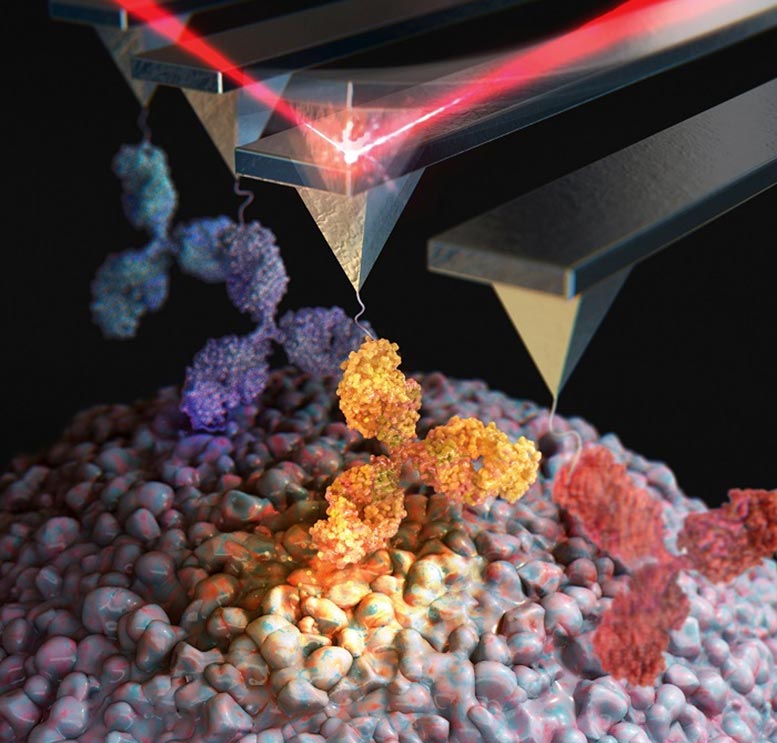
    Quadruple Force Mapping of Hetero-Oligomers
    Schematic diagram of quadruple force mapping of hetero-oligomers derived from amyloid-beta and alpha-synuclein. Hetero-oligomers were characterized by the four types of AFM probes tethering an antibody recognizing each end of peptides. Credit: POSTECH

    To this, the researchers used the AFM to observe the surface characteristic of the hetero-oligomer nano-aggregates derived from amyloid-beta, known as the biomarker of Alzheimer’s disease, and alpha-synuclein, known as the biomarker of Parkinson’s disease, at the single-molecule level.

    Evidence of Hetero-Oligomer Prevalence
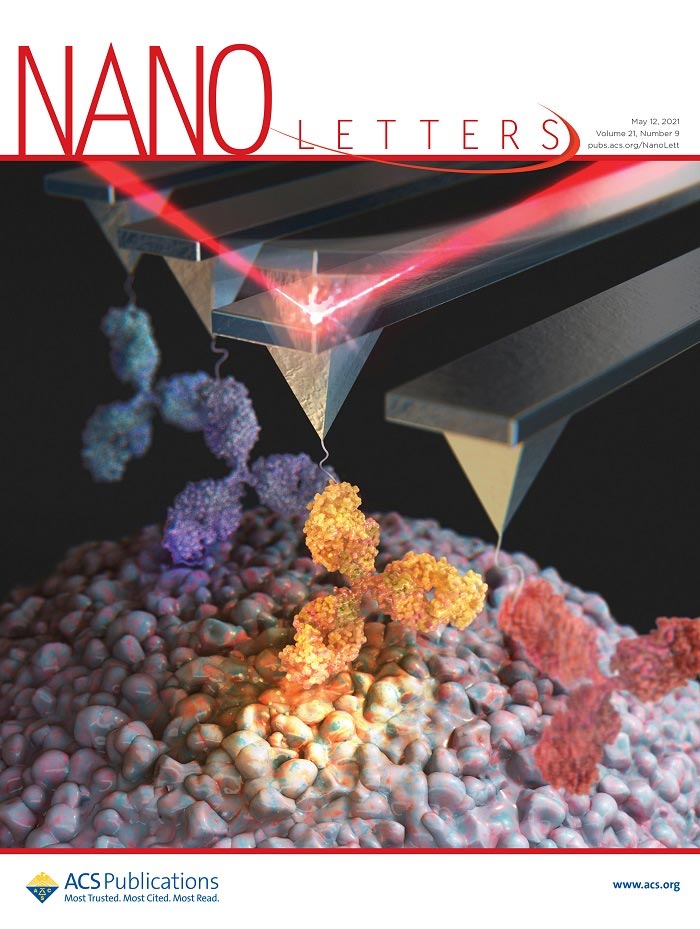
    Nano Letters May 2021
    Front cover of Nano Letters. Credit: POSTECH

    When the research team investigated with four AFM tips immobilized with antibodies that recognize N-terminus or C-terminus of each peptide, it was confirmed that all aggregates were hetero-oligomers. In addition, in the case of hetero-oligomer, it was confirmed that the probability of recognizing the end of the peptide is higher than that of the homo-oligomer.[1]

    This result indicates that the end of each peptide has a bigger tendency to be located on the surface of hetero-oligomers than homo-oligomers, or that the ends of the peptides located on the surface have more degrees of freedom. That is, it can be confirmed that the aggregation between peptides is more loosely packed in the hetero-oligomer than in the homo-oligomer.

    New Analytical Method with Broad Implications

    This study is the first study to observe the structure of protein disordered nano-aggregates, which has never been identified before, using the quadruple mapping with four AFM tips. It serves as experimental grounds to verify the hypothesis of hetero-oligomer aggregation. It can also be used in studies related to the overlapping phenomena of various neurodegenerative diseases other than Alzheimer’s and Parkinson’s.

    “Until now, there was no adequate method to analyze the nano-aggregates, making it impossible to elucidate the structural identity of heterogeneous aggregates,” explained Professor Joon Won Park. “As the analysis method developed in this study is applicable to other amyloid protein aggregates, it will help to identify the cause of diseases such as Alzheimer’s or the mad cow disease.”

    Notes

    1. Protein aggregate derived from a single peptide (amyloid-beta or alpha-synuclein).

    Reference: “Nanoaggregates Derived from Amyloid-beta and Alpha-synuclein Characterized by Sequential Quadruple Force Mapping” by Eun Ji Shin and Joon Won Park, 12 April 2021, Nano Letters.
    DOI: 10.1021/acs.nanolett.1c00058

    This study was conducted with the support from the Mid-career Researcher Program and the Global Ph.D. Fellowship Program of the National Research Foundation of Korea.

    Never miss a breakthrough: Join the SciTechDaily newsletter.
    Follow us on Google and Google News.

    Alzheimer's Disease Biochemistry Biomedical Engineering Biotechnology Nanotechnology Parkinson's Disease Pohang University of Science & Technology Popular
    Share. Facebook Twitter Pinterest LinkedIn Email Reddit

    Related Articles

    Compact Wearable “Lab on the Skin” Continuously Monitors Glucose, Alcohol, and Lactate

    First Nano-Sized Molecular Device Capable of Sensing and Altering Cells’ Bioelectric Fields

    Graphene Binds Drugs That Kill Bacteria on Medical Implants To Prevent Infection

    Incredible Fibers Produced by Engineered Bacteria: Stronger Than Steel, Tougher Than Kevlar

    Revolutionary Self-Aware Materials Build the Foundation for Living Structures

    COVID-19 Coronavirus Breathalyzer Test Developed

    New Nano-Scale Device Can Weigh Individual Molecules

    New Biomimetic Strategy Quickly Dissolves Blood Clots

    “Acoustic Tweezers” Use Sound Waves to Control Items

    1 Comment

    1. Alex on May 31, 2021 9:46 pm

      Hmm. Is this a CAUSE or the EFFECT of another CAUSE? Once upon a time, “prions” were isolated in the brains of Alzheimer’s sufferers. “Surface” dynamics seem to be in play. I’m interested in where this might lead.

      Reply
    Leave A Reply Cancel Reply

    • Facebook
    • Twitter
    • Pinterest
    • YouTube

    Don't Miss a Discovery

    Subscribe for the Latest in Science & Tech!

    Trending News

    These Toads Are Surviving a Deadly Fungus – Scientists May Finally Know Why

    These Brain Cells May Explain Why We Eventually Have To Sleep

    Tomatoes Contain an Invisible Ingredient With Surprising Effects on Liver Health

    World’s First Heat-Powered Cooling System Turns Waste Heat Into Cold

    Antarctica Gained a Record 695 Billion Tons of Ice in Just Two Years

    Don’t Miss: A Brilliant Venus and Glowing Harvest Moon Light Up the Sky

    New Twist on the Einstein Problem Reveals Unexpected Physics

    JWST Captures Stunning Evidence of How Supermassive Black Holes Feed

    Follow SciTechDaily
    • Facebook
    • Twitter
    • YouTube
    • Pinterest
    • Newsletter
    • RSS
    SciTech News
    • Biology News
    • Chemistry News
    • Earth News
    • Health News
    • Physics News
    • Science News
    • Space News
    • Technology News
    Recent Posts
    • Scientists Discover a Hidden Defect That Could Explain Why IBD Keeps Coming Back
    • Millions Take Blood Pressure Drugs, but Many May Be Missing Their Heart-Protective Benefits
    • Could Alien Life Be Conscious in Ways We Can’t Imagine?
    • Scientists Develop a Fruit Wash That Removes Pesticide Residues and Keeps Produce Fresh Longer
    • Scientists May Have Finally Explained Why Astronauts Get Constipated in Space
    Copyright © 1998 - 2026 SciTechDaily. All Rights Reserved.
    • Science News
    • About
    • Contact
    • Editorial Board
    • Privacy Policy
    • Terms of Use

    Type above and press Enter to search. Press Esc to cancel.