
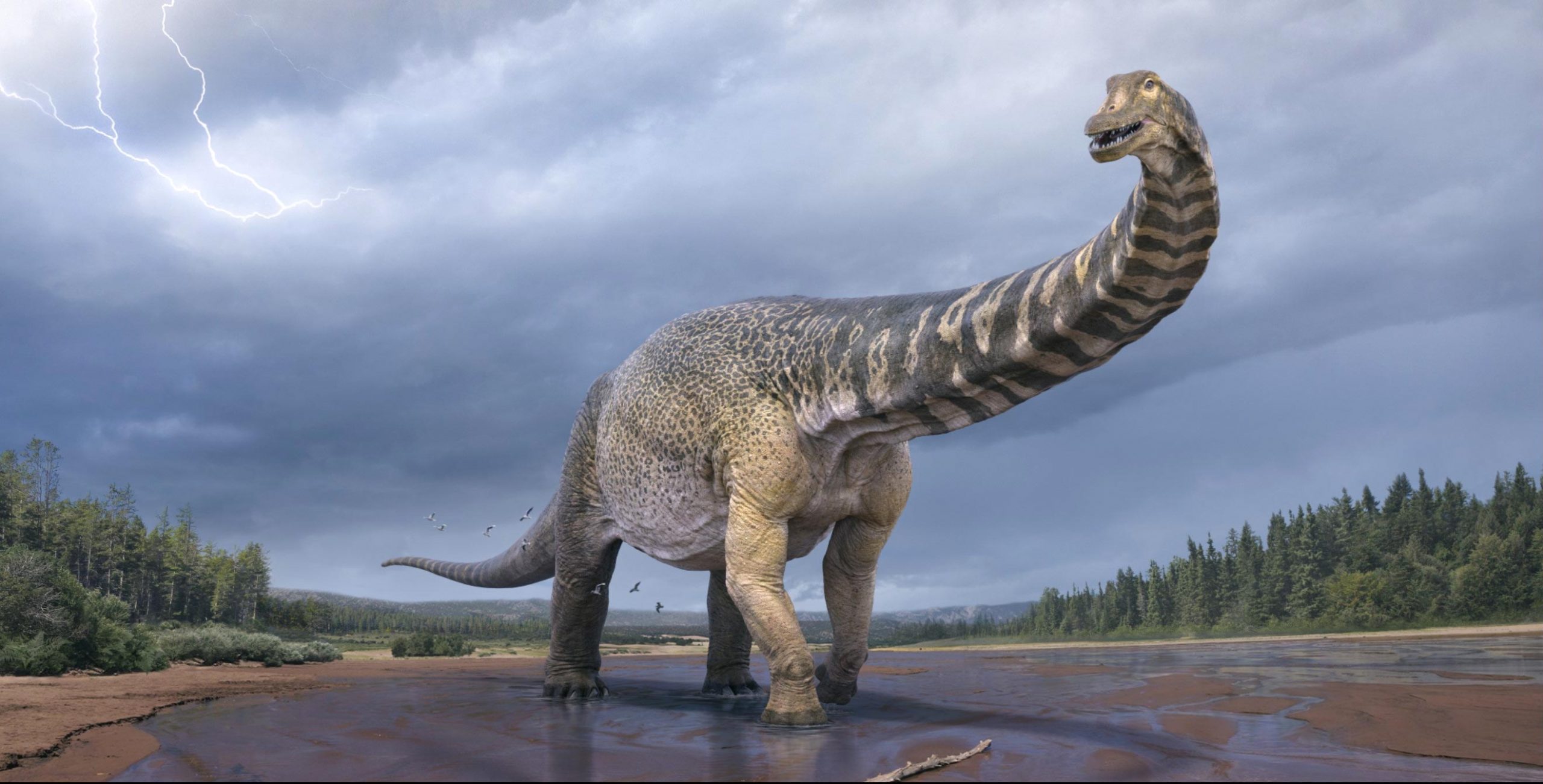
A 30-meter-long sauropod named Australotitan cooperensis is now Australia’s largest dinosaur.
What’s as long as a basketball court, taller than a b-double, and has just stomped into the record books as Australia’s largest dinosaur? It’s time to meet Australotitan cooperensis — a new species of giant sauropod dinosaur from Eromanga, southwest Queensland.
Australotitan, “the southern titan,” has been scientifically described and named by Queensland Museum and Eromanga Natural History Museum paleontologists.
It is estimated to have reached a height of 5-6.5 meters (16-21 feet) at the hip and 25-30 meters (82-98 feet) in length and sits within the top 10-15 largest dinosaurs worldwide, representing Australia’s entry into the largest species to have ever walked the Earth.
The fossilized skeleton was originally nicknamed ‘Cooper’ after Cooper Creek, when first discovered in 2007 by the Eromanga Natural History Museum. It now represents the largest species of dinosaur ever found in Australia.
The scientific publication marks a seventeen-year-long culmination of the joint effort between Queensland Museum and Eromanga Natural History Museum paleontologists, fossil preparators, geologists, and countless volunteers.
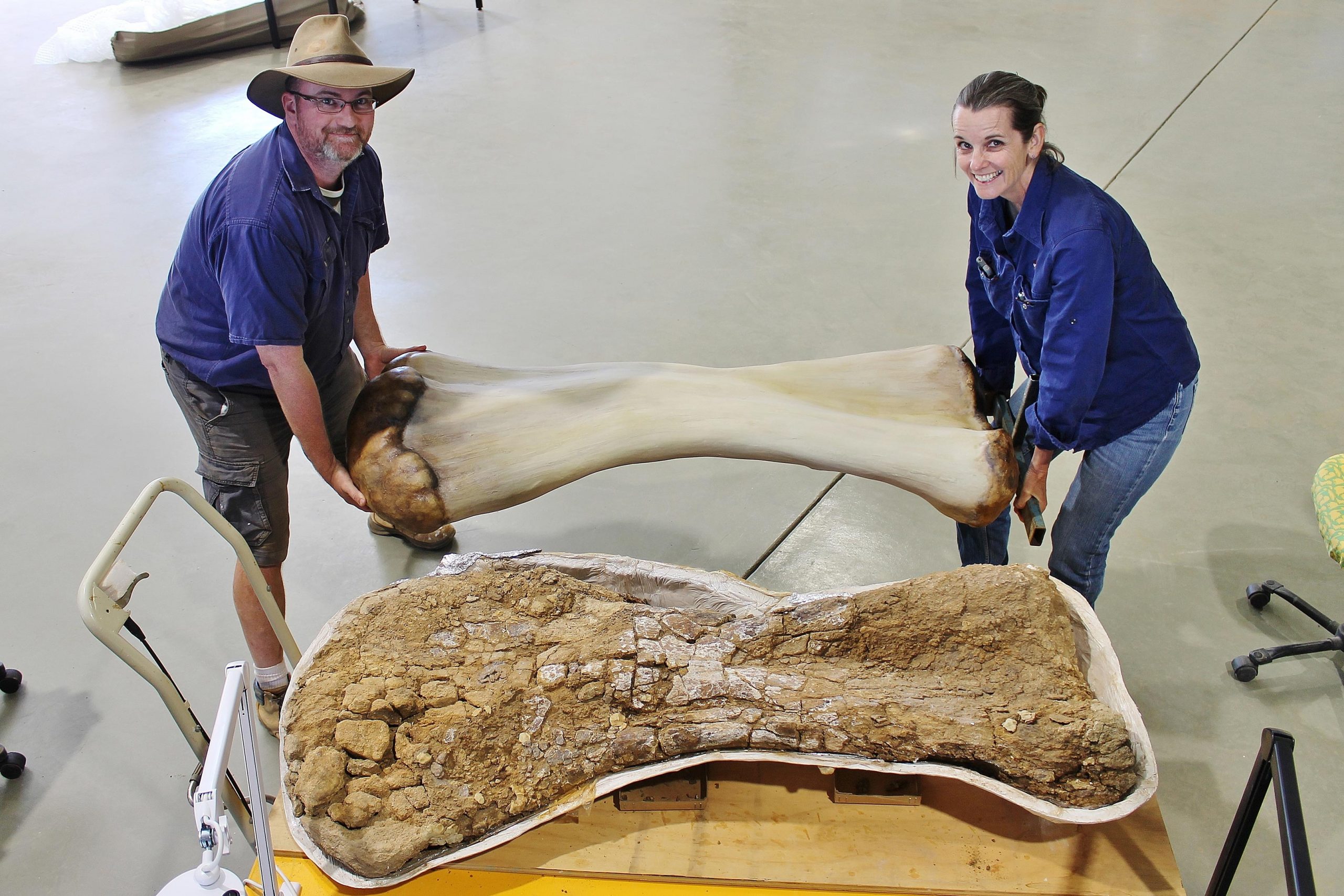
“Australotitan adds to the growing list of uniquely Australian dinosaur species discovered in Outback Queensland, and just as importantly showcases a totally new area for dinosaur discovery in Australia,” Dr Hocknull said.
“To make sure Australotitan was a different species, we needed to compare its bones to the bones of other species from Queensland and globally. This was a very long and painstaking task.”
Digitizing Dinosaurs for Global Science
Dinosaur bones are enormous, heavy, and fragile, and are kept in museums 100s-1000s of kilometers apart, making scientific study very difficult. For the first time, the team used new digital technology to 3-D scan each bone of Australotitan and compare them to the bones of its closest relatives. These scans will form part of the museum’s digital collection that is powered by Project DIG, a partnership between Queensland Museum Network and BHP.
“The 3-D scans we created allowed me to carry around 1000s of kilos dinosaur bones in a 7 kg (15 lb) laptop. Better yet, we can now share these scans and knowledge online with the world,” Dr Hocknull said.
Australia’s Giant Sauropod Family Tree
The study found that Australotitan was closely related to three other Australian sauropods that lived during the Cretaceous Period (92-96 million years ago).
“We compared the three species found to the north, near Winton, to our new Eromanga giant and it looks like Australia’s largest dinosaurs were all part of one big happy family.
“We found that Australotitan was the largest in the family, followed by Wintonotitan with big hips and long legs, whilst the two smaller sauropods, Diamantinasaurus and Savannasaurus were shorter in stature and heavily set.” Dr. Hocknull said along with the description of Australotitan, the study has also revealed a swathe of new discoveries in the area awaiting full scientific study.
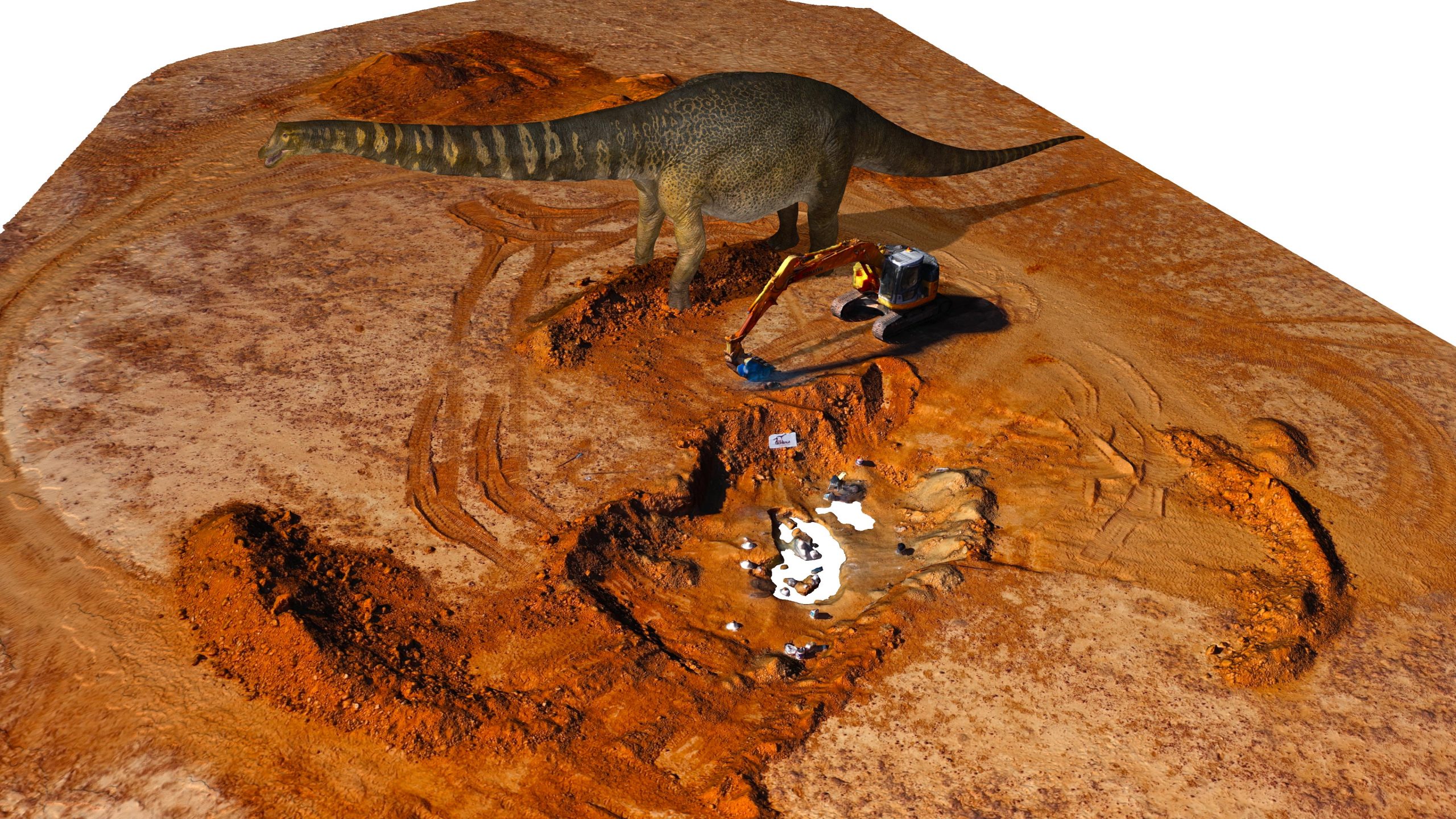
“Over the last 17 years numerous dinosaur, skeletons have been found, including one with an almost complete tail. The discovery of a rock shelf, almost 100 meters (330 feet) long, represents a sauropod pathway, where the dinosaurs walked along trampling mud and bones into the soft ground,” Dr. Hocknull said. “Discoveries like this are just the tip of the iceberg. Our ultimate goal is to find the evidence that tells the changing story of Queensland, hundreds of millions of years in the making. A grand story all scientists, museums, and tourists can get behind.”
Minister for Arts Leeanne Enoch said the exciting new discovery helps to cement Queensland as Australia’s dinosaur capital.
“Discoveries like Australotitan tell the story of a time when dinosaurs roamed Queensland,” Minister Enoch said.
“Queensland Museum experts have been on the ground, sharing their knowledge with regional museums and helping to preserve and better understand the diverse paleontological history of our state.
“These unique outback discoveries are supporting Queensland as we deliver our economic recovery plan creating local jobs in regional and cultural tourism.” Robyn Mackenzie, General Manager of Eromanga Natural History Museum said it’s an exciting culmination of a major amount of work.
“Finding Cooper has changed the course of our lives and led to the establishment of the Eromanga Natural History Museum,” Ms Mackenzie said.
“Working with Queensland Museum to formally describe Cooper has helped put our little town of Eromanga in Quilpie Shire South West Qld on the map. Australotitan is just the start, we have many more discoveries awaiting full scientific study.
From Backyard Bones to World-Class Museum
“It’s amazing to think from the first bones discovered by our son, the first digs with the Queensland Museum, through to the development of a not-for-profit museum that runs annual dinosaur digs, all have helped us to get to this point, it’s a real privilege.”
Queensland Museum Network CEO Dr. Jim Thompson said this represented the first dinosaur discovery in this corner of south-west Queensland.
“In the early 2000s, Australia was at the beginning of a dinosaur rush, with a number of significant new species of dinosaurs and megafauna being discovered in the past 20 years. Australia is one of the last frontiers for dinosaur discovery and Queensland is quickly cementing itself as the paleo-capital of the nation — there is still plenty more to discover,” Dr. Thompson said.
“I am proud that Queensland Museum paleontologists have been part of many of these amazing discoveries and are leaders in their fields.”
The new paper was published recently in PeerJ — the Journal of Life and Environmental Sciences.
For more on this research, read Meet the Massive Australotitan, the “Southern Titan” – Australia’s Largest Dinosaur!
Reference: “A new giant sauropod, Australotitan cooperensis gen. et sp. nov., from the mid-Cretaceous of Australia” by Scott A. Hocknull, Melville Wilkinson, Rochelle A. Lawrence, Vladislav Konstantinov, Stuart Mackenzie and Robyn Mackenzie, 7 June 2021, PeerJ.
DOI: 10.7717/peerj.11317
Never miss a breakthrough: Join the SciTechDaily newsletter.
Follow us on Google and Google News.