
Close Menu
    Facebook X (Twitter) Instagram
    SciTechDaily
    • Biology
    • Chemistry
    • Earth
    • Health
    • Physics
    • Science
    • Space
    • Technology
    Facebook X (Twitter) Pinterest YouTube RSS
    SciTechDaily
    Home»Science»The ‘Firewalkers’ of Karoo: Dinosaurs Left Tracks in a ‘Land of Fire’ 183 Million Years Ago
    Science

    The ‘Firewalkers’ of Karoo: Dinosaurs Left Tracks in a ‘Land of Fire’ 183 Million Years Ago

    By PLOSFebruary 8, 2020No Comments3 Mins Read
    Facebook Twitter Pinterest Telegram LinkedIn WhatsApp Email Reddit
    Share
    Facebook Twitter LinkedIn Pinterest Telegram Email Reddit
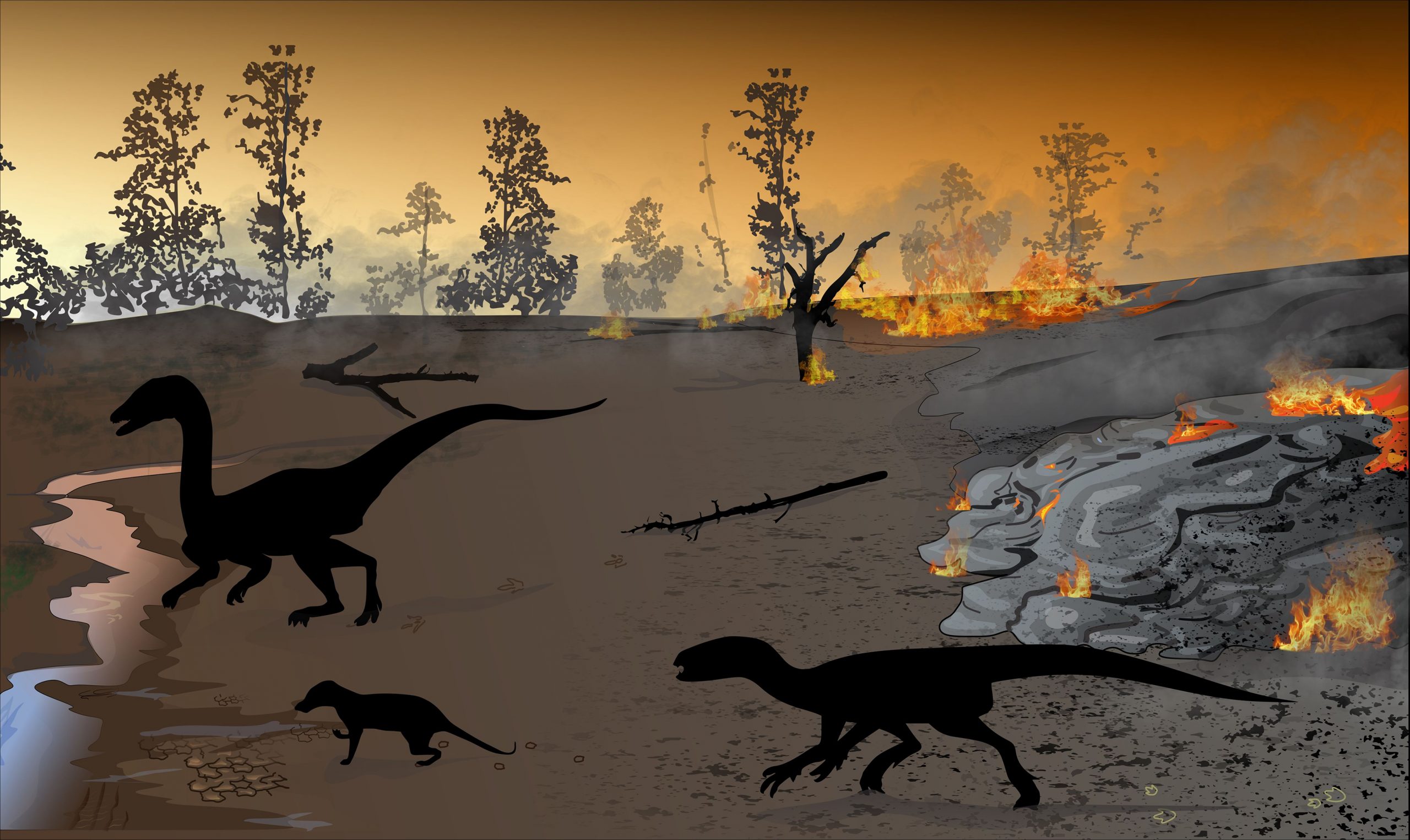
    Firewalkers of Karoo
    Palaeoenvironmental reconstruction of the Highlands ichnosite at the Pliensbachian-Toarcian boundary. Credit: Bordy et al, 2020

    Several groups of reptiles persisted in Jurassic Africa even as volcanism ruined their habitat.

    In southern Africa, dinosaurs and synapsids, a group of animals that includes mammals and their closest fossil relatives, survived in a “land of fire” at the start of the Early Jurassic mass extinction, according to a study published on January 29, 2020, in the open-access journal PLOS ONE by Emese M. Bordy of the University of Cape Town and colleagues.

    The Karoo Basin of southern Africa is well-known for its massive deposits of igneous rocks left behind by extensive basaltic lava flows during the Early Jurassic. At this time, intense volcanic activity is thought to have had dramatic impacts on the local environment and global atmosphere, coincident with a worldwide mass extinction recorded in the fossil record. The fossils of the Karoo Basin thus have a lot to tell about how ecosystems responded to these environmental stresses.

    In this study, Bordy and colleagues describe and identify footprints preserved in a sandstone layer deposited between lava flows, dated to 183 million years ago. In total, they report five trackways containing a total of 25 footprints, representing three types of animals: 1) potentially small synapsids, a group of animals that includes mammals and their forerunners; 2) large, bipedal, likely carnivorous dinosaurs; and 3) small, quadrupedal, likely herbivorous dinosaurs represented by a new ichnospecies (trace fossils like footprints receive their own taxonomic designations, known as ichnospecies).

    These fossils represent some of the very last animals known to have inhabited the main Karoo Basin before it was overwhelmed by lava. Since the sandstone preserving these footprints was deposited between lava flows, this indicates that a variety of animals survived in the area even after the volcanic activity had begun and the region was transformed into a “land of fire.” The authors suggest that further research to uncover more fossils and refine the dating of local rock layers has the potential to provide invaluable data on how local ecosystems responded to intense environmental stress at the onset of a global mass extinction.

    Bordy adds: “The fossil footprints were discovered within a thick pile of ancient basaltic lava flows that are ~183 million years old. The fossil tracks tell a story from our deep past on how continental ecosystems could co-exist with truly giant volcanic events that can only be studied from the geological record, because they do not have modern equivalents, although they can occur in the future of the Earth.”

    Reference: “Tracking the Pliensbachian–Toarcian Karoo firewalkers: Trackways of quadruped and biped dinosaurs and mammaliaforms” by Emese M. Bordy, Akhil Rampersadh, Miengah Abrahams, Martin G. Lockley and Howard V. Head, 29 January 2020, PLOS ONE.
    DOI: 10.1371/journal.pone.0226847

    This work was supported by grants to EMB from the National Research Foundation-DST Centre of Excellence in Palaeosciences [COE PAL grant number COE2019-OP04], National Research Foundation of South Africa [NRF CPRR grant number 113394; NRF AOP grant number 98825], as well as COE PAL bursaries to AR and MA. The funders had no role in study design, data collection and analysis, decision to publish, or preparation of the manuscript.

    The authors have declared that no competing interests exist.

    Never miss a breakthrough: Join the SciTechDaily newsletter.
    Follow us on Google and Google News.

    Archaeology Biodiversity Dinosaurs Paleontology Popular
    Share. Facebook Twitter Pinterest LinkedIn Email Reddit

    Related Articles

    World’s First: Dinosaur Discovered Sitting on Nest of Eggs With Fossilized Babies

    Do Teenage “Tyrants” – Carnivorous Dinosaur Offspring – Explain Lack of Dinosaur Diversity?

    The Original Story of Flight: Pterosaur Precursors Discovered That Fill Gap in Early Evolutionary History

    Paleontologists Surprising Discovery: Fossil Shark Turns Into Mystery Pterosaur

    Complete Brain of One of the Oldest Dinosaurs Reconstructed for the First Time

    Dinosaur Feather Study Debunked: Overwhelming Evidence Supports Jurassic Fossil Belongs to Archaeopteryx

    Researchers Stunned to Discover Ancient Crocodiles That Walked on Two Legs

    Evidence T. Rex’s Long Legs Evolved for Distance, Not Speed Like Previously Thought

    Growing Up Tyrannosaurus Rex: Researchers Learn More About Teen-Age T.Rex

    Leave A Reply Cancel Reply

    • Facebook
    • Twitter
    • Pinterest
    • YouTube

    Don't Miss a Discovery

    Subscribe for the Latest in Science & Tech!

    Trending News

    Millions Take These IBS Drugs, But a New Study Finds Serious Risks

    Scientists Unlock Hidden Secrets of 2,300-Year-Old Mummies Using Cutting-Edge CT Scanner

    Bread Might Be Making You Gain Weight Even Without Eating More Calories

    Scientists Discover Massive Magma Reservoir Beneath Tuscany

    Europe’s Most Active Volcano Just Got Stranger – Here’s Why Scientists Are Rethinking It

    Alzheimer’s Symptoms May Start Outside the Brain, Study Finds

    Millions Take This Popular Supplement – Scientists Discover a Concerning Link to Heart Failure

    The Universe Is Expanding Too Fast and Scientists Can’t Explain Why

    Follow SciTechDaily
    • Facebook
    • Twitter
    • YouTube
    • Pinterest
    • Newsletter
    • RSS
    SciTech News
    • Biology News
    • Chemistry News
    • Earth News
    • Health News
    • Physics News
    • Science News
    • Space News
    • Technology News
    Recent Posts
    • Scientists Say a Hidden Structure May Exist Inside Earth’s Core
    • Doctors Surprised by the Power of a Simple Drug Against Colon Cancer
    • Why Popular Diabetes Drugs Like Ozempic Don’t Work for Everyone: The “Genetic Glitch”
    • Scientists Create Improved Insulin Cells That Reverse Diabetes in Mice
    • Scientists Stunned After Finding Plant Thought Extinct for 60 Years
    Copyright © 1998 - 2026 SciTechDaily. All Rights Reserved.
    • Science News
    • About
    • Contact
    • Editorial Board
    • Privacy Policy
    • Terms of Use

    Type above and press Enter to search. Press Esc to cancel.