

Fossil captures dinosaur parenting, with embryos and stomach stones revealing new behavioral insights.
The fossil in question is that of an oviraptorosaur, a group of bird-like theropod dinosaurs that thrived during the Cretaceous Period, the third and final time period of the Mesozoic Era (commonly known as the ‘Age of Dinosaurs’) that extended from 145 to 66 million years ago. The new specimen was recovered from uppermost Cretaceous-aged rocks, some 70 million years old, in Ganzhou City in southern China’s Jiangxi Province.
“Dinosaurs preserved on their nests are rare, and so are fossil embryos. This is the first time a non-avian dinosaur has been found, sitting on a nest of eggs that preserve embryos, in a single spectacular specimen,” explains Dr. Shundong Bi.
The fossil consists of an incomplete skeleton of a large, presumably adult oviraptorid crouched in a bird-like brooding posture over a clutch of at least 24 eggs. At least seven of these eggs preserve bones or partial skeletons of unhatched oviraptorid embryos inside. The late stage of development of the embryos and the close proximity of the adult to the eggs strongly suggest that the latter died in the act of incubating its nest, like its modern bird cousins, rather than laying its eggs or simply guarding its nest crocodile-style, as has sometimes been proposed for the few other oviraptorid skeletons that have been found atop nests.
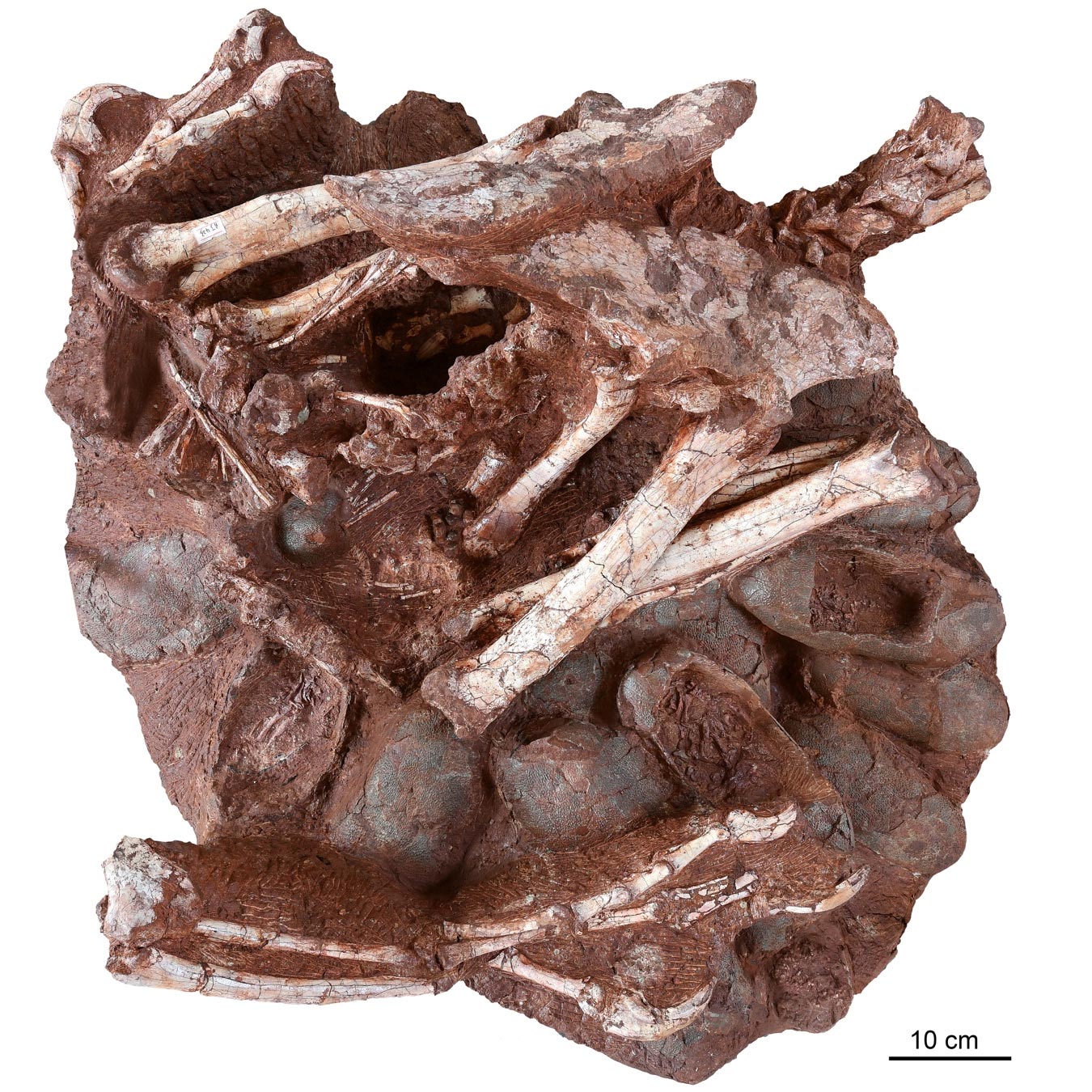
“This kind of discovery, in essence, fossilized behavior, is the rarest of the rare in dinosaurs,” explains Dr. Lamanna. “Though a few adult oviraptorids have been found on nests of their eggs before, no embryos have ever been found inside those eggs. In the new specimen, the babies were almost ready to hatch, which tells us beyond a doubt that this oviraptorid had tended its nest for quite a long time. This dinosaur was a caring parent that ultimately gave its life while nurturing its young.”
Bird-Like Brooding and Asynchronous Hatching
The team also conducted oxygen isotope analyses that indicate that the eggs were incubated at high, bird-like temperatures, adding further support to the hypothesis that the adult perished in the act of brooding its nest. Moreover, although all embryos were well-developed, some appear to have been more mature than others, which in turn suggests that oviraptorid eggs in the same clutch might have hatched at slightly different times. This characteristic, known as asynchronous hatching, appears to have evolved independently in oviraptorids and some modern birds.
One other interesting aspect of the new oviraptorid specimen is that the adult preserves a cluster of pebbles in its abdominal region. These are almost certainly gastroliths, or “stomach stones,” rocks that would have been deliberately swallowed to aid the dinosaur in digesting its food. This is the first time that undoubted gastroliths have been found in an oviraptorid, and as such, these stones may provide new insights into the diets of these animals.
Says Dr. Xu, “It’s extraordinary to think how much biological information is captured in just this single fossil. We’re going to be learning from this specimen for many years to come.”
Reference: “An oviraptorid preserved atop an embryo-bearing egg clutch sheds light on the reproductive biology of non-avialan theropod dinosaurs” by Shundong Bi, Romain Amiot, Claire Peyre de Fabrègues, Michael Pittman, Matthew C. Lamanna, Yilun Yu, Congyu Yu, Tzuruei Yang, Shukang Zhang, Qi Zhao and XingXu, 16 December 2020, Science Bulletin.
DOI: 10.1016/j.scib.2020.12.018
Never miss a breakthrough: Join the SciTechDaily newsletter.
Follow us on Google and Google News.
6 Comments
Did oviraptorid theropod just waited to be fossilized? Something happened suddenly for this dinosaur’s actions to be “memorialized.” Could a tsunami of mud have covered the nesting creature, the instincts of which was to stay with its young? The flood during the days of Noah provides a reasonable explanation for this fossil discovery, as it does for almost all fossilizations.
A tsunami of mud would have swept the nest and occupants away. Other similar nests have been found in the Gobi desert that suggest they were covered by a powerful sand storm.
Noah’s flood happened 70 million years ago? Your theory on that is going to need a little more work…
It seems more likely that the adult was overcome by poison gas from a nearby volcano.
Brooding is not a bird feature Siamese crocodile brooding it’s nest it’s on YouTube bird is not a dinosaur they are not cousin with the gator the gator is true dinosaur the most advance dinosaur ever 6 bone fuse to braincase like mammal even first mesoeucrocodylia spinosauridae did not have that oviraptor and maniraptoran are not thecodont or tetanuran they lack wider skull and lack Cingulum teeth and the most sensoritive face in animal kingdom bird tail is nothing like dinosaur there occified tendon is like mammal the dinosaur occified tendon is like gator dinosaur do not have giant ankle as the tibia bird antitrochanter have no link to dinosaur antitrochanter occified tendon is key bipedal feature gator bipedal is different from birds oviraptor hollow bone on the leg is same place as birds because it’s a bird not a dinosaur whole body of birds is different from dinosaur like muscle attachment the gator is greatest tyrannosaur ever the sagittal crest tyrannosaur group Nile crocodile still has serrated teeth like it’s ancestor baryonyx gator lack serrated teeth
Fabulous discovery. Profoundly dissapointing the scientists involved are still in the hammer and chisle era. Will someone please pass along that this is not the 19th century. We don’t have to break eggs to see what’s inside, anymore.
All these years is still on YouTube the link.rare crocodile egg bbc earth unplugged ep 28 .they cliam modern crocodilian do not have serrated teeth that why use monitor lizard for test there is monitor lizard call crocodile monitor lizard it has strait teeth and serrated teeth like crocodile because eat like crocodile most monitor have very curve teeth probably ziphodont like a land feature most dinosaur had this teeth because most dinosaur are land animal I read snake report they have curve teeth Nile crocodile has fake ziphodont teeth it is not that curve one dwarf caiman it is that curve but it is a gator so lack serrated teeth the early gator type land mesoeucrocodylia has ziphodont teeth the modern type 3 toe claw allso has ziphodont teeth the fossil won.they allways say gator is primitive it’s a sprawler only could do high walk not a bipedal animal like a bird but there is scientific report in 1980,s that say gator is bipedal that why you see those Youtube video of them bipedal because they are a bipedal animal even thou leg muscle is weak because dinosaur is at evolution top modern birds can fly without furcula early gator type land mesoeucrocodylia is much better bipedal even better than dinosaur they have bird feature not found in dinosaur gator bipedal is like human because they have human ankle very rare feature in animal kingdom .gator ankle is dinosaur feature because it show fusion proterosuchus never show fusion no peg ankle ornithosuchus peg is other side that why it is dinosaur it show fusion but it is not in dinosaur group the gator is the gator is tetanuran dinosaur Cingulum lacrimal foramen dinosaur a spinosauridae dinosaur ornithosuchus is much primitive dinosaur .dinosaur ankle all ankle is fuse the 2 ankle bone is fuse then fuse to tibia and fibula a land feature 4 finger dinosaur only one bone fuse mite be fibula or tibia