
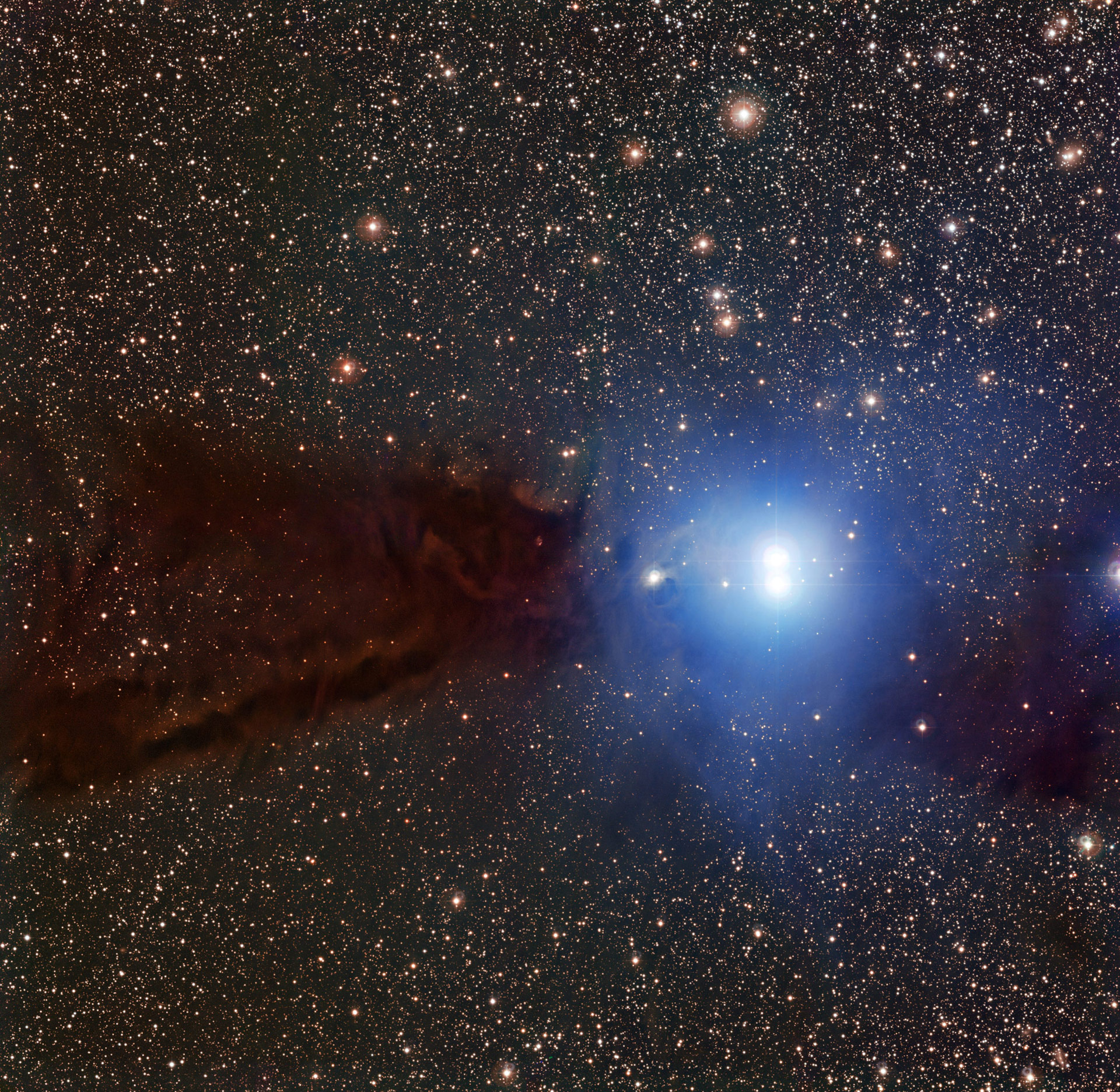
CfA astronomers used the Submillimeter Array to probe the transition disk around Sz 91, finding that it is more like a ring than a disk and that the mass of the disk is about the same as the mass of Jupiter.
A star is typically born with a disk of gas and dust encircling it, the spinning remnant of the much larger cloud of natal material. As the star begins to shine, planets develop from the dust grains in the disk as they stick together and grow. Although the vast majority of very young stars show indirect evidence for such circumstellar disks, in only a few cases have disks been imaged directly or studied in any detail because their sizes in the sky are small (much smaller than the atmospherically blurred sizes of the stars themselves), and in most situations they are fainter than their parent stars. The discovery of ubiquitous planets (“exoplanets”) around other stars lends further credence to the ideas about disks, and adds to the need for an improved understanding of the details of disk formation, structure, and evolution.
Young disks are known to emit at infrared wavelengths because they are warmed by the star to temperatures above the cold, ambient interstellar dust. Astronomers use the particular colors of the star and disk system to characterize the young disk’s properties. After about five million years, however, nearly all stars lack evidence of warm circumstellar dust, suggesting that most disks (or at least around stars roughly the size of the Sun) have disappeared by this time: the disk material has been accreted onto the star or converted into planets or sub-planet-sized bodies, or else dispersed via ultraviolet evaporation or winds. So-called transition disks bridge the gap between the endpoints of disk evolution: They have not yet been disbursed, but although they are present they emit only slightly in the infrared, at characteristically cooler temperatures.
CfA astronomers Sean Andrews and David Wilner, along with a large team of collaborators, have used the Submillimeter Array (SMA) to probe the transition disk around Sz 91, a young star about half the mass of the Sun, located about 600 light-years away. The color of its infrared emission is characteristic of a transition disk, and the scientists wanted to try to use the capabilities of the SMA to obtain an image of the disk that seemed to be nearing the end of its lifetime.
They succeeded. The team has directly imaged the disk, and found that it is more like a ring than a disk, with the dust having an inner radius of 65 AU (astronomical units, the average distance of the Earth from the Sun), and an outer radius is 170 AU; rotating gas is seen out to 420 AU. The mass of the disk is comparatively large, about the same as the mass of Jupiter. They find that the infrared emission also has a hot component, about 180 degrees kelvin, consistent with it coming from a thin ring inside the disk gap and only 2.3 AU from the star, or perhaps from a hot planet inside the gap. The results confirm previous models of the object but extend them, and allow the astronomers to conclude that this star is probably in a stage of nearly completing its planet formation.
Reference: “High-Resolution Submillimeter and Near-Infrared Studies of the Transition Disk Around Sz 91” by Takashi Tsukagoshi, Munetake Momose, Jun Hashimoto, Tomoyuki Kudo, Sean Andrews, Masao Saito, Yoshimi Kitamura, Nagayoshi Ohashi, David Wilner, Ryohei Kawabe, Lyu Abe, Eiji Akiyama, Wolfgang Brandner, Timothy D. Brandt, Joseph Carson, Thayne Currie, Sebastian E. Egner, Miwa Goto, Carol Grady, Olivier Guyon, Yutaka Hayano, Masahiko Hayashi, Saeko Hayashi, Thomas Henning, Klaus W. Hodapp, Miki Ishii, Masanori Iye, Markus Janson, Ryo Kandori, Gillian R. Knapp, Nobuhiko Kusakabe, Masayuki Kuzuhara, Jungmi Kwon, Mike McElwain, Taro Matsuo, Satoshi Mayama, Shoken Miyama, Jun-ichi Morino, Amaya Moro-Martín, Tetsuro Nishimura, Tae-Soo Pyo, Eugene Serabyn, Takuya Suenaga, Hiroshi Suto, Ryuji Suzuki, Yasuhiro Takahashi, Hideki Takami, Michihiro Takami, Naruhisa Takato, Hiroshi Terada, Christian Thalmann, Daigo Tomono, Edwin L. Turner, Tomonori Usuda, Makoto Watanabe, John P. Wisniewski, Toru Yamada and Motohide Tamura, 20 February 2014, The Astrophysical Journal.
DOI: 10.1088/0004-637X/783/2/90
arXiv:1402.1538
Never miss a breakthrough: Join the SciTechDaily newsletter.
Follow us on Google and Google News.