
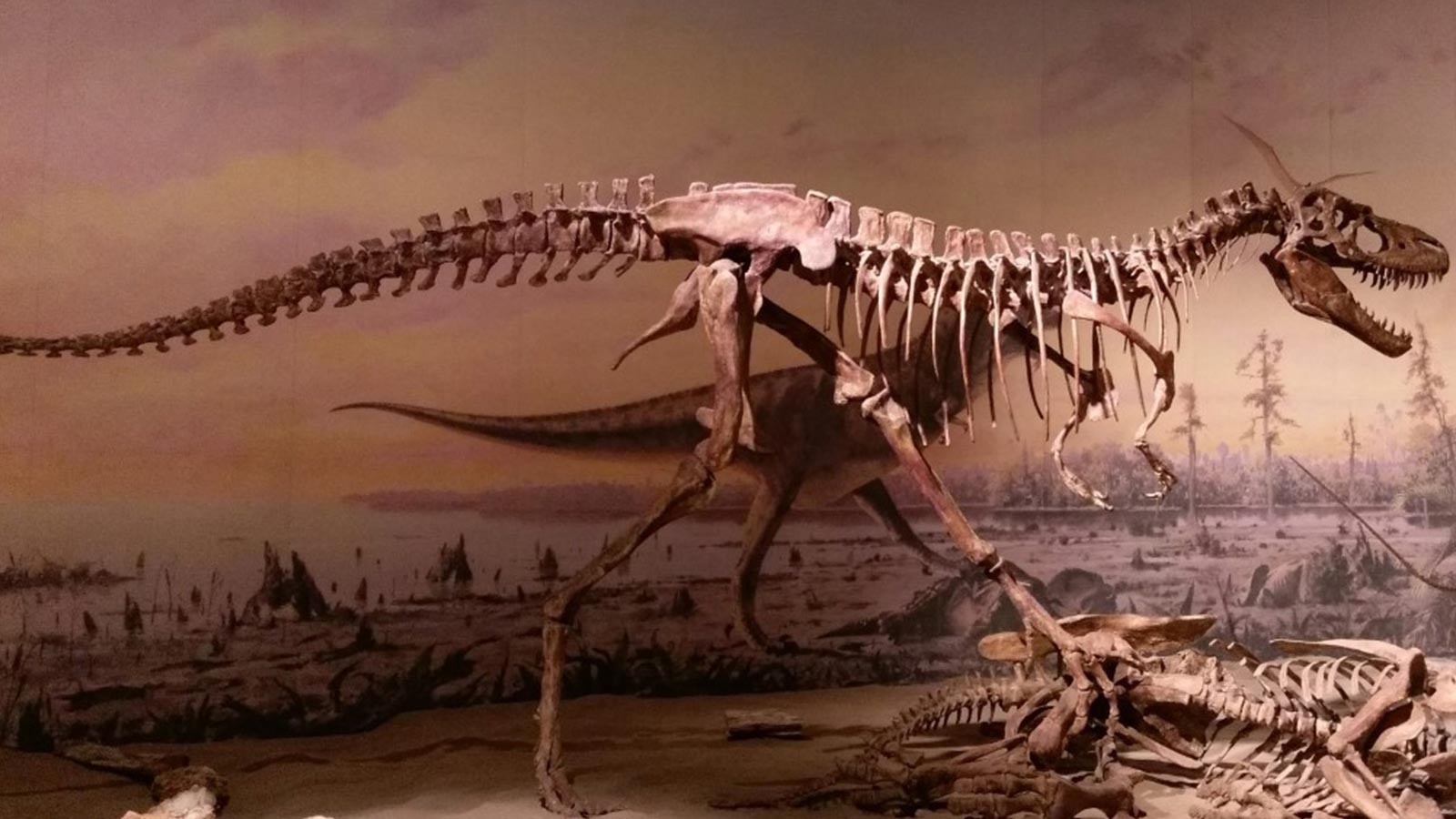
UNM researchers examine how carnivorous dinosaur offspring reduced species diversity.
Paleo-ecologists from The University of New Mexico and at the University of Nebraska-Lincoln have demonstrated that the offspring of enormous carnivorous dinosaurs, such as Tyrannosaurus rex may have fundamentally re-shaped their communities by out-competing smaller rival species.
The study, released this week in the journal Science, is the first to examine community-scale dinosaur diversity while treating juveniles as their own ecological entity.
“Dinosaur communities were like shopping malls on a Saturday afternoon — jam-packed with teenagers” explained Kat Schroeder, a graduate student in the UNM Department of Biology who led the study. “They made up a significant portion of the individuals in a species and would have had a very real impact on the resources available in communities.”
Because they were born from eggs, dinosaurs like T. rex necessarily were born small — about the size of a house cat. This meant as they grew to the size of a city bus, these “megatheropods,” weighing between one and eight tons, would have changed their hunting patterns and prey items. It’s long been suspected by paleontologists that giant carnivorous dinosaurs would change behavior as they grew. But how that might have affected the world around them remained largely unknown.
A Hypothesis of Ecological Role-Shifting
“We wanted to test the idea that dinosaurs might be taking on the role of multiple species as they grew, limiting the number of actual species that could co-exist in a community,” said Schroeder.

The number of different types of dinosaurs known from around the globe is low, particularly among small species.
“Dinosaurs had surprisingly low diversity. Even accounting for fossilization biases, there just really weren’t that many dinosaur species,” said Felisa Smith, professor of Biology at UNM and Schroeder’s graduate advisor.
To approach the question of decreased dinosaur diversity, Schroeder and her coauthors collected data from well-known fossil localities from around the globe, including over 550 dinosaur species. Organizing dinosaurs by mass and diet, they examined the number of small, medium and large dinosaurs in each community.
They found a strikingly clear pattern:
“There is a gap — very few carnivorous dinosaurs between 100-1000kg [200 pounds to one ton] exist in communities that have megatheropods,” Schroeder said. “And the juveniles of those megatheropods fit right into that space.”
Schroeder also notes that looking at dinosaur diversity through time was key. Jurassic communities (200-145 million years ago) had smaller gaps and Cretaceous communities (145-65 million years ago) had large ones.
“Jurassic megatheropods don’t change as much — the teenagers are more like the adults, which leaves more room in the community for multiple families of megatheropods as well as some smaller carnivores,” Schroeder explained. “The Cretaceous, on the other hand, is completely dominated by Tyrannosaurs and Abelisaurs, which change a lot as they grow.”
Reconstructing Ecosystems With Growth Data
To tell whether the gap was really caused by juvenile megatheropods, Schroeder and her colleagues rebuilt communities with the teens taken into account. By combining growth rates from lines found in cross-sections of bones, and the number of infant dinosaurs surviving each year based on fossil mass-death assemblages, the team calculated what proportion of a megatheropod species would have been juveniles.
Schroeder explained that this research is important because it (at least partially) elucidates why dinosaur diversity was lower than expected based on other fossil groups. It also explains why there are many more very large species of dinosaurs than small ones, which is the opposite of what would be expected. But most importantly, she added, it demonstrates the results of growth from very small infants to very large adults on an ecosystem.
“Dinosaurs have been a life-long passion. I was, and still very much am a ‘dinosaur kid.’ My interest in dinosaur diversity came about when I realized that no one was really looking at dinosaurs the way we look at modern mammals and birds,” Schroeder said. “There’s a ton to be gained from applying the methods of modern and paleo-ecology to dinosaurs. Fortunately, we’re now in an age of dinosaur research where a lot of information is available digitally, so the big data-intensive questions of ecology are now becoming more plausible for dinosaur paleontology.”
Reference: “The influence of juvenile dinosaurs on community structure and diversity” by Katlin Schroeder, S. Kathleen Lyons and Felisa A. Smith, 25 February 2021, Science.
DOI: 10.1126/science.abd9220
Never miss a breakthrough: Join the SciTechDaily newsletter.
Follow us on Google and Google News.
1 Comment
As a general rule, the bigger the animal, the longer they live and the lower the reproductive rate. So, one wouldn’t really expect a lot of ‘teenagers!’ Perhaps the intermediate-sized predator dinosaurs were irresistible snacks for the apex adult predators and got devoured and chewed up, lowering the rate of fossilization.
One is confronted with another problem in that there aren’t gaps in the diversity of mammalian predators even though young lions are intermediate in size between adults and other, small predator species. Bobcats live in the same territory as mountain lions, even though their size is similar to young mountain lions.
The absence of intermediate-sized predators would suggest that adults might have been more inclined towards cannibalism when the usual prey species were scarce. While not unheard of today, it is a negative force on survival of the species. Today, large African cats are known to kill competitive predator species, and not always eat them. They are very protective of their hunting territory.
An interesting hypothesis, but I don’t think that this rex will hunt.