
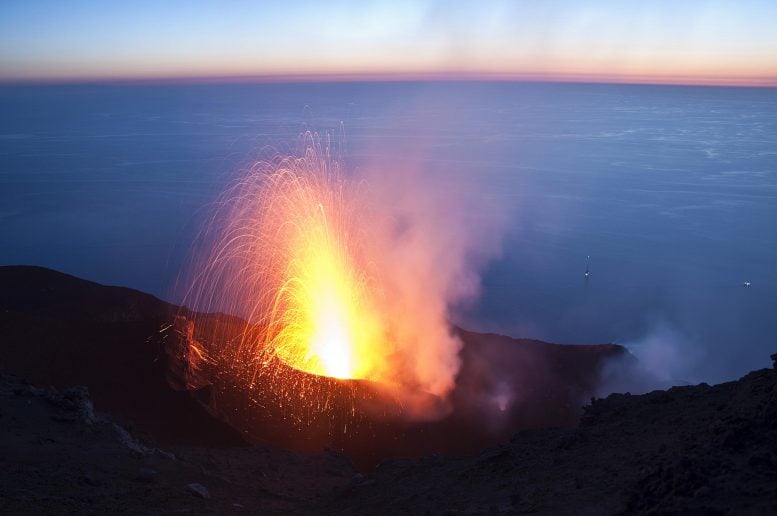
Geologists led by the UNIGE have reviewed the internal and external mechanisms that trigger volcanic eruptions to better anticipate the potential signs of a future eruption.
What causes an eruption? Why do some volcanoes erupt regularly, while others remain dormant for thousands of years?
A team of geologists and geophysicists, led by the University of Geneva (UNIGE), Switzerland, has reviewed the literature on the internal and external mechanisms that lead to a volcanic eruption. Analyzing the thermo-mechanics of deep volcanic processes and magma propagation to the surface, together with magma chemistry, the geologists determined that most of the magma rising from depth actually does not cause a volcanic eruption. They also show that older volcanoes tend to produce less frequent, but larger and more dangerous eruptions.
Their findings, published in Nature Reviews Earth and Environment, will help refine models of volcanic processes to reduce the impact of volcanic eruptions on the more than 800 million people living near active volcanoes.
Volcanic activity remains difficult to predict even when it is closely monitored. Why didn’t Mount Fuji erupt after the strong earthquake in Tohoku, Japan? Why did the eruption of Eyjafjallajökul generate such a large amount of volcanic ash? In order to determine the causes of volcanic eruptions, geologists and geophysicists led by Luca Caricchi, professor at the Department of Earth Sciences of the Faculty of Science of the UNIGE, have taken up the existing literature and analyzed all the stages that precede an eruption.
The Path of Magma From the Depths of the Earth
Magma is molten rock that comes from tens of kilometers deep and rises to the Earth’s surface. “During its journey, magma can get trapped in reservoirs within the Earth’s crust, where it may stagnate for thousands of years and potentially never erupt,” explains Meredith Townsend, a researcher at the Department of Earth Sciences of the University of Oregon (USA).
Specializing in thermomechanical modeling, the American researcher focused on calculating the pressure required for the magma to break up the rocks surrounding the reservoir and rise to the surface. Eleonora Rivalta, a researcher at the Potsdam Research Centre for Geosciences (Germany) and the University of Bologna (Italy), studied the propagation of magma as it rises to the surface: “If it is runny enough, that is if it does not contain too many crystals, magma can rise very quickly by a sort of self-propelled fracking,” she continues. If magma crystallizes more than 50%, it becomes too viscous and its march towards the surface stops. Magma can also take different paths, vertical, horizontal, or inclined. Luca Caricchi specializes in magma chemistry, which provides vital information about the state of the magma before a volcanic eruption occurs.
“The chemistry of magma and the crystals it contains provide vital information on the sequence of events leading to a volcanic eruption, which is valuable to better interpret the monitoring signals of active volcanoes and anticipate- whether an eruption might occur,” explains the Geneva-based researcher. Finally, Atsuko Namiki, a researcher at the Graduate School of Environmental Studies at Nagoya University (Japan), has analyzed the external triggers of an eruption, such as earthquakes, tides or rain: “These alone cannot cause an eruption, the magma has to be ready and awaiting a trigger.”
“For an eruption to take place, several conditions must be met simultaneously. Magma with less than 50% crystals must be stored in a reservoir,” begins Luca Caricchi. Then this reservoir must be overpressurized. The overpressure can be the result of internal phenomena such as a renewed injection of magma or the exsolution of magmatic gases or it can rise to critical values because of external events such as earthquakes. Finally, once the pressure is sufficient for the magma to start rising, there are still many obstacles that can prevent the magma from erupting.
The Age of the Volcano as a Primary Criterion
This comprehensive analysis sheds a light on the behavior of volcanoes that can change over their lifetime. “When a volcano is just starting to be active, its reservoir is rather small (a few km³) and the surrounding crust is relatively cold, which leads to many frequent, but small and rather predictable eruptions,” explains Luca Caricchi.
It’s a different story with old volcanoes. “Their reservoir is bigger and the rocks around them are hotter. When new magma is injected, it does not generate much overpressure because the rocks around the reservoir deform and the growth continues,” says the geologist.
As an example, Mt St Helens (USA) started erupting 40,000 years ago (a time lapse by geological standards) and its last eruption in 2008 was small and not dangerous. On the contrary, Toba (Indonesia) started erupting explosively about 1.2 million years ago and its last eruption 74000 years ago was cataclysmic. It totally destroyed the surroundings and had an impact on the global climate.
Eventually, the accumulation of large amounts of magma will lead to large eruptions. “Moreover, the warning signs are very difficult to detect because the high temperatures decrease seismic activity and the interaction between gases and magma modifies their composition, making it harder to understand what is going on underneath,” he says. The higher the rate of magma input, the faster the volcano ‘ages’.
Knowing the age of the volcano, which can be dated by analyzing the zircon in the rocks, allows geologists to understand the stage of life of the volcanoes. “There are currently 1,500 active volcanoes, and about 50 of them erupt each year. Knowing whether or not to evacuate the population is crucial and we hope that our study will contribute to decrease the impact of volcanic activity on our society,” continues Luca Caricchi. “Hopefully our findings will be tested on volcanoes that have been studied extensively, such as those in Italy, USA, and Japan, and transferred to other volcanoes for which there are less data, such as in Indonesia or South America.”
Reference: “The build-up and triggers of volcanic eruptions” by Luca Caricchi, Meredith Townsend, Eleonora Rivalta and Atsuko Namiki, 22 June 2021, Nature Reviews Earth & Environment.
DOI: 10.1038/s43017-021-00174-8
Never miss a breakthrough: Join the SciTechDaily newsletter.
Follow us on Google and Google News.