
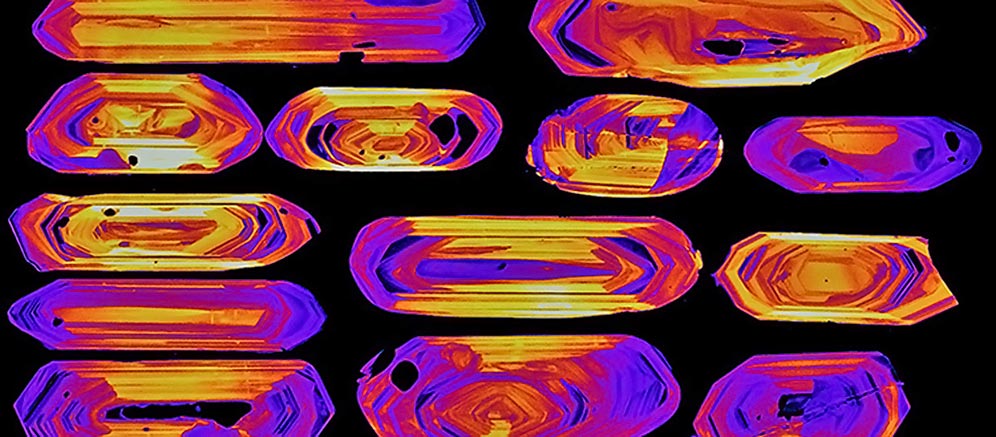
A new method shows that it’s now possible to estimate the volume of magma stored below volcanoes providing essential information about the potential size of future eruptions.
Most active volcanoes on Earth are dormant, meaning that they have not erupted for hundreds or even thousands of years, and are normally not considered hazardous by the local population. A team of volcanologists from the University of Geneva (UNIGE), working in collaboration with the University of Heidelberg in Germany, has devised a technique that can predict the devastating potential of volcanoes.
The scientists used zircon, a tiny crystal contained in volcanic rocks, to estimate the volume of magma that could be erupted once Nevado de Toluca volcano (Mexico) wakes up from its dormancy. Up to 350 km3 (84 mi³) of magma — about four times the volume of water stored in Lake Geneva — are currently lying below Nevado de Toluca and their eruption could bring devastation. The new technique, applicable to most types of volcanoes across the globe, is described in the scientific journal Nature Communications.
The largest volcanic eruptions in the last 100 years were sourced from volcanoes that do not erupt frequently and therefore fly under the “radar” of scientists. Yet today, 800 million people around the world live close to volcanoes and are potentially at risk. A determining factor for the dangerousness of volcanoes is the volume of eruptible magma stored in their bellies, as this is related to the magnitude of future eruptions. Unfortunately, this magma is stored at inaccessible depths of 6-10 km and cannot be directly measured.
Tiny watches with a thermometer
The UNIGE volcanologists used a new approach combining zircon geochronology and thermal modeling to determine the volume of potentially-eruptible magma present in the volcanic reservoirs. “Zircon is a small crystal found in rocks erupted by volcanoes, and it contains uranium and thorium,” begins Gregor Weber, a postdoctoral fellow at UNIGE and co-author of the study. “The decay of these radioactive elements allows us to date when they crystallized. Additionally, zircon crystallizes only in a specific temperature range. With these two parameters, we can determine how fast the magma is cooling below a volcano. Like a pot of water, the larger the pot, the more time it takes to cool it. We analyzed the zircons erupted over the last 1.5 million years by Nevado de Toluca thus determining the evolution of temperature of the magma stored below the volcano over time. This information can be converted into a volume of magma using thermal modeling.” This approach has a resolution two times higher than that of existing techniques.
Sleeping monster
The methodology in the study was applied to the Mexican volcano Nevado de Toluca, also called Xinantécatl, a representative example of a dormant volcano located in the vicinity of Mexico City. The results were used to determine the maximum possible size of a future eruption from this volcano, which with 350 km3 could have potentially devastating effect. “The system can quickly wake up if the deep magma supply starts again,” warns Weber.
Guiding the radars
This finding is essential for assessing volcanic risk quantitatively. “Knowing the size of a volcanic reservoir is important to identify volcanoes that are most likely to produce a large magnitude eruption in the future. Our method is a new way to evaluate the candidates for such eruptions,” explains Weber. This approach is applicable to most types of volcanoes, whether active or dormant, and provides valuable insights into which volcanic systems need to be monitored more closely.
Reference: “Determining the current size and state of subvolcanic magma reservoirs” by Gregor Weber, Luca Caricchi, José L. Arce and Axel K. Schmitt, 5 November 2020, Nature Communications.
DOI: 10.1038/s41467-020-19084-2
Never miss a breakthrough: Join the SciTechDaily newsletter.
Follow us on Google and Google News.