
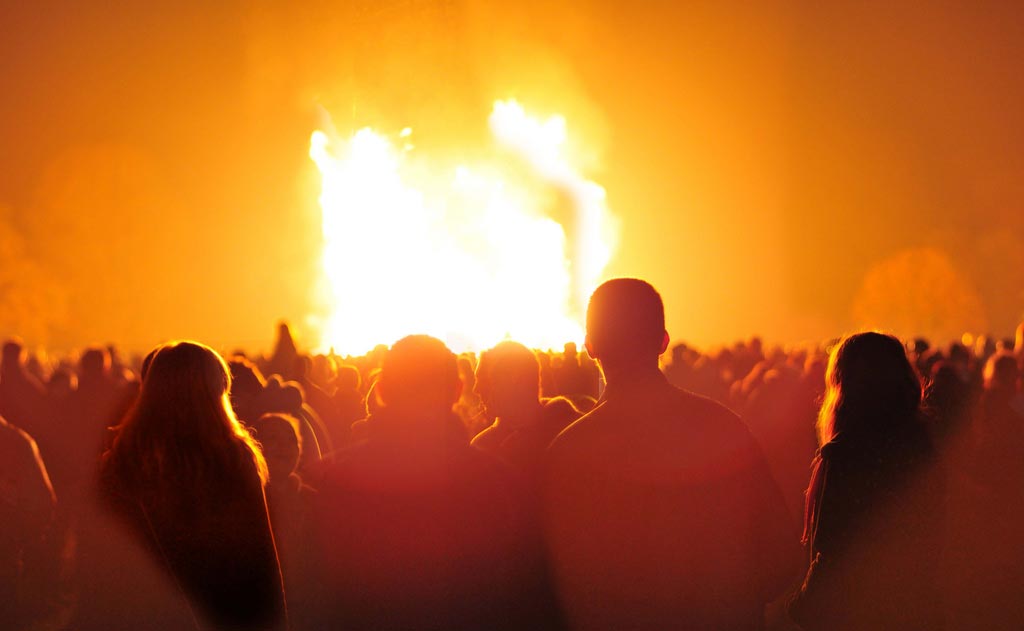
Bonfire Night celebrations contaminate our air with hugely elevated amounts of soot, scientists have found.
Researchers from the University of Leeds were monitoring air quality to determine whether soot created by fires and fireworks, known as black carbon, could help to create ice in clouds.
They found soot in the atmosphere around Guy Fawkes Night events was around 100 times its normal level.
Ice occurs naturally in clouds, but tiny particles of desert dust, soil dust, fungus, and bacteria swept high into the air can cause supercooled water droplets in clouds to freeze around them. High concentrations of these ice-nucleating particles can cause clouds to freeze, potentially impacting the earth’s climate.
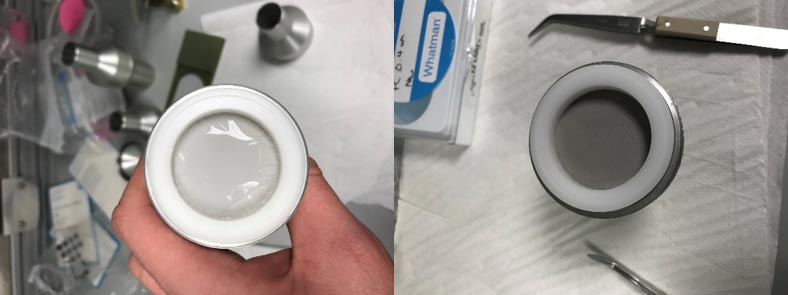
The team carried out experiments on November 5, 2016, into the early hours of the following day, and in 2017 from November 4 and 5, filtering the air with samples taken hourly. Equipment was set up on the balcony of the School of Earth and Environment building, 15m from ground level and more than 0.5 km from any individual bonfires or firework displays, to give a representative view of the air quality across the city.
The filters were washed and the liquid subjected to different temperatures to replicate atmospheric conditions.
The researchers discovered black carbon produced on Bonfire Night did not act as ice nucleating particles — but they did not expect to see such high levels of the polluting matter in the atmosphere.
Black carbon particles are so small, they can penetrate deep into the lungs and cause irritation. Long term exposure can cause harmful effects on the heart and lungs and contributes to millions of deaths worldwide each year.
The paper, A major combustion aerosol event had a negligible impact on the atmospheric ice-nucleating particle population, has been published in Journal of Geophysical Research: Atmospheres today (November 5, 2020).
The research was funded by the European Research Council.
Lead author Michael Adams, Research Fellow in Atmospheric Ice Nucleation, said: “Our measurements showed that whilst pollution emitted on Bonfire Night shouldn’t have any effect on whether clouds are liquid or ice, the elevated concentrations of soot and other pollutants in the atmosphere should be a warning to those with pre-existing health conditions, as the aerosol particles are in the size range where they can enter the lungs and cause problems.”
Research supervisor Benjamin Murray, Professor of Atmospheric Science in Leeds’ School of Earth and Environment, said: “Bonfire Night is a massive pollution event across the UK. People with existing health problems, such as heart and lung conditions, are at increased risk.”
“The impact on clouds and climate was not clear. The good news is that Bonfire Night does not impact the formation of ice in supercooled cloud droplets. But, we know that BC causes climate warming in other ways.
“I was surprised to see levels of black carbon so persistently high for so long on multiple nights. It was striking how poor air quality was on Bonfire Night.”
Weather conditions can affect how long the particles remain in the air. The team found the pollution was flushed out of the city within a few hours during the 2016 experiment, due to a brisk wind from the north.
But in 2017 the air was relatively still and the pollution lingered into the next day.
While providing insight into the levels of black carbon emitted on Bonfire Night, the team’s discoveries have also contributed to the understanding of different sources of ice nucleating particles — a key research area in climate science.
Prof Murray said: “Clouds containing supercooled water and ice are first order importance for climate. Vast cloud systems made of a mixture of ice and water over the world’s oceans buffer the warming effect of CO2.
“But the buffering capacity depends on how much ice is in them, which in turn depends on the concentration and distribution of ice nucleating particles.
“We found that aerosol particles emitted during the celebration are not as effective at nucleating ice as aerosol particle already present in the atmosphere.
“We conclude that aerosol particles emitted from combustion processes such as those observed on Bonfire Night are not an important source of ice nucleating particles.”
Reference: “A major combustion aerosol event had a negligible impact on the atmospheric ice‐nucleating particle population” by M. P. Adams, M. D. Tarn, A. Sanchez‐Marroquin, G. C. E. Porter, D. O’Sullivan, A. D. Harrison, Z. Cui, J. Vergara‐Temprado, F. Carotenuto, M. A. Holden, M. I. Daily, T. F. Whale, S. N. F. Sikora, I. T. Burke, J.‐u. Shim, J. B. McQuaid and B. J. Murray, 5 November 2020, Journal of Geophysical Research: Atmospheres.
DOI: 10.1029/2020JD032938
Never miss a breakthrough: Join the SciTechDaily newsletter.
Follow us on Google and Google News.