
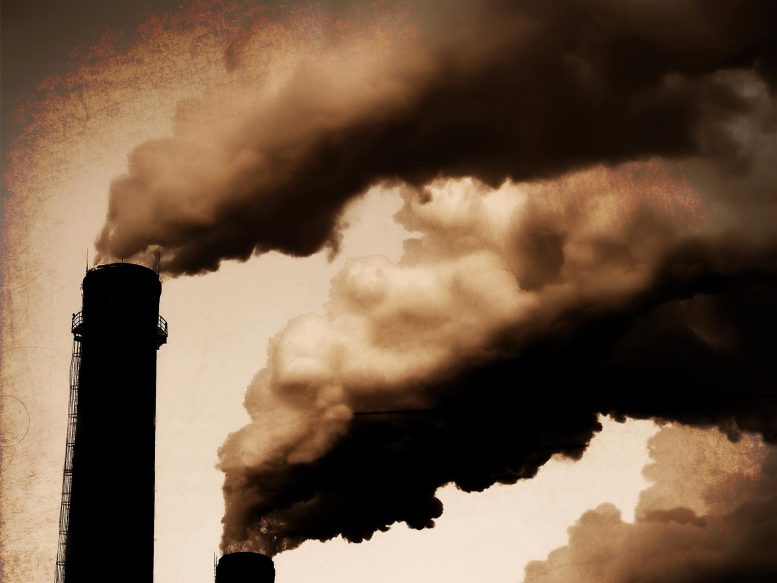
A new comprehensive and quantitative analysis of the role of black carbon, aka soot, in the climate system found that the direct warming effect of black carbon could be about twice that of previous estimates.
Soot is the second largest man-made contributor to global warming and its influence on climate has been greatly underestimated, according to the first comprehensive analysis of the problem.
The landmark study, co-led by the University of Leeds and published in the Journal of Geophysical Research: Atmospheres, says the direct warming effect of black carbon, the term used by scientists to describe soot, could be about twice previous estimates.
Black carbon is believed to have a warming effect of about 1.1 Watts per square meter (W/m2), approximately two-thirds of that of the largest man-made contributor to global warming, carbon dioxide, and greater than that of methane.
The figures indicate that there may be a greater potential to curb warming by reducing soot emissions than previously thought.
Professor Piers Forster from the University of Leeds’ School of Earth and Environment, who co-led the study, said: “There are exciting opportunities to cool climate by cutting soot emissions, but it is not straightforward. Reducing emissions from diesel engines and domestic wood and coal fires is a no-brainer, as there are tandem health and climate benefits.
“If we did everything we could to reduce these emissions, we could buy ourselves up to half a degree less warming—or a couple of decades of respite,” Professor Forster said.
The 232-page report, which took four years to complete, is the first comprehensive and quantitative analysis of the role of black carbon in the climate system. Its best estimate of the direct climate influence from black carbon is about a factor of two higher than most previous work, including the estimates in the last Intergovernmental Panel on Climate Change (IPCC) Assessment in 2007.
Co-lead author David Fahey from the U.S. National Oceanic and Atmospheric Administration (NOAA) said: “This study confirms and goes beyond other research that suggested black carbon has a strong warming effect on climate, just ahead of methane.” Previous studies had also indicated underestimates of some regions’ soot emissions.
Huge quantities of man-made soot enter the atmosphere every year, with about 7.5 million tonnes emitted in 2000 alone. These emissions come from a variety of sources. The largest global cause is the burning of forest and savannah grasslands, but diesel engines account for about 70 percent of emissions from Europe, North America, and Latin America.
Residential fires contribute 60 to 80 percent of Asian and African emissions and coal fires are also a significant source of soot in China, some Eastern European countries and the former USSR.
The small, dark particles that make up black carbon directly heat the atmosphere by absorbing incoming and scattered heat from the sun. They can promote the formation of clouds that can have either cooling or warming impacts. Black carbon can also fall on the surface of snow and ice, promoting warming and increasing melting by reducing light reflection.
Professor Forster said: “Mitigation is a complex issue because soot is typically emitted with other particles and gases that probably cool the climate. For instance, organic matter in the atmosphere produced by open vegetation burning likely has a cooling effect. Therefore the net effect of eliminating that source might not give us the desired cooling.”
There are some targets for reduction that scientists believe will have a clear benefit.
“One great candidate is soot from diesel engines. It may also be possible to look at wood and coal burning in some kinds of industry and in small household burners. In these cases, soot makes up a large fraction of their emissions, so removing these sources would likely cool the climate,” Professor Forster said.
Reducing black carbon emissions has a major advantage: Its effect would be seen almost immediately because black carbon’s influence is a continuous short-term process. While carbon dioxide remains in the atmosphere for relatively long periods, existing soot emissions are washed out of the atmosphere in a few weeks.
However, black carbon reduction could only be part of a solution. Professor Forster said: “Soot mitigation is an immediate effect but helps for a short time only. We will always need to mitigate CO2 to achieve a long-term cooling.”
The report finds black carbon is a significant cause of the rapid warming in the Northern Hemisphere at mid to high latitudes, including the northern United States, Canada, northern Europe, and northern Asia. Its impact can also be felt further south, causing changes in rainfall patterns from the Asian Monsoon. Curbing black carbon emissions could significantly reduce regional climate change, while also having a positive impact on human health.
Co-lead author Dr. Tami Bond, Associate Professor in the Department of Civil and Environmental Engineering at the University of Illinois, said: “Policymakers like the Climate and Clean Air Coalition are talking about ways to slow global warming by reducing black carbon emissions. This study shows that this is a viable option for some black carbon sources and, since black carbon is short-lived, the impacts would be noticed immediately. Mitigating black carbon is good for curbing short-term climate change, but to really solve the long-term climate problem, carbon dioxide emissions must also be reduced.”
The study was commissioned by the International Global Atmospheric Chemistry Project (IGAC), an international organization aimed at fostering cooperation on research into climate change, and involved 31 of the leading international experts on soot emissions.
Reference: “Bounding the role of black carbon in the climate system: A scientific assessment” by T. C. Bond, S. J. Doherty, D. W. Fahey, P. M. Forster, T. Berntsen, B. J. DeAngelo, M. G. Flanner, S. Ghan, B. Kärcher, D. Koch, S. Kinne, Y. Kondo, P. K. Quinn, M. C. Sarofim, M. G. Schultz, M. Schulz, C. Venkataraman, H. Zhang, S. Zhang, N. Bellouin, S. K. Guttikunda, P. K. Hopke, M. Z. Jacobson, J. W. Kaiser, Z. Klimont, U. Lohmann, J. P. Schwarz, D. Shindell, T. Storelvmo, S. G. Warren and C. S. Zender, 15 January 2013, Journal of Geophysical Research: Atmospheres.
DOI: 10.1002/jgrd.50171
Never miss a breakthrough: Join the SciTechDaily newsletter.
Follow us on Google and Google News.
1 Comment
what’s happening, primary blog on oleaginous loss. equivalent helped.