
Close Menu
    Facebook X (Twitter) Instagram
    SciTechDaily
    • Biology
    • Chemistry
    • Earth
    • Health
    • Physics
    • Science
    • Space
    • Technology
    Facebook X (Twitter) Pinterest YouTube RSS
    SciTechDaily
    Home»Technology»New Nano-Scale Device Can Weigh Individual Molecules
    Technology

    New Nano-Scale Device Can Weigh Individual Molecules

    By SciTechDailyAugust 31, 2012No Comments2 Mins Read
    Facebook Twitter Pinterest Telegram LinkedIn WhatsApp Email Reddit
    Share
    Facebook Twitter LinkedIn Pinterest Telegram Email Reddit
    molecular-scale
    Researchers have created a scale that can weigh individual molecules, including nanoparticles and human antibodies, for the first time.

    A gold particle five nanometers in width weighs just a few megadaltons, a tiny unit of measure used in biochemistry that is equivalent to the atomic mass unit. However, researchers at the California Institute of Technology and CEA-Leti, a government-funded research organization in Grenoble, France, have built a scale that weighs single objects, including nano-particles and human antibody molecules. It’s the first device of its kind that can be used to determine the masses of individual molecules.
    nano-scale-device

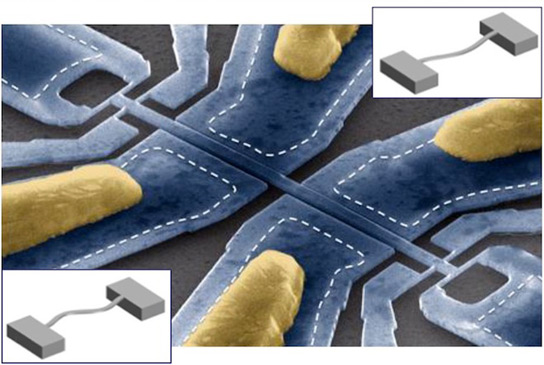
    The scientists published their findings in the journal Nature Nanotechnology. The device is run by a nanoelectromechanical resonator, a tiny beam of silicon vibrating two tones simultaneously. It’s continually being subjected to electrostatic excitation. The beam runs diagonally and measures 10 microns long by 300 nanometers wide. Tiny arms connect the ends of the beam to the rest of the device, where the resonator’s vibrations are converted into an electrical signal using a phenomenon known as the piezoresistive effect. When a single molecule lands on the beam, it shifts the frequency of the two tones downward. This allows researchers to deduce the mass of the particle.

    The sensitivity of the device has allowed scientists to perform mass spectroscopy, which helps identify the various particles in a mixture by their masses, on collections of gold nano-particles.

    Past resonators were only able to measure molecular masses after hundreds of identical molecules had been deposited onto the beam. The new more sensitive device allows researchers to perform mass spectroscopy to identify the various individual particles within a mixed sample.

    Reference: “Single-protein nanomechanical mass spectrometry in real time” by M. S. Hanay, S. Kelber, A. K. Naik, D. Chi, S. Hentz, E. C. Bullard, E. Colinet, L. Duraffourg and M. L. Roukes, 26 August 2012, Nature Nanotechnology.
    DOI: 10.1038/nnano.2012.119

    Never miss a breakthrough: Join the SciTechDaily newsletter.
    Follow us on Google and Google News.

    Biochemistry Nano-scale Nanotechnology Popular
    Share. Facebook Twitter Pinterest LinkedIn Email Reddit

    Related Articles

    DNA Nano Engine: The Revolutionary Power Behind Tomorrow’s Nanomachines

    Structure of a Toxic Matter Identified That Destroys the Nerves in the Brain, Causing Alzheimer’s and Parkinson’s Diseases

    Titanate Nanowire Mask Filter Can Kill Bacteria and Viruses Including SARS-CoV-2/COVID-19

    Double-Walled Silicon Nanotube Battery Shows Promise

    Engineered Nanoparticles Deliver Antibiotics Directly to Bacteria

    Nanotextures Make Anti-Fogging, Self-Cleaning and Glare-Free Glass

    Engineered Coating for Implants Reduces the Risk of Complications

    Bringing Microfluidics to the Marketplace

    High Resolution 3D Printer Prints 5 Meters per Second

    Leave A Reply Cancel Reply

    • Facebook
    • Twitter
    • Pinterest
    • YouTube

    Don't Miss a Discovery

    Subscribe for the Latest in Science & Tech!

    Trending News

    Giant Crocodylians Ruled South America’s Ancient Food Chain

    Breakthrough in a Bizarre Galaxy Could Help Unlock the Mystery of Dark Matter

    Just 4 Minutes of Daily Strength Training Can Quadruple Fitness in Older Adults

    Almost All Plant-Based Meat Alternatives Contain Mycotoxins, Study Finds

    Astronomers Detect a Record-Breaking “Cosmic Laser” From 8 Billion Light-Years Away

    A 47-Year-Old Scientist Tracked Himself for Months – His Biological Age Fell to 32

    Construction Crew Uncovers Giant 20-Meter Dinosaur in Brazil

    30 Years of Hurricane Data Reveal 4 Warning Signs Before Storms Strengthen

    Follow SciTechDaily
    • Facebook
    • Twitter
    • YouTube
    • Pinterest
    • Newsletter
    • RSS
    SciTech News
    • Biology News
    • Chemistry News
    • Earth News
    • Health News
    • Physics News
    • Science News
    • Space News
    • Technology News
    Recent Posts
    • A 20-Year Study Finds Preschool Can Influence Success for Years
    • 55-Million-Year-Old Penguin Fossils Preserve Clues to a Warmer Antarctica
    • A 35,000-Year-Old Neanderthal Pelvis May Explain Why Men and Women Walk Differently
    • Hidden Brain Wiring May Help Preserve Thinking As Gray Matter Shrinks
    • Dual Stem Cell Treatment Restores Vision in First Human Trial
    Copyright © 1998 - 2026 SciTechDaily. All Rights Reserved.
    • Science News
    • About
    • Contact
    • Editorial Board
    • Privacy Policy
    • Terms of Use

    Type above and press Enter to search. Press Esc to cancel.