

Close Menu
    Facebook X (Twitter) Instagram
    SciTechDaily
    • Biology
    • Chemistry
    • Earth
    • Health
    • Physics
    • Science
    • Space
    • Technology
    Facebook X (Twitter) Pinterest YouTube RSS
    SciTechDaily
    Home»Biology»Answers to a Fundamental Puzzle: Why Are Some Fish Warm-Blooded When Most Are Not?
    Biology

    Answers to a Fundamental Puzzle: Why Are Some Fish Warm-Blooded When Most Are Not?

    By Trinity College DublinJuly 11, 2021No Comments4 Mins Read
    Facebook Twitter Pinterest Telegram LinkedIn WhatsApp Email Reddit
    Share
    Facebook Twitter LinkedIn Pinterest Telegram Email Reddit
    Tiger Shark (Galeocerdo cuvier)
    A tiger shark (Galeocerdo cuvier) swimming at the surface with a biologging package attached to dorsal fin. This package records temperature, swimming speed, depth, body movement and video footage. Credit: Diego Camejo (Beneath the Waves)

    Warm-blooded fish swim faster but don’t tolerate wider temperature ranges, making them just as climate-sensitive as other fish.

    New research from marine biologists offers answers to a fundamental puzzle that had until now remained unsolved: why are some fish warm-blooded when most are not?

    It turns out that while (warm-blooded) fish able to regulate their own body temperatures can swim faster, they do not live in waters spanning a broader range of temperatures.

    The research therefore provides some of the first direct evidence as to the evolutionary advantage of being warm-blooded as well as underlining that species in this demographic — such as the infamous white shark and the speedy bluefin tuna — are likely just as vulnerable to changing global ocean temperatures as their cold-blooded relatives.

    Lucy Harding, PhD Candidate in Trinity College Dublin’s School of Natural Sciences, is the first author of the associated research article, which has just been published in the journal, Functional Ecology. She said:

    “Scientists have long known that not all fish are cold-blooded. Some have evolved the ability to warm parts of their bodies so that they can stay warmer than the water around them, but it has remained unclear what advantages this ability provided.

    “Some believed being warm-blooded allowed them to swim faster, as warmer muscles tend to be more powerful, while others believed it allowed them to live in a broader range of temperatures and therefore be more resilient to the effects of ocean warming as a result of climate change.”
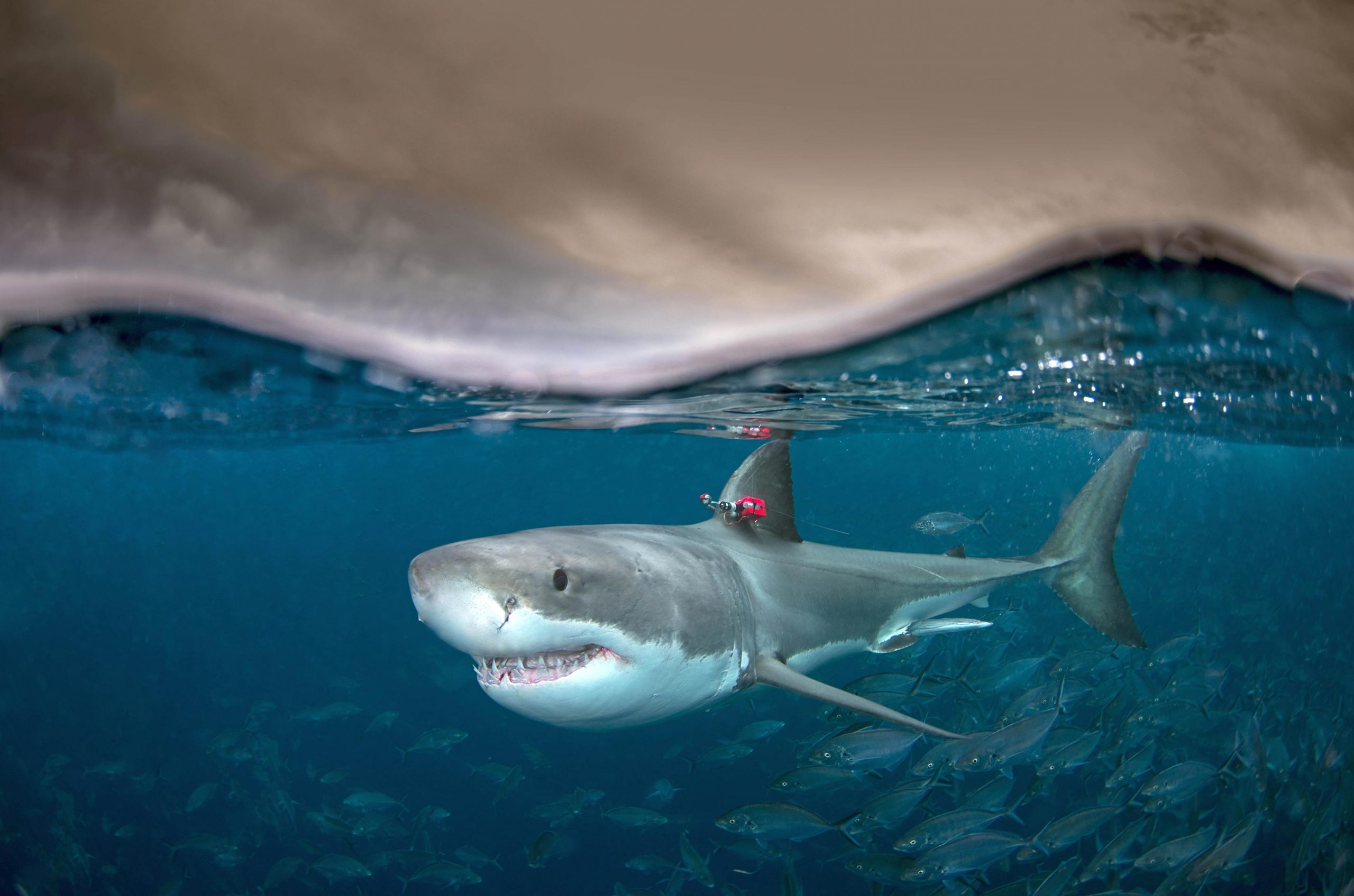
    White Shark (Carcharodon carcharias)
    A white shark (Carcharodon carcharias) swimming at the surface with a biologging package attached to dorsal fin. This package records temperature, swimming speed, depth, body movement and video footage. Credit: Andrew Fox

    Lucy and her international team of collaborators assessed these two possibilities by collecting data from wild sharks and bony fish, as well as using existing databases.

    By attaching biologging devices to the fins of the animals they caught, they were able to collect information such as water temperatures encountered by the fish in their habitats; the speeds at which the fish swam for most of the day; and the depths of water the fish swam in.

    Faster Fish, But Not More Resilient

    The results showed that warm-blooded fishes swim approximately 1.6 times faster than their cold-blooded relatives, but they did not live in broader temperature ranges.

    Nick Payne, Assistant Professor in Zoology in Trinity’s School of Natural Sciences, said:

    “The faster swimming speeds of the warm-blooded fishes likely gives them competitive advantages when it comes to things like predation and migration. With predation in mind, the hunting abilities of the white shark and bluefin tuna help paint a picture of why this ability might offer a competitive advantage.

    “Additionally, and contrary to some previous studies and opinions, our work shows these animals do not live in broader temperature ranges, which implies that they may be equally at risk from the negative impacts of ocean warming. Findings like these — while interesting on their own — are very important as they can aid future conservation efforts for these threatened animals.”

    Reference: “Endothermy makes fishes faster but does not expand their thermal niche” by Lucy Harding, Andrew Jackson, Adam Barnett, Ian Donohue, Lewis Halsey, Charles Huveneers, Carl Meyer, Yannis Papastamatiou, Jayson M. Semmens, Erin Spencer, Yuuki Watanabe and Nicholas Payne, 30 June 2021, Functional Ecology.
    DOI: 10.1111/1365-2435.13869

    The research was supported by Science Foundation Ireland.

    Never miss a breakthrough: Join the SciTechDaily newsletter.
    Follow us on Google and Google News.

    Biodiversity Climate Change Evolution Marine Biology Popular Sharks Trinity College Dublin
    Share. Facebook Twitter Pinterest LinkedIn Email Reddit

    Related Articles

    New Climate Change Research: Future Too Warm for Baby Sharks

    Prehistoric Shark Hid Its Largest, Sharpest Teeth

    The Great Barrier Reef Has Lost Half Its Corals – Massive Declines in Just 3 Decades

    Whale Shark Girls Overtake the Boys to Become World’s Largest Fish

    Unexpected Discovery of a 410-Million-Year-Old Fossil Forces Rethink of Shark Evolution

    Surprises Surfacing in the Atlantic: Species Far From Home Detected by DNA Traces in Seawater

    “Treasure Trove” of New Coral Species Discovered Along the Great Barrier Reef

    Scientists Cracked the Case of Why Octopuses of the Same Species Can Look Totally Different

    Relationships of Male Dolphins from Shark Bay Determined by Slow Swimming

    Leave A Reply Cancel Reply

    • Facebook
    • Twitter
    • Pinterest
    • YouTube

    Don't Miss a Discovery

    Subscribe for the Latest in Science & Tech!

    Trending News

    Scientists Discover How Coffee Impacts Memory, Mood, and Gut Health

    Why Did the Neanderthals Disappear? Scientists Reveal Humans Had a Hidden Advantage

    Physicists Propose Strange Experiment Where Time Goes Quantum

    Magnesium Magic: New Drug Melts Fat Even on a High-Fat, High-Sugar Diet

    Weight-Loss Drugs Like Ozempic May Come With an Unexpected Cost

    Mezcal “Worm” in a Bottle Mystery: DNA Testing Reveals a Surprise

    New Research Reveals That Your Morning Coffee Activates an Ancient Longevity Switch

    This Is What Makes You Irresistible to Mosquitoes

    Follow SciTechDaily
    • Facebook
    • Twitter
    • YouTube
    • Pinterest
    • Newsletter
    • RSS
    SciTech News
    • Biology News
    • Chemistry News
    • Earth News
    • Health News
    • Physics News
    • Science News
    • Space News
    • Technology News
    Recent Posts
    • Scientists Turn Cancer’s Own Bacteria Against It in Breakthrough Therapy
    • Cannabis Can Make You Remember Things That Never Happened
    • Doctors Are Surprised by What This Vaccine Is Doing to the Heart
    • Quantum Breakthrough Turns Simple Forces Into Powerful New Interactions
    • Blue Origin’s New Moon Lander Passes a Crucial Test for NASA Missions
    Copyright © 1998 - 2026 SciTechDaily. All Rights Reserved.
    • Science News
    • About
    • Contact
    • Editorial Board
    • Privacy Policy
    • Terms of Use

    Type above and press Enter to search. Press Esc to cancel.