
Close Menu
    Facebook X (Twitter) Instagram
    SciTechDaily
    • Biology
    • Chemistry
    • Earth
    • Health
    • Physics
    • Science
    • Space
    • Technology
    Facebook X (Twitter) Pinterest YouTube RSS
    SciTechDaily
    Home»Physics»Experimental Confirmation of the Fundamental Principle of Wave-Particle Duality
    Physics

    Experimental Confirmation of the Fundamental Principle of Wave-Particle Duality

    By Institute for Basic ScienceAugust 29, 20218 Comments4 Mins Read
    Facebook Twitter Pinterest Telegram LinkedIn WhatsApp Email Reddit
    Share
    Facebook Twitter LinkedIn Pinterest Telegram Email Reddit
    Particle Wave Physics Concept
    Particle Wave Physics Concept

    Complementarity relation of wave-particle duality is analyzed quantitatively with entangled photons as path detectors.

    The twenty-first century has undoubtedly been the era of quantum science. Quantum mechanics was born in the early twentieth century and has been used to develop unprecedented technologies which include quantum information, quantum communication, quantum metrology, quantum imaging, and quantum sensing. However, in quantum science, there are still unresolved and even inapprehensible issues like wave-particle duality and complementarity, superposition of wave functions, wave function collapse after quantum measurement, wave function entanglement of the composite wave function, etc.

    To test the fundamental principle of wave-particle duality and complementarity quantitatively, a quantum composite system that can be controlled by experimental parameters is needed. So far, there have been several theoretical proposals after Neils Bohr introduced the concept of “complementarity” in 1928, but only a few ideas have been tested experimentally, with them detecting interference patterns with low visibility. Thus, the concept of complementarity and wave-particle duality still remains elusive and has not been fully confirmed experimentally yet.
    Wave-Particle Duality Figure 1
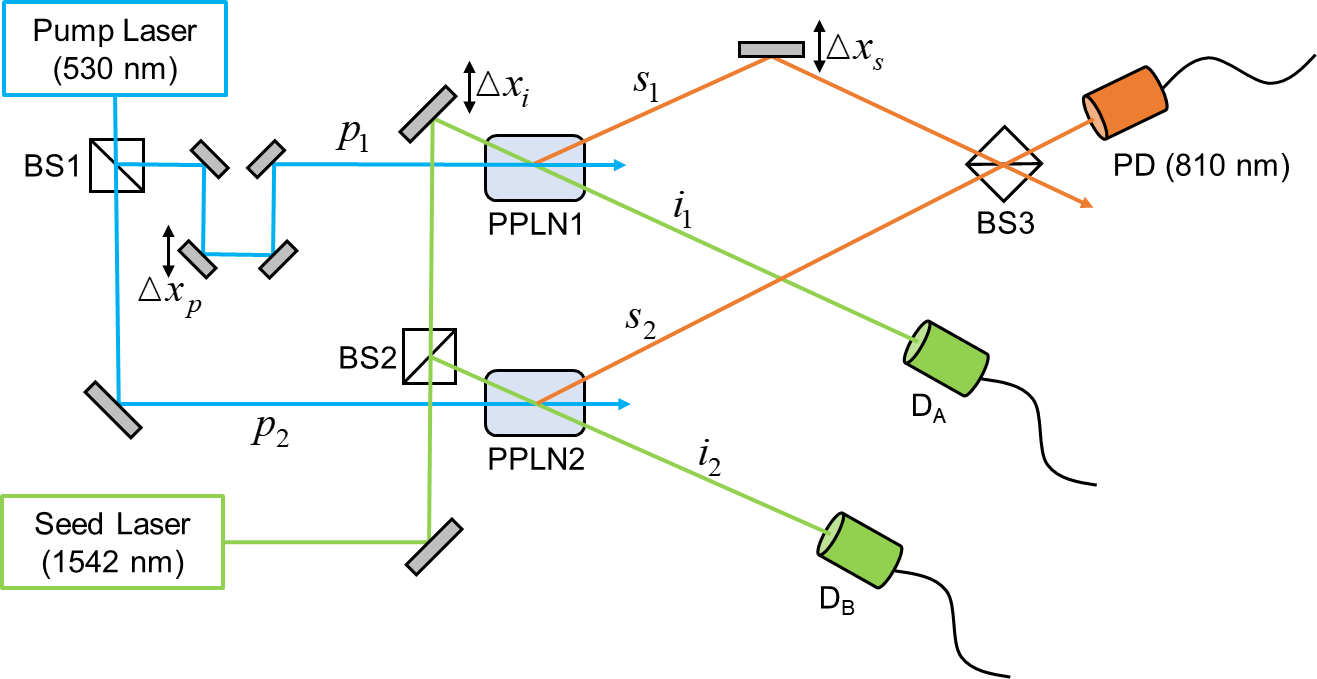
    Figure 1. Double-path single-photon interferometer with controllable source purity used in our ENBS model. Two SPDC crystals, PPLN1 and PPLN2, are pumped and seeded simultaneously by the same pump and seed coherent lasers, respectively, resulting in the emission of two signal photons s1 or s2 for quantum interference detection at PD. Then, conjugate idler photons i1 and i2 provide the which-path (or which-source) information, where the controllable source purity is determined by the overlap between the SPACS of one of the idler modes and the unchanged coherent state of another idler mode. Two idler fields can be detected independently by detectors DA and DB. Credit: Institute for Basic Science

    To address this issue, a research team from the Institute for Basic Science (IBS, South Korea) constructed a double-path interferometer consisting of two parametric downconversion crystals seeded by coherent idler fields, which is shown in Figure1. The device generates coherent signal photons (quantons) that are used for quantum interference measurement. The quantons then travel down two separate paths before reaching the detector. The conjugate idler fields are used for extracting path information with controllable fidelity, which is useful for quantitatively elucidating the complementarity.

    Managing Entanglement to Improve Purity

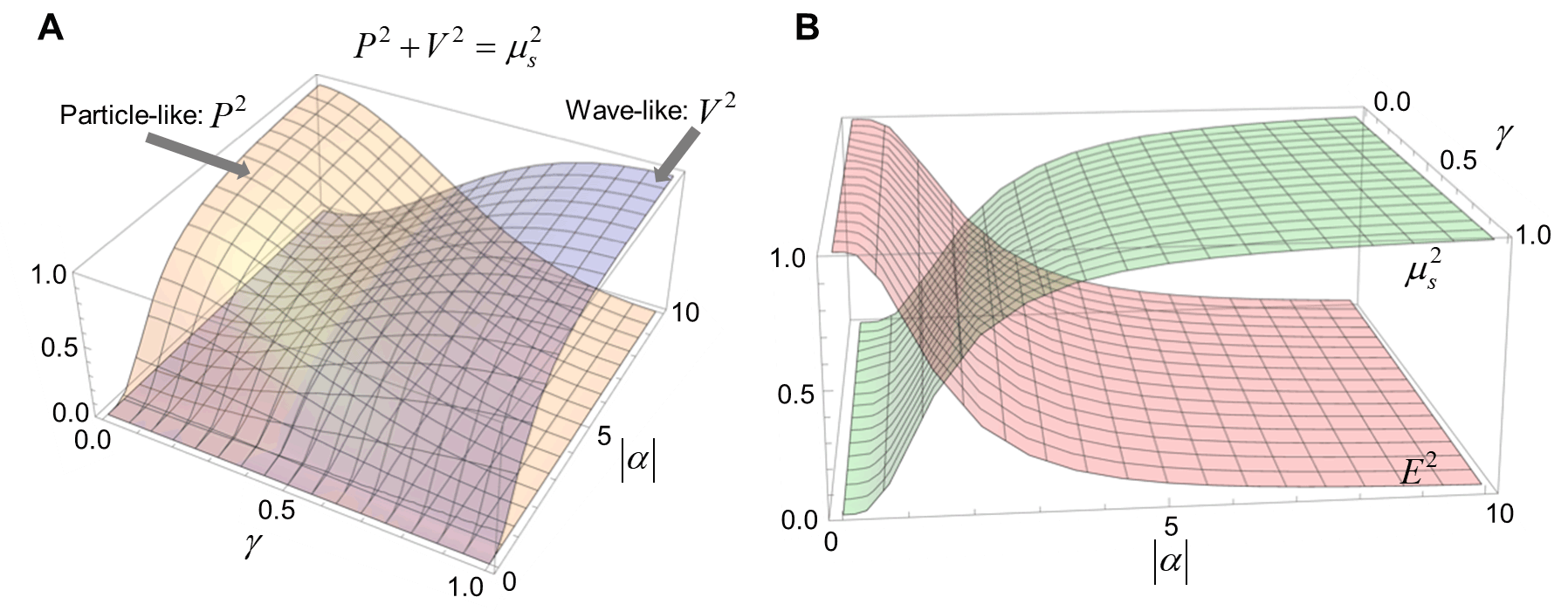
    In a real experiment, the source of quantons is not pure due to its entanglement with the remaining degrees of freedom. However, the quanton source purity is tightly bounded by the entanglement between the generated quantons and all the other remaining degrees of freedom by the relation μs = √(1 – E2), which the researchers confirmed experimentally.
    Wave-Particle Duality Figure 2
    Figure 2. Quantitative complementarity relation of wave-particle duality. (A) Quantitative complementarity relation P2 + V2 = μs2 with respect with respect to γ = ∣α2∣ / ∣α1∣ and ∣α∣ = ∣α2∣. Here, path predictability P represents particle-like behavior, while fringe visibility V represents wave-like behavior of the quanton in the double-path interferometer. The totality of complementarity is bounded by the source purity. (B) Source purity μs of the quanton (signal photon) and entanglement E between the quanton and which-path (which-source) detector form another complementarity relation μs2 + E2 = 1. These two measures are plotted with respect to γ = ∣α2∣ / ∣α1∣ and ∣α∣ = ∣α2∣. Credit: Institute for Basic Science

    The wave-particle duality and the quantitative complementarity P2 + V2 = μs2 (P, a priori predictability; V, visibility) were analyzed and tested using this entangled nonlinear bi-photon source (ENBS) system, where the superposition states of the quantons are quantum mechanically entangled with conjugate idler states in a controllable manner. It was shown that a priori predictability, visibility, entanglement (thus, source purity, and fidelity in our ENBS model) strictly depend on the seed beam photon numbers. This points to the potential application of this approach for the preparation of distant entangled photon states.

    Wave-Particle Duality Figure 3
    Figure 3. Fringe visibility V and a priori visibility V0 as functions of γ = ∣α2∣ / ∣α1∣ and ∣α∣ = ∣α2∣. Blue points are experimental data taken from the team’s recent paper. Experimental data coincide with the visibility V, not a priori visibility V0 across the whole ranges of γ and |α|. This plot validates the team’s analysis of the ENBS experimental results in terms of the wave-particle duality and quantitative complementarity relations. Credit: Institute for Basic Science

    Richard Feynman once stated that solving the puzzle of quantum mechanics lies in the understanding of the double-slit experiment. It is anticipated that the interpretation based on the double-path interferometry experiments with ENBS will have fundamental implications for better understanding the principle of complementarity and the wave-particle duality relation quantitatively.

    Reference: “Quantitative complementarity of wave-particle duality” by Tai Hyun Yoon and Minhaeng Cho, 18 August 2021, Science Advances.
    DOI: 10.1126/sciadv.abi9268

    Never miss a breakthrough: Join the SciTechDaily newsletter.
    Follow us on Google and Google News.

    Institute for Basic Science Particle Physics Photonics Popular Wave Particle Duality
    Share. Facebook Twitter Pinterest LinkedIn Email Reddit

    Related Articles

    Einstein Meets Newton: Scientists Demonstrate New Aspect of Wave-Particle Duality

    Light-Matter Magic Explained: Broken Symmetry Drives Polaritons

    Photonic Hopfions: Light Shaped as a Smoke Ring Behaves Like a Particle

    MIT Physicists Detect Strange Hybrid Particle Held Together by Uniquely Intense “Glue”

    Recycling Lost Energy: Quantum Laser Turns Energy Loss Into Gain?

    First High Sensitivity Dark Matter Axion Hunting Results From CAPP-8TB Haloscope

    Quantum Interference Shown Experimentally in Larger Molecules

    Quantum Entanglement of 8 Photons Successfully Accomplished by Physicists

    Higgs Boson Signals Gain Strength at Large Hadron Collider

    8 Comments

    1. Howard Jeffrey Bender, Ph.D. on August 29, 2021 10:57 am

      It’s refreshing to see experiments focused on the wave-particle duality, although their concerns about entanglement seem to be getting in the way.

      Regarding supersymmetry, one possibility from a view of String Theory is that strings are formed as pairs, one open string matched with one closed string. This may explain some of the curious features we see, such as light being both a particle and a wave. Specifics can be found in the YouTube, Supersymmetry – A String Theory Way at https://www.youtube.com/watch?v=IOndwjeNbjI&t=10s

      Reply
    2. Spyroe on August 29, 2021 6:44 pm

      Spyroe theory claims to solve the wave particle confusion. Double slit paradox solved using spyroe theory.

      Reply
    3. Laszlo on August 29, 2021 8:52 pm

      Quantum theory: quanta exist. Not more, not less. Then, our obsession with waves came about.

      Reply
    4. BibhutibhusanPatel on August 30, 2021 12:27 am

      The Theorem òf Wave Particle duality is Universal.However Ìnverse Square Law and Ĺambert’s Cosine Law are followed for distance and and angle of plane with soùrce that makes at the point of incedence.

      Reply
    5. BibhutibhusanPatel on August 30, 2021 12:36 am

      Wave particle duality holds good and is universal obeying all laws of optiçs or physics.So for distance
      Inverse Square Law is followed forspecified Intensity.

      Reply
    6. Santiago on August 30, 2021 4:17 am

      La mecánica cuántica es la sublimación de la filosofía metafísica e incluso del idealismo alemán anclados a un antropocentrismo arcaico que los hace ser medida de la materia a su imagen y semejanza en sus limitaciones y en la incapacidad de elevar la perspectiva hasta una mentalidad infinita en la que ni las ondas ni las partículas y cualquier tipo de manifestación fenomenológica de la materia, no es otra cosa que, como decía frederick Nietzsche, no pasan de ser interpretaciones que aunque, parezcan muy absolutas, no son más que, insisto, interpretaciones surgidas del mismísimo vientre del ser humano. http://www.rincondelpensadordesanti. de Santi

      Reply
    7. J Scotillo on August 30, 2021 8:16 am

      De Broglie / Bohm pilot wave theory intrigues me more than any other.

      Reply
    8. Koob on August 30, 2021 8:19 pm

      A wave isn’t that something is, a wave is what something does…

      Reply
    Leave A Reply Cancel Reply

    • Facebook
    • Twitter
    • Pinterest
    • YouTube

    Don't Miss a Discovery

    Subscribe for the Latest in Science & Tech!

    Trending News

    The Universe Is Expanding Too Fast and Scientists Can’t Explain Why

    “Like Liquid Metal”: Scientists Create Strange Shape-Shifting Material

    Early Warning Signals of Esophageal Cancer May Be Hiding in Plain Sight

    Common Blood Pressure Drug Shows Surprising Power Against Deadly Antibiotic-Resistant Superbug

    Scientists Uncover Dangerous Connection Between Serotonin and Heart Valve Disease

    Scientists Discover a “Protector” Protein That Could Help Reverse Hair Loss

    Bone-Strengthening Discovery Could Reverse Osteoporosis

    Scientists Uncover Hidden Trigger Behind Stem Cell Aging

    Follow SciTechDaily
    • Facebook
    • Twitter
    • YouTube
    • Pinterest
    • Newsletter
    • RSS
    SciTech News
    • Biology News
    • Chemistry News
    • Earth News
    • Health News
    • Physics News
    • Science News
    • Space News
    • Technology News
    Recent Posts
    • Natural Component From Licorice Shows Promise for Treating Inflammatory Bowel Disease
    • New Research Finds Shocking Link Between Chili Peppers and Cancer
    • Scientists Warn: Popular Sweetener Linked to Dangerous Metabolic Effects
    • The Most Powerful Neutrino Ever Detected May Have a Surprising Cosmic Source
    • Newton’s 300-Year-Old Law Passes Its Biggest Cosmic Test Yet
    Copyright © 1998 - 2026 SciTechDaily. All Rights Reserved.
    • Science News
    • About
    • Contact
    • Editorial Board
    • Privacy Policy
    • Terms of Use

    Type above and press Enter to search. Press Esc to cancel.