
Close Menu
    Facebook X (Twitter) Instagram
    SciTechDaily
    • Biology
    • Chemistry
    • Earth
    • Health
    • Physics
    • Science
    • Space
    • Technology
    Facebook X (Twitter) Pinterest YouTube RSS
    SciTechDaily
    Home»Physics»Recycling Lost Energy: Quantum Laser Turns Energy Loss Into Gain?
    Physics

    Recycling Lost Energy: Quantum Laser Turns Energy Loss Into Gain?

    By The Korea Advanced Institute of Science and Technology (KAIST)July 10, 20213 Comments3 Mins Read
    Facebook Twitter Pinterest Telegram LinkedIn WhatsApp Email Reddit
    Share
    Facebook Twitter LinkedIn Pinterest Telegram Email Reddit
    Exciton-Polaritonic PT Symmetry
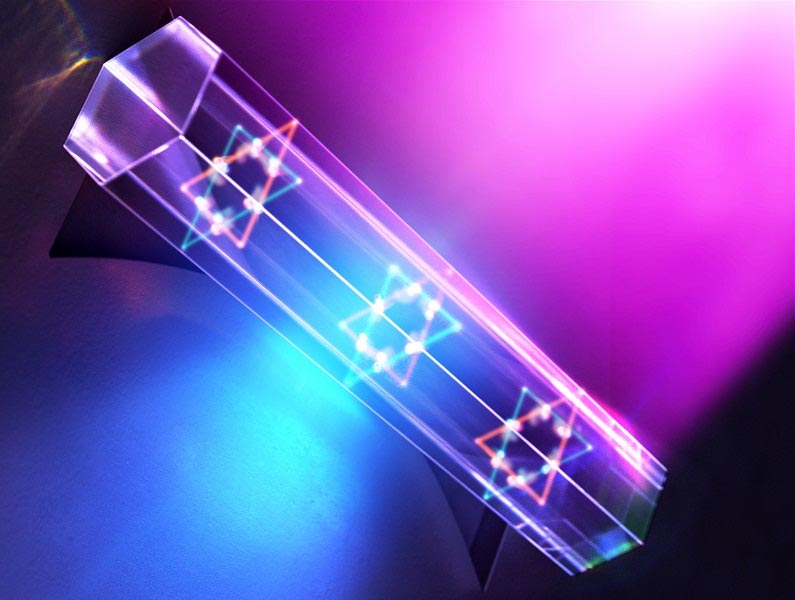
    Exciton-polaritonic PT symmetry: Direct coupling between upward- and downward-polariton modes in a six-fold symmetric microcavity with loss manipulation leads to PT-symmetry breaking with low-threshold phase transition. Credit: KAIST

    A new laser that generates quantum particles can recycle lost energy for highly efficient, low threshold laser applications.

    Scientists at KAIST have fabricated a laser system that generates highly interactive quantum particles at room temperature. Their findings, published in the journal Nature Photonics, could lead to a single microcavity laser system that requires lower threshold energy as its energy loss increases.

    The system, developed by KAIST physicist Yong-Hoon Cho and colleagues, involves shining light through a single hexagonal-shaped microcavity treated with a loss-modulated silicon nitride substrate. The system design leads to the generation of a polariton laser at room temperature, which is exciting because this usually requires cryogenic temperatures.

    The researchers found another unique and counter-intuitive feature of this design. Normally, energy is lost during laser operation. But in this system, as energy loss increased, the amount of energy needed to induce lasing decreased. Exploiting this phenomenon could lead to the development of high-efficiency, low-threshold lasers for future quantum optical devices.

    Harnessing Parity-Time Symmetry for Optical Gains

    “This system applies a concept of quantum physics known as parity-time reversal symmetry,” explains Professor Cho. “This is an important platform that allows energy loss to be used as gain. It can be used to reduce laser threshold energy for classical optical devices and sensors, as well as quantum devices and controlling the direction of light.”

    The key is the design and materials. The hexagonal microcavity divides light particles into two different modes: one that passes through the upward-facing triangle of the hexagon and another that passes through its downward-facing triangle. Both modes of light particles have the same energy and path but don’t interact with each other. 

    However, the light particles do interact with other particles called excitons, provided by the hexagonal microcavity, which is made of semiconductors. This interaction leads to the generation of new quantum particles called polaritons that then interact with each other to generate the polariton laser. By controlling the degree of loss between the microcavity and the semiconductor substrate, an intriguing phenomenon arises, with the threshold energy becoming smaller as energy loss increases.

    Reference: “Room-temperature polaritonic non-Hermitian system with single microcavity” by Hyun Gyu Song, Minho Choi, Kie Young Woo, Chung Hyun Park and Yong-Hoon Cho, 10 June 2021, Nature Photonics.
    DOI: 10.1038/s41566-021-00820-z

    This research was supported by the Samsung Science and Technology Foundation and Korea’s National Research Foundation.

    Never miss a breakthrough: Join the SciTechDaily newsletter.
    Follow us on Google and Google News.

    Energy Korea Advanced Institute of Science and Technology Lasers Particle Physics Photonics Popular Quantum Physics
    Share. Facebook Twitter Pinterest LinkedIn Email Reddit

    Related Articles

    This Simple Laser Trick Could Supercharge Quantum Tech

    Photonic Hopfions: Light Shaped as a Smoke Ring Behaves Like a Particle

    Experiment Using Photons Could Detect Quantum-Scale Black Holes

    Photons Traverse Optical Obstacles as Both a Wave and Particle Simultaneously

    Fastest Laser Blast – 67 Quintillionths of a Second

    Physicists Use Cheap Colliders to Probe for Heavy Photons

    Quantum Interference Shown Experimentally in Larger Molecules

    Evidence of Elusive Majorana Fermions Raises Possibilities for Quantum Computing

    Higgs Boson Signals Gain Strength at Large Hadron Collider

    3 Comments

    1. Clyde Spencer on July 10, 2021 3:48 pm

      Are they suggesting that the infamous Perpetual Motion Machine is theoretically possible? It seems that the Laws of Thermodynamics has something to say about that!

      Reply
    2. William Taylor on September 6, 2024 12:02 am

      Can this device be used to remove thermal energy from a device as light?

      Reply
    Leave A Reply Cancel Reply

    • Facebook
    • Twitter
    • Pinterest
    • YouTube

    Don't Miss a Discovery

    Subscribe for the Latest in Science & Tech!

    Trending News

    What if Time Isn’t Fundamental? Physicists Just Tested the Idea in the Lab

    Scientists Say We’ve Been Wrong About the Aging Brain

    68 Quadrillion Miles: Scientists Map Earth’s Vast Hidden Fungal Network for the First Time

    Hidden Damage From Youth May Explode Into Disease Later in Life

    Climate Models May Be Wrong About How Trees Store Carbon

    Scientists Discover Brain-Protecting Peptide That Could Change Parkinson’s Treatment

    This Copper Drug Clears Alzheimer’s Brain Toxins and Boosts Memory

    Adults Over 65 Lost Massive Amounts of Weight With Ozempic

    Follow SciTechDaily
    • Facebook
    • Twitter
    • YouTube
    • Pinterest
    • Newsletter
    • RSS
    SciTech News
    • Biology News
    • Chemistry News
    • Earth News
    • Health News
    • Physics News
    • Science News
    • Space News
    • Technology News
    Recent Posts
    • Ancient Ice Man Still Hosts Mysterious Cold-Loving Organisms, Study Finds
    • Scientists Discover a Gene That Boosts Youth – but It Comes With a Cost
    • A Decade-Long Physics Mystery May Finally Be Solved
    • AI Cracks the Secrets of How the Universe’s Heaviest Elements Are Forged
    • After 50 Years, Astronomers Finally Found What the Milky Way’s Black Hole Was Hiding
    Copyright © 1998 - 2026 SciTechDaily. All Rights Reserved.
    • Science News
    • About
    • Contact
    • Editorial Board
    • Privacy Policy
    • Terms of Use

    Type above and press Enter to search. Press Esc to cancel.