
Close Menu
    Facebook X (Twitter) Instagram
    SciTechDaily
    • Biology
    • Chemistry
    • Earth
    • Health
    • Physics
    • Science
    • Space
    • Technology
    Facebook X (Twitter) Pinterest YouTube RSS
    SciTechDaily
    Home»Physics»COVID Aerosol Filtration: Nanofiber Face Masks Improve Efficiency, Need Replacing More Often
    Physics

    COVID Aerosol Filtration: Nanofiber Face Masks Improve Efficiency, Need Replacing More Often

    By American Institute of PhysicsSeptember 7, 2021No Comments3 Mins Read
    Facebook Twitter Pinterest Telegram LinkedIn WhatsApp Email Reddit
    Share
    Facebook Twitter LinkedIn Pinterest Telegram Email Reddit
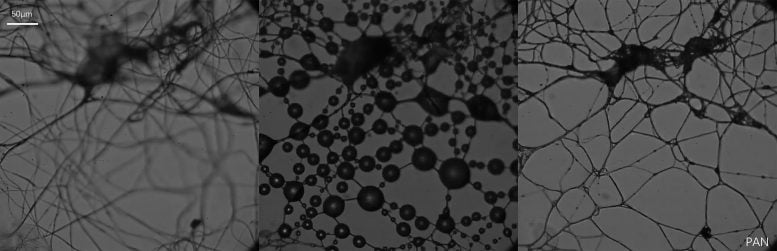
    Polyacrylonitrile Nanofiber Mesh
    Polyacrylonitrile nanofiber mesh before (left), during (middle), and after (right) capturing water aerosols. The mesh becomes coarser as some nanofibers stick together after the captured water droplets are fully evaporated. Credit: Southern University of Science and Technology, Shenzhen, China

    Videos capture nanofiber behavior under water aerosol exposure.

    Since its outbreak, the COVID-19 virus has infected more than 220.9 million people worldwide and has claimed more than 4.5 million lives, according to the World Health Organization coronavirus dashboard as of September 7, 2021.

    However, many medical professionals attribute the consequential role of face masks in slowing the spread of the virus and protecting human health.

    Innovations to improve mask efficacy, with increasing focus on nanofiber manufacturing, have resulted in higher filtration efficiency, greater comfort, and easier breathing capacity. However, the effects of microwater droplets on the integrity of nanofibers are relatively unclear.

    In Physics of Fluids, by AIP Publishing, researchers from Southern University of Science and Technology in Shenzhen, China, examine these ambiguities through a visualization of nanofibers interacting with water aerosol exposure.


    The video shows the polyacrylonitrile (PAN) nanofiber mesh capturing water aerosols. The mesh becomes coarser as some nanofibers stick together after the captured water droplets are fully evaporated. Credit: Southern University of Science and Technology, Shenzhen, China

    “When COVID-19 first hit, face masks were in extremely short supply everywhere, and people came up with all kinds of ways to ‘rejuvenize’ used face masks. It was like a chef’s contest, with boiling, steaming, grilling, and even smoking involved,” said co-author Boyang Yu. “Our intuition told us this can’t be right. We have to look into it and see what exactly happened with the nanofibers.”

    Yu and his colleagues used high-speed microscopic videos to systematically visualize the evolution of nanofibers made of polymers with different contact angles, diameters, and mesh sizes under water aerosol exposure.

    “Filming nanofibers is like taking portraits of babies,” said Yu. “They don’t like to stay in place for the camera. This is because nanofibers are very soft and flimsy, especially with the aerosol flow blowing through. But with enough care, patience, and luck, we eventually got nice shots for our analysis.” 

    The images produced reveal nanofibers coalesce irreversibly during the “droplet capture stage” as well as the subsequent liquid evaporation stage, significantly reducing the effective fiber length for capturing aerosols. They show hydrophobic and orthogonally woven fibers can reduce capillary forces and decrease the fiber coalescing rate.

    “We confirmed three things,” said co-author Weiwei Deng. “One, nanofibers are superb at capturing droplets in aerosol. Two, the nanofibers are bonded together after the aerosol is captured. And three, this bonding is tight and irreversible, even after the captured droplets evaporate.

    Capillary Forces Cause Mesh Collapse in Wet Conditions

    “Wetted fibers tend to bond to each other in the same way that wet hairs tend to bundle together. It is because of the capillary force, which becomes dominant as the size scale shrinks, and it is extremely strong for nanofibers.”

    The study’s findings are expected to help improve design, fabrication, and use of face masks made with nanofibers. They provide direct visual evidence for the need to replace face masks frequently, especially in cold environments.

    “The winter is coming,” said Deng. “When it’s cold outside, your breath contains more droplets that may make the nanofiber mesh collapse more quickly.”

    Reference: “Visualization of the interaction of water aerosol and nanofiber mesh” by Boyang Yu, Jian Chen, Daner Chen, Rouxi Chen, Yuenan Wang, Xiujuan Tang, Hsing-Lin Wang, Lian-Ping Wang and Weiwei Deng, 7 September 2021, Physics of Fluids.
    DOI: 10.1063/5.0061847

    Never miss a breakthrough: Join the SciTechDaily newsletter.
    Follow us on Google and Google News.

    American Institute of Physics COVID-19 Fluid Mechanics Nanomaterials Nanotechnology Public Health
    Share. Facebook Twitter Pinterest LinkedIn Email Reddit

    Related Articles

    Hand-Held Particle Detector Measures Aerosols for Coronavirus Risk Assessment

    Some Masks Can Be Worse Than Not Wearing One at All: Physics of How Masks Affect Airflow and COVID-19 Protection

    New Testing Shows Masks Not Enough to Stop COVID-19’s Spread Without Social Distancing

    Safe Social Distancing Alert: Long Streams of Virus-Laden Droplets Can Trail Behind Infected Individuals

    COVID-19 Pandemic Could Be Stopped if at Least 70% of the Public Wore Face Masks Consistently

    COVID-19 Transmission: Tracking Flight Trajectory of Evaporating Cough Droplets

    COVID-19 Warning: Flushing Public Restroom Toilets Can Spew Clouds of Particles Carrying Viruses

    Droplet Spread From Humans Doesn’t Always Follow Airflow – Important Implications for Spread of COVID-19

    How Face Mask Construction & Materials Matter for Containing Coughing & Sneezing Droplets

    Leave A Reply Cancel Reply

    • Facebook
    • Twitter
    • Pinterest
    • YouTube

    Don't Miss a Discovery

    Subscribe for the Latest in Science & Tech!

    Trending News

    Scientists Discover How Coffee Impacts Memory, Mood, and Gut Health

    Why Did the Neanderthals Disappear? Scientists Reveal Humans Had a Hidden Advantage

    Physicists Propose Strange Experiment Where Time Goes Quantum

    Magnesium Magic: New Drug Melts Fat Even on a High-Fat, High-Sugar Diet

    Weight-Loss Drugs Like Ozempic May Come With an Unexpected Cost

    Mezcal “Worm” in a Bottle Mystery: DNA Testing Reveals a Surprise

    New Research Reveals That Your Morning Coffee Activates an Ancient Longevity Switch

    This Is What Makes You Irresistible to Mosquitoes

    Follow SciTechDaily
    • Facebook
    • Twitter
    • YouTube
    • Pinterest
    • Newsletter
    • RSS
    SciTech News
    • Biology News
    • Chemistry News
    • Earth News
    • Health News
    • Physics News
    • Science News
    • Space News
    • Technology News
    Recent Posts
    • Harvard Scientists Reveal Secret Structure Behind How You Smell
    • Scientists Just Discovered the Hidden Trick That Keeps Your Cells Alive
    • This Simple Movement Could Be Secretly Cleaning Your Brain
    • Male Birth Control Breakthrough: Scientists Find Way To Turn Sperm Production Off and Back On
    • A Common Vitamin Could Hold the Key to Treating Fatty Liver Disease
    Copyright © 1998 - 2026 SciTechDaily. All Rights Reserved.
    • Science News
    • About
    • Contact
    • Editorial Board
    • Privacy Policy
    • Terms of Use

    Type above and press Enter to search. Press Esc to cancel.