
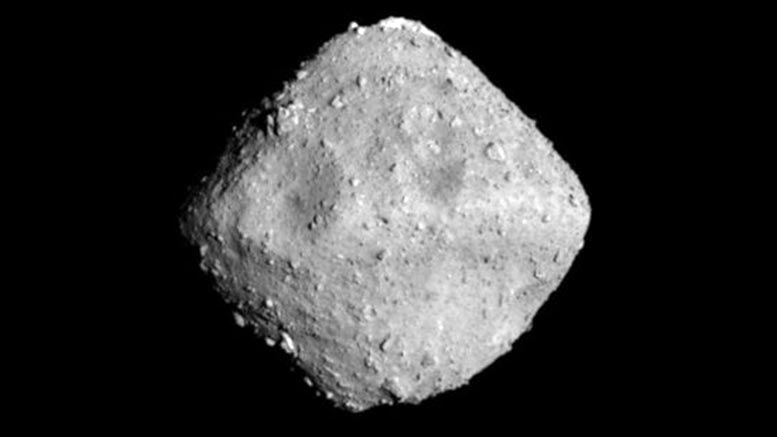
Brown scientists are analyzing a tiny chunk of the asteroid Ryugu in an effort to better understand the early history of the solar system.
In December 2020, Japan’s Hayabusa2 spacecraft swung by Earth to drop off a cache of rock samples taken from a near-Earth asteroid called Ryugu. Asteroids like Ryugu are thought to represent the ancient building blocks of the solar system, and scientists have been eager to get a closer look at the returned samples.
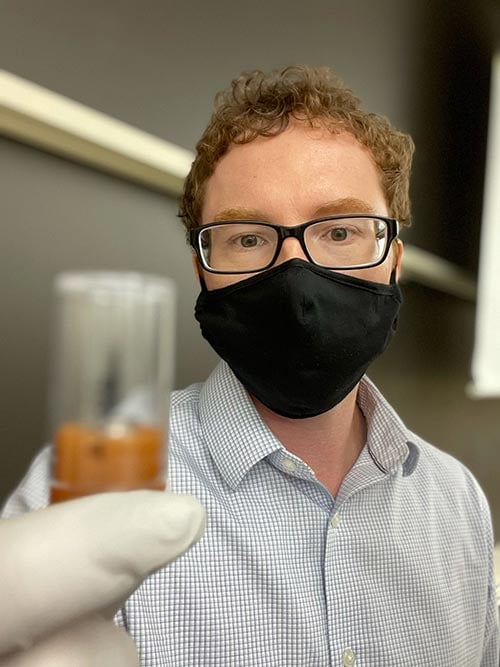
Last week, the Japanese Aerospace Exploration Agency shipped one of the samples — a millimeter-sized fragment from the asteroid’s surface — to the laboratory of Brown University planetary scientist Ralph Milliken for analysis. Milliken’s lab is one of the first in the U.S. to examine a Ryugu sample so far.
Milliken and Takahiro Hiroi, a senior research scientist at Brown, are members of the Hayabusa2 mission’s science team. They’re interested in investigating evidence of water-bearing minerals on the asteroid, and they’ve already published research on the topic based on the spacecraft’s remote sensing equipment. Now that they have a returned sample, Milliken and Hiroi are eager to compare their remote measurements with the close-up observations in the lab.
Milliken discussed the ongoing work in an interview.
Q: Why was Brown selected as one of the labs to analyze a Ryugu sample?
First of all, we’re really excited to be a part of what is an amazing international mission, and it’s a great honor to be able to analyze this sample so early in the process. I think there are a couple of reasons why we were chosen. One is the presence of our colleague, Takahiro Hiroi, who is an expert in working with meteorite samples and asteroid science in general, and he also worked on the first Hayabusa mission. There are other Brown connections on the mission as well, including professor Seiji Sugita at the University of Tokyo, a Brown Ph.D. graduate who is the lead scientist on the spacecraft’s main camera.
Another reason is that Brown operates a NASA facility called RELAB, the Reflectance Experiment Laboratory. RELAB has a long history — going on 30 years now — of working with extraterrestrial samples dating back to the Apollo missions to the Moon, as well as the Soviet Luna missions. So we have a lot of expertise in making high-precision measurements, working with colleagues to interpret those data and then combining those findings with other observations to get a clear understanding of these samples and what they mean for processes happening beyond Earth.
Q: Can you describe the sample itself in a bit more detail?
It’s quite small — only about 1 millimeter by 0.5 millimeters. It comes from Ryugu’s outer surface. The Hayabusa2 spacecraft made two touchdowns on Ryugu. On the first, it touched down on the undisturbed surface and grabbed some of that material. Then for the second touchdown, the spacecraft sampled a location where an artificial impact crater had been made on the surface in the hopes that it would churn up some deeper material. The idea is to compare that surface material with the “fresher” material underneath that has been shielded a bit more from space weathering effects that can modify the uppermost undisturbed surface. The sample we looked at was from the first touchdown on the surface.
Q: What in particular are you looking for in your analysis?
The Hayabusa2 mission has a big science team, and each of those experts has a different question they’re pursuing. Our group is really interested in minerals formed by water and organic compounds. Are they present in these samples, and if so, what is their chemistry and what do they tell us about the role of water in the first few million years of our solar system? Our initial data from the remote sensing instruments on the spacecraft suggested that maybe Ryugu wasn’t quite as water-rich as we expected it might be. One hypothesis is that the original asteroid was altered by water, leading to the formation of water-bearing clay and perhaps other minerals, but at some point the asteroid was then heated up to the point where it partially dehydrated. Now that we have the samples in hand, we can take a closer look and see if that hypothesis was right.
Q: What form does the analysis take?

To start, we’re doing what’s known as near and mid-infrared reflectance spectroscopy, which analyzes the light reflected by the sample at wavelengths longer than what the human eye can see but which tells us about the minerals present. There are similar instruments on the spacecraft that analyzed the asteroid surface on the scale of many meters to centimeters. But in the lab we’re looking at the micrometer scale. So we can look at the individual little grains, the complexities of the minerals and their chemistry, and understand if and how water-bearing minerals are present in the sample. Once we have that detailed information, we can go back and look at our larger-scale spacecraft data and ask: Were the hypotheses we made based on those data correct or do we need to revise our interpretations? Being able to have remotely sensed spacecraft data and then samples in hand to do detailed lab analyses really helps us learn how to bridge those spatial scales.
Q: Why is it important to study asteroids like Ryugu?
We think that asteroids like Ryugu represent the primordial building blocks of the solar system. So by learning more about Ryugu, we might be able to learn more about how the solar system formed and how it evolved to be as it is today.
In addition, both Takahiro and I are co-investigators on NASA’s OSIRIS-REx mission which is currently on its way back to Earth to return samples from the asteroid Bennu and which the spacecraft data have shown is home to water-bearing minerals and organic compounds. We’re looking forward to measuring samples from that mission as well, so this analysis of the Ryugu samples will also help us prepare for those future measurements.
Never miss a breakthrough: Join the SciTechDaily newsletter.
Follow us on Google and Google News.