
Close Menu
    Facebook X (Twitter) Instagram
    SciTechDaily
    • Biology
    • Chemistry
    • Earth
    • Health
    • Physics
    • Science
    • Space
    • Technology
    Facebook X (Twitter) Pinterest YouTube RSS
    SciTechDaily
    Home»Space»Australia-Bound Asteroid Sample From Japan’s Hayabusa2 Mission May Reveal Life’s Origins
    Space

    Australia-Bound Asteroid Sample From Japan’s Hayabusa2 Mission May Reveal Life’s Origins

    By Australian National UniversityDecember 5, 20204 Comments3 Mins Read
    Facebook Twitter Pinterest Telegram LinkedIn WhatsApp Email Reddit
    Share
    Facebook Twitter LinkedIn Pinterest Telegram Email Reddit
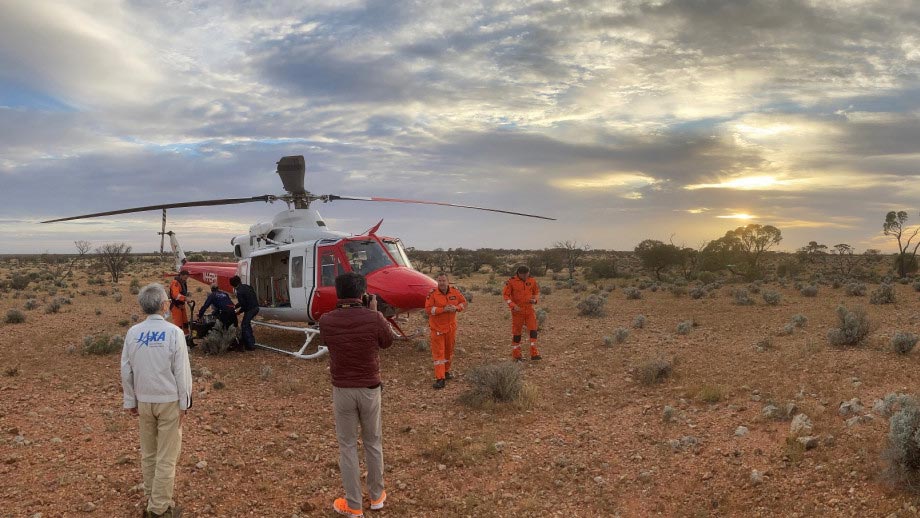
    Hayabusa2 Sample Capsule Collection Rehearsal
    Scientists at Woomera conduct a ‘dress rehearsal’ for finding and collecting the Hayabusa2 sample capsule when it lands. Credit: Trevor Ireland, ANU

    A Japanese space mission will deliver samples collected from asteroid Ryugu in a capsule to the outback desert of Woomera in South Australia this Sunday morning.

    A leading expert from The Australian National University (ANU) who will analyze the samples says they could provide major insights into the origin of life on Earth.

    The subsurface material collected from the asteroid will be dropped off by Hayabusa2. Testing will start almost immediately on the returned material.

    The mission aims to shed light on the nature of asteroids and the origins of planets in our solar system, as well as the origin of Earth’s water, which is vital for all life.

    ANU space rock expert Professor Trevor Ireland, who is on the Hayabusa2 science team, is in Woomera awaiting the arrival of the asteroid sample, which he will analyze in the lab.

    “I anticipate that the Hayabusa2 samples of asteroid Ryugu will be very similar to the meteorite that fell in Australia near Murchison, Victoria, more than 50 years ago,” Professor Ireland, from the ANU Research School of Earth Sciences, said.

    “The Murchison meteorite opened a window on the origin of organics on Earth because these rocks were found to contain simple amino acids as well as abundant water.”

    Professor Ireland said his work would help answer big questions about the diamond-shaped asteroid, which is about one kilometer in diameter and in an orbit that takes it between Earth and Mars.

    “We will examine whether Ryugu is a potential source of organic matter and water on Earth when the solar system was forming and whether these still remain intact on the asteroid,” he said.

    “This C-type asteroid, which is the most common kind, appears to be similar to the Murchison meteorites — rare carbonaceous chondrites packed with organic molecules and water.

    “We might find that missing connection on Ryugu.

    “We will also discover the history of this curious-looking asteroid. The other rubble-pileasteroid Itokawa is quite young. Will Ryugu prove to be a lot older?”

    ANU astronomer Dr. Brad Tucker said technology has enabled space missions to regularly land on objects in space and return back to Earth.

    “With China’s Chang’e 5 mission landing on the Moon and returning in late December, Osiris-Rex and future missions planned, we’ll be able to get our hands dirty and learn a lot about the solar system and our own planet,” Dr. Tucker, from the ANU Research School of Astronomy and Astrophysics, said.

    “Future space travel and exploration missions are going to be needed to be able to extract resources in space. Missions like Hayabusa2 are laying the groundwork for this endeavor.”

    Never miss a breakthrough: Join the SciTechDaily newsletter.
    Follow us on Google and Google News.

    Asteroid Astrobiology Australian National University Hayabusa2 Mission JAXA Popular
    Share. Facebook Twitter Pinterest LinkedIn Email Reddit

    Related Articles

    Rethinking Cosmic Origins: The Ryugu Asteroid Samples’ Revelatory Findings

    Japan’s Martian Moons eXploration Mission Will Return a Sample From Mars’ Moon Phobos

    Next Target Asteroid for Hayabusa2 Photographed by Subaru Telescope

    World’s First Gas Sample From Deep Space Returned With Asteroid Ryugu Material From Hayabusa2

    NASA to Study Ryugu Asteroid Sample Collected by Japan’s Hayabusa2 in New Astromaterials Research Lab

    Solving a Paradox to Uncover Key Clues About Our Solar System’s History

    Asteroid Ryugu Sample Collected in Space and Delivered to Earth – Now NASA Astrobiologists Prepare to Probe It

    Hera Team Congratulates Japan Aerospace Exploration Agency on Hayabusa2’s Asteroid Sample Return

    Japanese Hayabusa2 Spacecraft Reveals More Secrets From Asteroid Ryugu

    4 Comments

    1. Jaime Bento Silva on December 5, 2020 7:01 pm

      Sou admirador dos estudos galáticos, principalmente no tocante asteróide, como surgem, e até sua deterioração, sou leigo mas um grande admirador dos estudos relacionado ao espaço sideral.

      Reply
    2. Bonnie Davis on December 6, 2020 11:25 am

      I am a little surprised that something obtained in such a high tech, high science, high priced fashion would be recovered in such a low tech exercise. It would make a great start to a sci-fi novel. . . the capsule burst open on landing and it indeed contained the seeds of life. And like any transplanted seed without a weed to oppose it. . .it began to grow. As the scientists hunting for it. . .found themselves the hunted. (Cue scary music. . .)

      Reply
      • Ca kjslfd; on December 9, 2020 7:03 am

        I so agree.

        Reply
    3. John on December 6, 2020 4:34 pm

      It may, with equal veracity, indicate the original recipe for brownies. The prominent use of “may” in clickbait headlines is astounding. Congrats to the Japanese for getting there and back successfully, but now research should supplant conjecture. Super inflated expectations almost always result in disappointment which overshadows real lessons.

      Reply
    Leave A Reply Cancel Reply

    • Facebook
    • Twitter
    • Pinterest
    • YouTube

    Don't Miss a Discovery

    Subscribe for the Latest in Science & Tech!

    Trending News

    Millions Take These IBS Drugs, But a New Study Finds Serious Risks

    Scientists Unlock Hidden Secrets of 2,300-Year-Old Mummies Using Cutting-Edge CT Scanner

    Bread Might Be Making You Gain Weight Even Without Eating More Calories

    Scientists Discover Massive Magma Reservoir Beneath Tuscany

    Europe’s Most Active Volcano Just Got Stranger – Here’s Why Scientists Are Rethinking It

    Alzheimer’s Symptoms May Start Outside the Brain, Study Finds

    Millions Take This Popular Supplement – Scientists Discover a Concerning Link to Heart Failure

    The Universe Is Expanding Too Fast and Scientists Can’t Explain Why

    Follow SciTechDaily
    • Facebook
    • Twitter
    • YouTube
    • Pinterest
    • Newsletter
    • RSS
    SciTech News
    • Biology News
    • Chemistry News
    • Earth News
    • Health News
    • Physics News
    • Science News
    • Space News
    • Technology News
    Recent Posts
    • Simple Blood Test May Predict Alzheimer’s Years Before Brain Scans Show Signs
    • Scientists Say Adding This Unusual Seafood to Your Diet Could Reverse Signs of Aging
    • U.S. Waste Holds $5.7 Billion Worth of Crop Nutrients
    • Scientists Say a Hidden Structure May Exist Inside Earth’s Core
    • Doctors Surprised by the Power of a Simple Drug Against Colon Cancer
    Copyright © 1998 - 2026 SciTechDaily. All Rights Reserved.
    • Science News
    • About
    • Contact
    • Editorial Board
    • Privacy Policy
    • Terms of Use

    Type above and press Enter to search. Press Esc to cancel.