
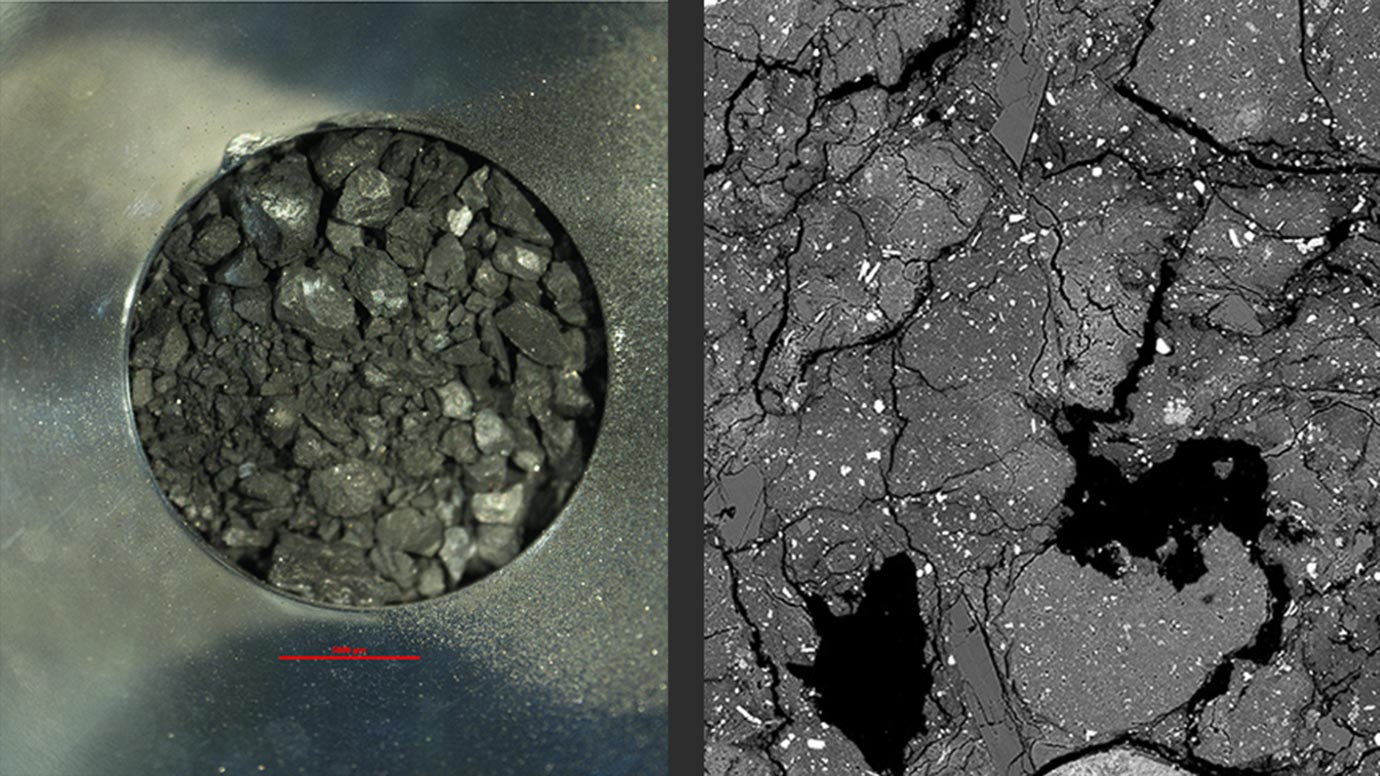
Asteroid Ryugu samples suggest it’s leftover from the formation of the sun billions of years ago.
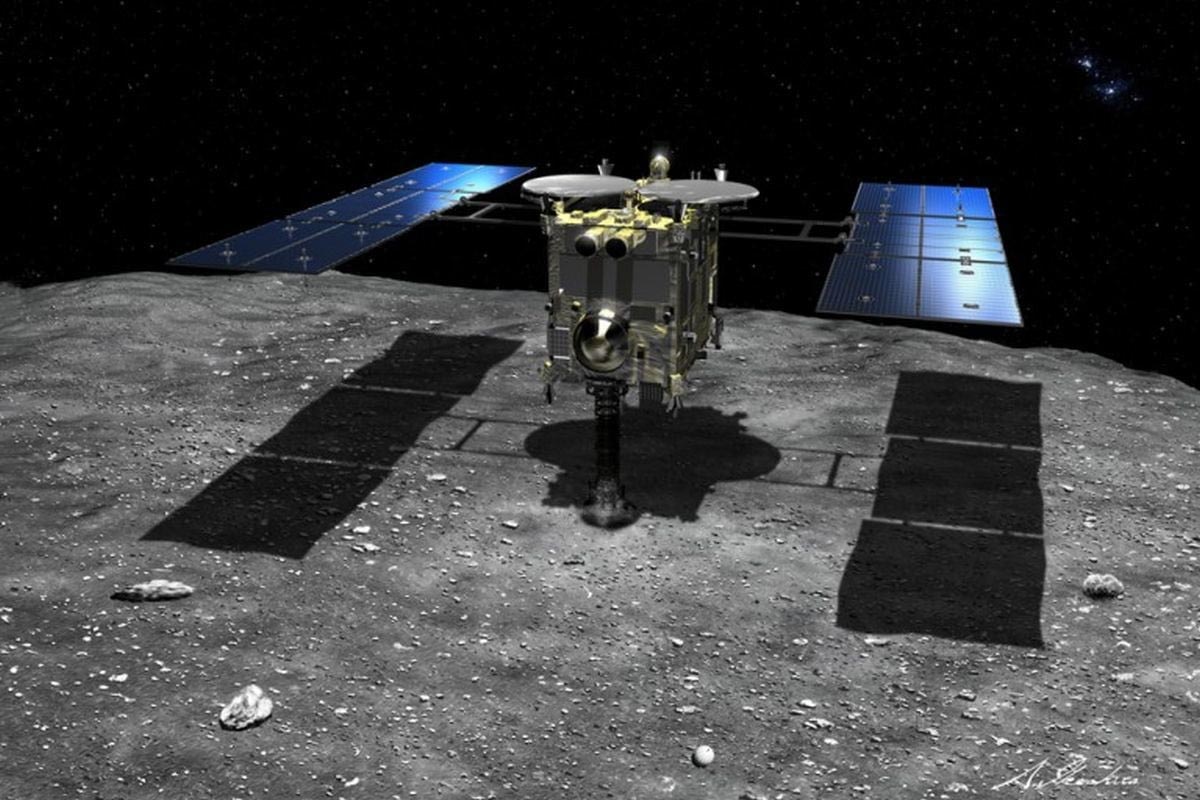
Hayabusa2, an asteroid sample-return mission operated by the Japan Aerospace Exploration Agency (JAXA) launched on December 3, 2014. It reached its target, near-Earth asteroid 162173 Ryugu on June 27, 2018. After a year and a half of surveying the asteroid and collecting samples, it began its return journey to Earth in November 2019.
After Hayabusa2’s six-year journey, the plucky spacecraft zinged back into Earth’s atmosphere in late 2020 and landed deep in the Australian outback. When researchers from the Japanese space agency JAXA opened it, they found its precious payload sealed and intact: a handful of dirt that Hayabusa2 managed to scoop off the surface of a speeding asteroid.
Scientists have now begun to announce the first results from the analysis of this extraordinary sample. What they found suggests that this asteroid is a piece of the same stuff that coalesced into our sun four-and-a-half billion years ago.
“We previously only had a handful of these rocks to study, and all of them were meteorites that fell to Earth and were stored in museums for decades to centuries, which changed their compositions,” said geochemist Nicolas Dauphas, one of the three University of Chicago researchers who worked with a Japan-led international team of scientists to analyze the fragments. “Having pristine samples from outer space is simply incredible. They are witnesses from parts of the solar system that we have not otherwise explored.”
‘It’s spectacular’
In 2018, Hayabusa2 landed atop a moving asteroid named Ryugu and collected particles from above and below its surface. After spending a year and a half orbiting the asteroid, it returned to Earth with a sealed capsule containing about five grams of dust and rock. Scientists around the world have been eagerly anticipating the unique sample—one that could help redefine our understanding of how planets evolve and how our solar system formed.
Scientists are particularly excited because these particles would never have reached Earth without the protective barrier of a spacecraft.
“Usually, all we get to study of asteroids is the pieces that are big enough to make it to the ground as meteorites,” said UChicago geochemist Andrew M. Davis, another member of the analysis team. “If you took this handful and dropped it in the atmosphere, it would burn up. You would lose it, and a lot of evidence about the history of this asteroid would go with it.
“We really haven’t had a sample like this before. It’s spectacular.”
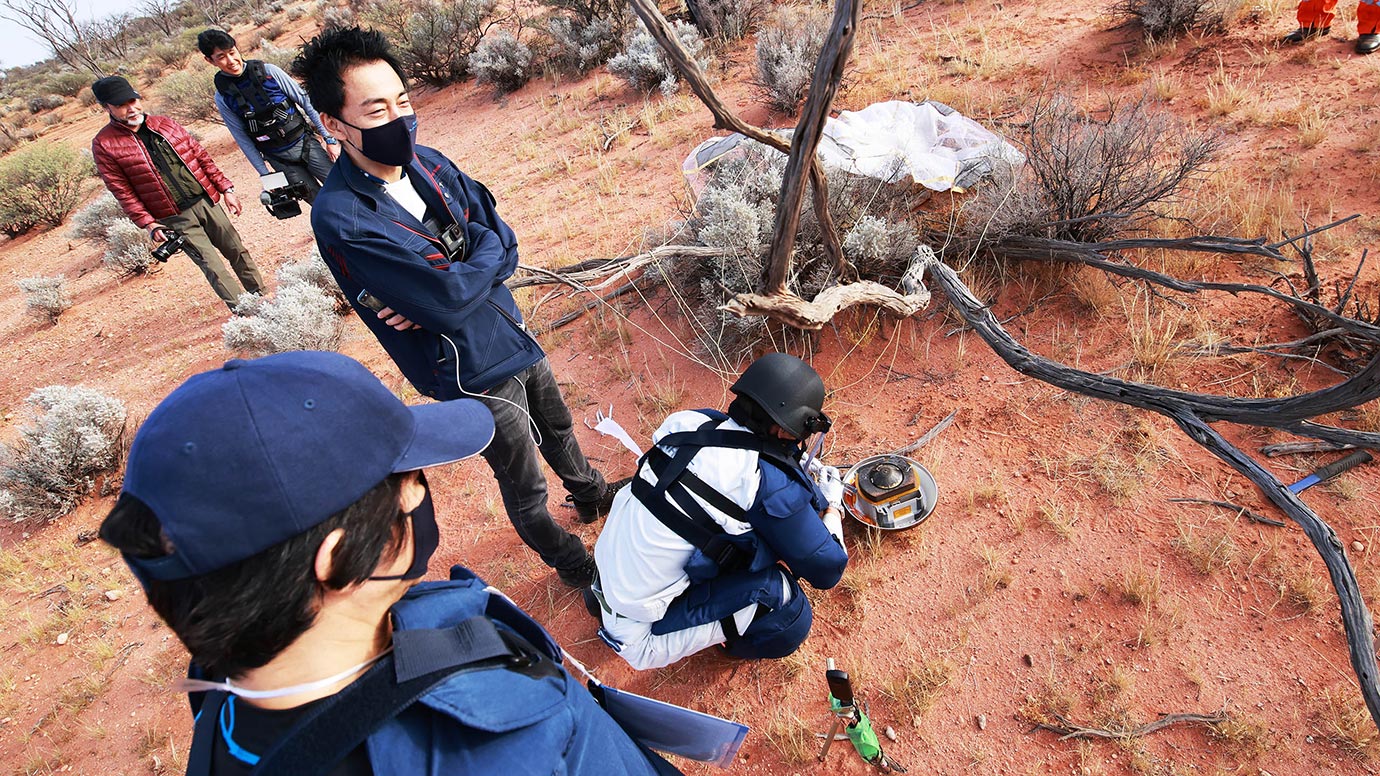
Davis, Dauphas, and UChicago colleague Reika Yokochi are all part of a team assembled to help Japanese researchers analyze the samples. Each part of the capsule’s contents is being rigorously studied. Yokochi is part of a team that is analyzing the gases that were trapped in the capsule or in the dirt. Dauphas and Davis are part of a team that is studying the chemical and isotopic composition grains to reveal their history.
Ancient Origins of Ryugu
The first compilation of these results, reported in the journal Science on June 9, reveals the makeup of Ryugu.
The rock is similar to a class of meteorites known as “Ivuna-type carbonaceous chondrites.” These rocks have a similar chemical composition to what we measure from the sun and are thought to date back to the very beginnings of the solar system approximately four-and-a-half billion years ago—before the formation of the sun, the moon, and Earth.
Back then, all that existed was a gigantic, rotating cloud of gas. Scientists think that most of that gas was pulled into the center and formed the star we know as the sun. As the remnants of that gas expanded into a disk and cooled, it transformed into rocks, which still float around the solar system today; it appears Ryugu may be one of them.

Water in the Early Solar System
Scientists said the fragments show signs of having been soaked in water at some point. “One must picture an aggregate of ice and dust floating in space, that turned into a giant mudball when ice was melted by nuclear energy from the decay of radioactive elements that were present in the asteroid when it formed,” said Dauphas. But surprisingly, today the rock itself appears to be relatively dry.
Using radioisotope dating, they estimated that Ryugu was altered by water circulation only about five million years after the solar system formed.
These findings are particularly interesting to researchers because they hint at similar formation conditions between comets and some asteroids such as Ryugu.
“By examining these samples, we can constrain the temperatures and conditions that must have been occurring in their lifetimes, and try to understand what happened,” Yokochi explained.
She compared the process to trying to figure out how a soup was made, but with only the final result rather than the recipe: “We can take the soup and separate the ingredients, and try to tell from their conditions how much it was heated and in what order.”
“This is a gift that keeps on giving.”
Prof. Andrew Davis
The Gift That Keeps on Giving
The scientists noted that a percentage of the findings will be set aside so that we can analyze them in the future with more advanced technology—much as we did with lunar samples from Apollo.
“After we got moon samples from Apollo 50 years ago, our ideas about how the moon formed completely changed,” Davis said. “We’re still learning new things from them, because our instruments and technology have advanced.
“The same will be true for these samples. This is a gift that keeps on giving.”
This mission is the first of several international missions that will bring back samples from another asteroid named Bennu, as well as unexplored areas on our moon, Mars, and Mars’ moon Phobos. This should all be taking place in the next 10 to 20 years.
“It has been very much under the radar for the public and some decision makers, but we are entering a new era of planetary exploration that is unprecedented in history,” said Dauphas. “Our children and grandchildren will see returned fragments of asteroids, Mars, and hopefully other planets when they visit museums.”
Reference: “Samples returned from the asteroid Ryugu are similar to Ivuna-type carbonaceous meteorites” by Tetsuya Yokoyama, Kazuhide Nagashima, Izumi Nakai, Edward D. Young, Yoshinari Abe, Jérôme Aléon, Conel M. O’D. Alexander, Sachiko Amari, Yuri Amelin, Ken-ichi Bajo, Martin Bizzarro, Audrey Bouvier, Richard W. Carlson, Marc Chaussidon, Byeon-Gak Choi, Nicolas Dauphas, Andrew M. Davis, Tommaso Di Rocco, Wataru Fujiya, Ryota Fukai, Ikshu Gautam, Makiko K. Haba, Yuki Hibiya, Hiroshi Hidaka, Hisashi Homma, Peter Hoppe, Gary R. Huss, Kiyohiro Ichida, Tsuyoshi Iizuka, Trevor R. Ireland, Akira Ishikawa, Motoo Ito, Shoichi Itoh, Noriyuki Kawasaki, Noriko T. Kita, Kouki Kitajima, Thorsten Kleine, Shintaro Komatani, Alexander N. Krot, Ming-Chang Liu, Yuki Masuda, Kevin D. McKeegan, Mayu Morita, Kazuko Motomura, Frédéric Moynier, Ann Nguyen, Larry Nittler, Morihiko Onose, Andreas Pack, Changkun Park, Laurette Piani, Liping Qin, Sara S. Russell, Naoya Sakamoto, Maria Schönbächler, Lauren Tafla, Haolan Tang, Kentaro Terada, Yasuko Terada, Tomohiro Usui, Sohei Wada, Meenakshi Wadhwa, Richard J. Walker, Katsuyuki Yamashita, Qing-Zhu Yin, Shigekazu Yoneda, Hiroharu Yui, Ai-Cheng Zhang, Harold C. Connolly, Dante S. Lauretta, Tomoki Nakamura, Hiroshi Naraoka, Takaaki Noguchi, Ryuji Okazaki, Kanako Sakamoto, Hikaru Yabuta, Masanao Abe, Masahiko Arakawa, Atsushi Fujii, Masahiko Hayakawa, Naoyuki Hirata, Naru Hirata, Rie Honda, Chikatoshi Honda, Satoshi Hosoda, Yu-ichi Iijima, Hitoshi Ikeda, Masateru Ishiguro, Yoshiaki Ishihara, Takahiro Iwata, Kosuke Kawahara, Shota Kikuchi, Kohei Kitazato, Koji Matsumoto, Moe Matsuoka, Tatsuhiro Michikami, Yuya Mimasu, Akira Miura, Tomokatsu Morota, Satoru Nakazawa, Noriyuki Namiki, Hirotomo Noda, Rina Noguchi, Naoko Ogawa, Kazunori Ogawa, Tatsuaki Okada, Chisato Okamoto, Go Ono, Masanobu Ozaki, Takanao Saiki, Naoya Sakatani, Hirotaka Sawada, Hiroki Senshu, Yuri Shimaki, Kei Shirai, Seiji Sugita, Yuto Takei, Hiroshi Takeuchi, Satoshi Tanaka, Eri Tatsumi, Fuyuto Terui, Yuichi Tsuda, Ryudo Tsukizaki, Koji Wada, Sei-ichiro Watanabe, Manabu Yamada, Tetsuya Yamada, Yukio Yamamoto, Hajime Yano, Yasuhiro Yokota, Keisuke Yoshihara, Makoto Yoshikawa, Kent Yoshikawa, Shizuho Furuya, Kentaro Hatakeda, Tasuku Hayashi, Yuya Hitomi, Kazuya Kumagai, Akiko Miyazaki, Aiko Nakato, Masahiro Nishimura, Hiromichi Soejima, Ayako Suzuki, Toru Yada, Daiki Yamamoto, Kasumi Yogata, Miwa Yoshitake, Shogo Tachibana and Hisayoshi Yurimoto, 9 June 2022, Science.
DOI: 10.1126/science.abn7850
Funding: Japan Society for the Promotion of Science, NASA, Australian Research Council.
Never miss a breakthrough: Join the SciTechDaily newsletter.
Follow us on Google and Google News.
1 Comment
All this money spent to land on this Rock and you only get 5 grams ? LOL