
Close Menu
    Facebook X (Twitter) Instagram
    SciTechDaily
    • Biology
    • Chemistry
    • Earth
    • Health
    • Physics
    • Science
    • Space
    • Technology
    Facebook X (Twitter) Pinterest YouTube RSS
    SciTechDaily
    Home»Biology»Chinese Soft Shelled Turtle Evacuates Majority of Urea through its Mouth
    Biology

    Chinese Soft Shelled Turtle Evacuates Majority of Urea through its Mouth

    By SciTechDailyOctober 12, 2012No Comments2 Mins Read
    Facebook Twitter Pinterest Telegram LinkedIn WhatsApp Email Reddit
    Share
    Facebook Twitter LinkedIn Pinterest Telegram Email Reddit
    chinese-soft-shelled-turtle
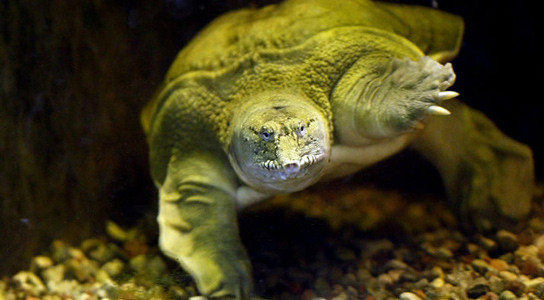
    Chinese soft-shelled turtles (Pelodiscus sinensis) Credit: Akwarium Gdynia

    When Chinese soft-shelled turtles (Pelodiscus sinensis) need to urinate, they open their mouths, according to a new study. As odd as it might seem, this actually makes sense for this amphibious organism.

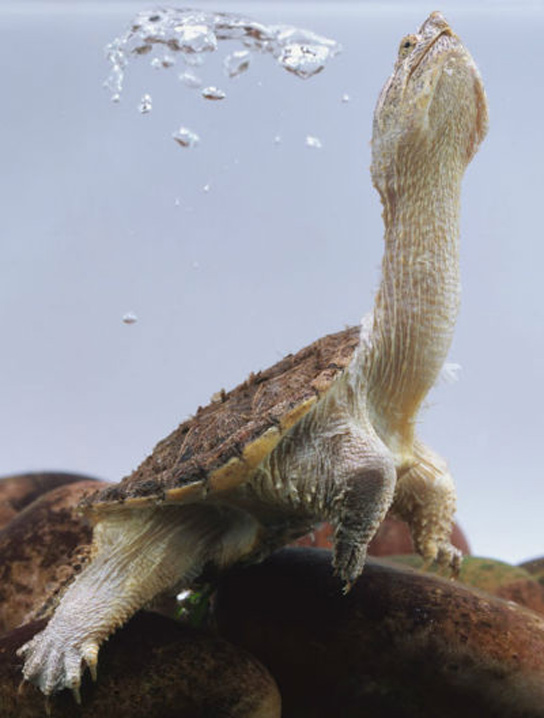
    The researchers published their findings in The Journal of Experimental Biology. These reptiles don’t have any gills, but they have structures inside their mouths that work like gills. This means that P. sinensis has the option of breathing underwater, though most of the time they just reach up and breathe air. But what researchers found perplexing was that when the turtles were on dry land, they would stick their heads in puddles and swish water around in their mouths. This was one of the clues that led researchers to consider that there was something more happening than respiration.
    pelodiscus-sinensis-reaching-up
    Credit: Frank Greenaway

    The scientists bought P. sinensis specimens at a market in Singapore and found ways to collect their urine. They attached a flexible latex tube to each underside. They discovered that the animals were getting rid of a vast majority of their urea, which is a major component of urine, through their mouths instead of their undersides.

    The team speculates that this might be because the animals have to drink a lot of water to make urine, which can be unhealthy in saltwater environments where these turtles spend most of their time. If they are just rinsing out the water around their mouths, they avoid having to get rid of the salt.

    Reference: “The Chinese soft-shelled turtle, Pelodiscus sinensis, excretes urea mainly through the mouth instead of the kidney” by Yuen K. Ip, Ai M. Loong, Serene M. L. Lee, Jasmine L. Y. Ong, Wai P. Wong and Shit F. Chew, 1 November 2012, The Journal of Experimental Biology.
    DOI: 10.1242/jeb.068916

    Never miss a breakthrough: Join the SciTechDaily newsletter.
    Follow us on Google and Google News.

    Turtle Zoology
    Share. Facebook Twitter Pinterest LinkedIn Email Reddit

    Related Articles

    Bactrian Camel Genome Might Help Survival in Harsh Environments

    First Sighting of the Spade-Toothed Whale

    Leopard Seals Suction Feed on Krill Like Whales

    Archer Fish Shoots Down Prey With Its Incredible Water Jet

    War of the Badgers Erupts in England

    Transgendered Bellbird Discovered in New Zealand

    Mother’s Presence Increases Survivability of Male Orca Offspring

    A Fifth of All Invertebrates on Earth Threatened by Extinction

    Previously Thought Extinct Sri Lankan Kandyan Dwarf Toad Reappears

    Leave A Reply Cancel Reply

    • Facebook
    • Twitter
    • Pinterest
    • YouTube

    Don't Miss a Discovery

    Subscribe for the Latest in Science & Tech!

    Trending News

    NASA’s Voyager 1 Is About to Become the First Spacecraft One Light-Day From Earth

    A Woman Who Lived 30,000 Years Ago Is Changing What We Know About Ice Age Europe

    A Rare Radioactive Element Reveals a Hidden Secret About the Heaviest Atoms

    Breakthrough Cancer Treatment Wipes Out Deadly Brain Tumors in Every Mouse Tested

    Something Remarkable Is Happening to Dogs Living Near Chernobyl’s Nuclear Plant

    Hubble Uncovers a Mysterious 93-Billion-Mile Structure Hiding in a Nearby Star System

    Earth’s Oceans Were Slowly Suffocating Millions of Years Before a Devastating Mass Extinction

    Why Are Men Twice As Likely To Develop Parkinson’s? Scientists Discover a Hidden Clue in the Brain

    Follow SciTechDaily
    • Facebook
    • Twitter
    • YouTube
    • Pinterest
    • Newsletter
    • RSS
    SciTech News
    • Biology News
    • Chemistry News
    • Earth News
    • Health News
    • Physics News
    • Science News
    • Space News
    • Technology News
    Recent Posts
    • Scientists Find a Clever Way to Read Quantum Information Without Destroying It
    • Chemical Breakthrough Could Unlock the “Holy Grail” of Solid-State Battery Technology
    • Kids Who Learn To Swim Early May Have an Unexpected Advantage in School
    • Could Type 2 Diabetes Be Reversed? 14-Year Study Reveals Remarkable Results
    • The Secret to Saving Shellfish From Acidifying Oceans Could Be Hiding in Crushed Shells
    Copyright © 1998 - 2026 SciTechDaily. All Rights Reserved.
    • Science News
    • About
    • Contact
    • Editorial Board
    • Privacy Policy
    • Terms of Use

    Type above and press Enter to search. Press Esc to cancel.