
Close Menu
    Facebook X (Twitter) Instagram
    SciTechDaily
    • Biology
    • Chemistry
    • Earth
    • Health
    • Physics
    • Science
    • Space
    • Technology
    Facebook X (Twitter) Pinterest YouTube RSS
    SciTechDaily
    Home»Biology»First Sighting of the Spade-Toothed Whale
    Biology

    First Sighting of the Spade-Toothed Whale

    By SciTechDailyNovember 7, 2012No Comments2 Mins Read
    Facebook Twitter Pinterest Telegram LinkedIn WhatsApp Email Reddit
    Share
    Facebook Twitter LinkedIn Pinterest Telegram Email Reddit
    spade-toothed-whale
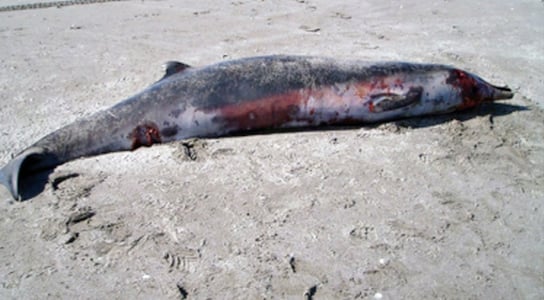
    The unfortunate adult female spade-toothed whale was found dead and beached on Opape Beach in 2010. Credit: New Zealand Government

    The spade-toothed whale (Mesoplodon traversii) is a little-known species of beaked whales. They were first discovered in 1872 when bone fragments were found on Pitt Island, in New Zealand.

    The scientists published their findings in the journal Current Biology. In the last 140 years, the only signs of the existence of these whales were in two partial skulls. M. traversii is considered to be the least known and rarest species of whale. A mother and her male calf beached and died on a New Zealand beach in December 2010. It was only after the researchers ran their DNA that they realized that these were M. traversii.

    gray-beaked-whale
    When two of the exceedingly rare spade-toothed whales washed up on a New Zealand shore, they were initially mistaken for the more common Gray’s beaked whales. Credit: New Zealand Government

    M. traversii is part of a family of whales that can dive more than 800m (2,600ft), and stay under for up to 87 minutes. There are currently 21 species of beaked whales, but there isn’t much information about them.

    No intact specimens had been discovered before this. Initially, the two M. traversii specimens were mistaken for the more common Gray’s beaked whales (Mesoplodon grayi).

    Besides the basic skull morphology, not much was known until now. The whales were stranded and died on Opape Beach in New Zealand. The female was 5.3 meters (17.3 feet) in length and the young calf was 3.5 m (11.5 ft) long.

    M. traversii differs from other beaked whales by the coloration of the rostrum, which is either dark gray or black, compared to the white of M. grayi. M. traversii also has a dark eye patch, white belly, and dark flippers.

    There is still no indication of how many of these whales exist in the wild, but the researchers conclude, “We can now confirm that the spade-toothed whale is extant and for the first time we have a description of the world’s rarest and perhaps most enigmatic marine mammal.”

    Reference: “The world’s rarest whale” by Kirsten Thompson, C. Scott Baker, Anton van Helden, Selina Patel, Craig Millar and Rochelle Constantine, 6 November 2012, Current Biology.
    DOI: 10.1016/j.cub.2012.08.055

    Never miss a breakthrough: Join the SciTechDaily newsletter.
    Follow us on Google and Google News.

    Marine Biology Whales Zoology
    Share. Facebook Twitter Pinterest LinkedIn Email Reddit

    Related Articles

    Comb Jellies Have Proteins to Generate & Sense Light

    European Catfish Learn to Catch Pigeons

    Blue Whales Use 360 Degree Body Rolls to Get at Krill

    Leopard Seals Suction Feed on Krill Like Whales

    Captive Beluga Whale Was Able to Mimic Speech

    Data Shows Humans as Leading Cause of Whale Deaths

    Mother’s Presence Increases Survivability of Male Orca Offspring

    Adult White Killer Whale Spotted in the Wild for the First Time

    Colossal Eyes Give Giant Squids an Advantage When Fighting Sperm Whales

    Leave A Reply Cancel Reply

    • Facebook
    • Twitter
    • Pinterest
    • YouTube

    Don't Miss a Discovery

    Subscribe for the Latest in Science & Tech!

    Trending News

    Invisible Black Holes Could Be Triggering Supernovae

    Scientists Discover the First Contagious Cancer in a Freshwater Animal

    THC-CBD Treatment Dramatically Reduces Agitation in Dementia Trial

    Scientists Say Love Follows Mathematical Patterns

    “Zombie Cells” Reveal a Hidden Weakness That Could Help Fight Aging

    Alien Signals May Be Hiding in a Radio Band SETI Has Barely Explored

    Earth’s Hidden Thermostat Has Regulated Climate for 60 Million Years

    This 518-Million-Year-Old Creature Reveals How Spiders Got Their Bite

    Follow SciTechDaily
    • Facebook
    • Twitter
    • YouTube
    • Pinterest
    • Newsletter
    • RSS
    SciTech News
    • Biology News
    • Chemistry News
    • Earth News
    • Health News
    • Physics News
    • Science News
    • Space News
    • Technology News
    Recent Posts
    • Scientists Who Uncovered Altermagnetism Win Major Physics Honor
    • UK’s £3 Million Bet Could Help NASA Find Life on Nearby Planets
    • Giant Alien World Found Hiding in Plain Sight for 11 Years
    • What It Takes To Make a White Blood Cell Could Unlock New Cancer Treatments
    • Scientists Turn Gut Bacteria Into Pancreatic Cancer Fighters
    Copyright © 1998 - 2026 SciTechDaily. All Rights Reserved.
    • Science News
    • About
    • Contact
    • Editorial Board
    • Privacy Policy
    • Terms of Use

    Type above and press Enter to search. Press Esc to cancel.