
Close Menu
    Facebook X (Twitter) Instagram
    SciTechDaily
    • Biology
    • Chemistry
    • Earth
    • Health
    • Physics
    • Science
    • Space
    • Technology
    Facebook X (Twitter) Pinterest YouTube RSS
    SciTechDaily
    Home»Space»Seeing Farther: Webb Space Telescope Is Designed To Answer Fundamental Questions of the Universe
    Space

    Seeing Farther: Webb Space Telescope Is Designed To Answer Fundamental Questions of the Universe

    By European Space Agency (ESA)December 13, 2021No Comments2 Mins Read
    Facebook Twitter Pinterest Telegram LinkedIn WhatsApp Email Reddit
    Share
    Facebook Twitter LinkedIn Pinterest Telegram Email Reddit
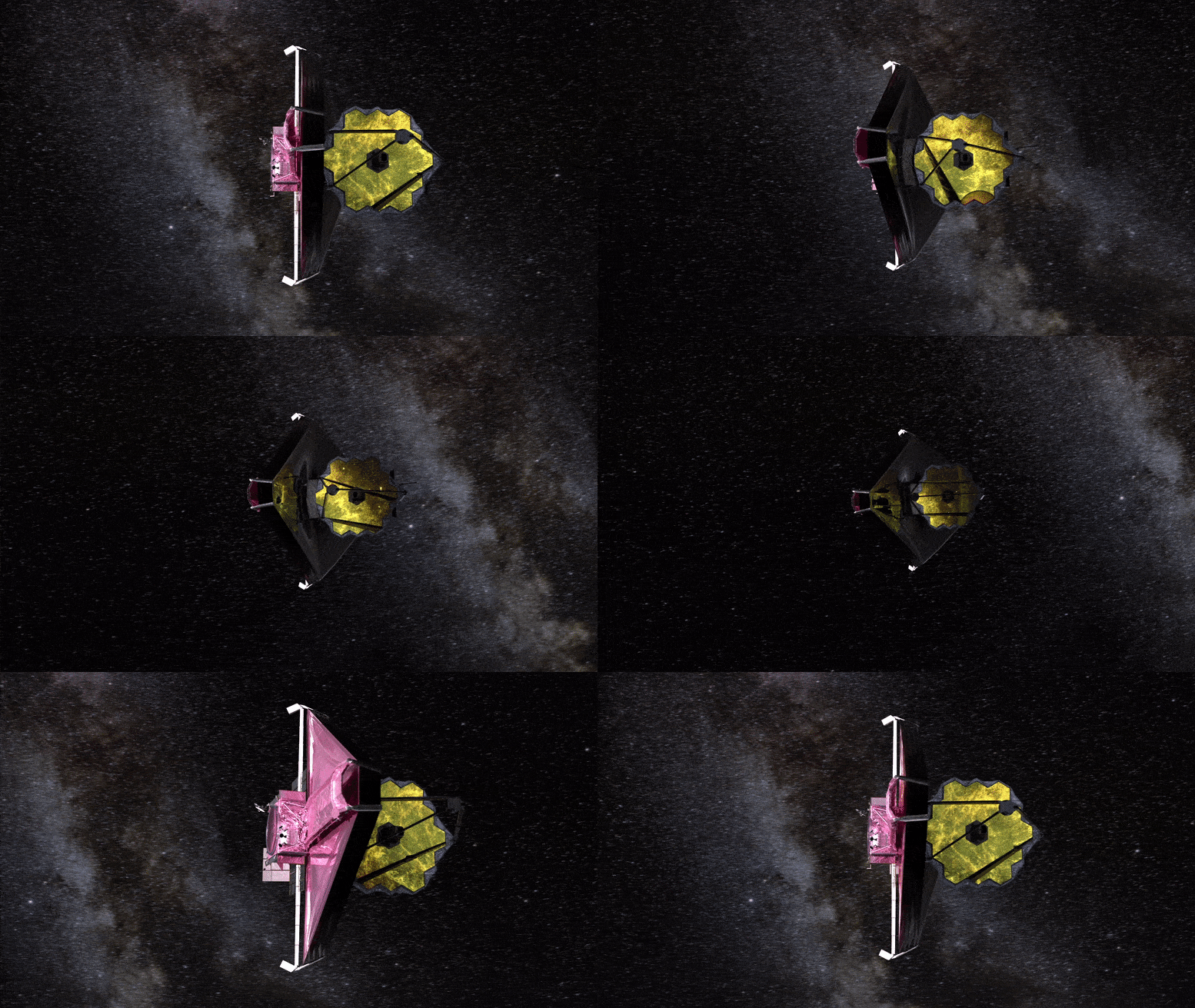
    Webb Telescope L2 Flyby
    The James Webb Space Telescope (JWST) is the next of NASA’s Great Observatories; following in the line of the Hubble Space Telescope, the Compton Gamma-ray Observatory, the Chandra X-ray Observatory, and the Spitzer Space Telescope. JWST combines qualities of two of its predecessors, observing in infrared light, like Spitzer, with fine resolution, like Hubble. Credit: NASA, SkyWorks Digital, Northrop Grumman, STScI

    The James Webb Space Telescope (Webb) is designed to answer fundamental questions about the Universe.

    With 100 times more sensitivity than the NASA/ESA Hubble Space Telescope, and a mirror which is nearly double the size of ESA’s Herschel Space Observatory, it can detect infrared light generated by galaxies as they formed more than 13.5 billion years ago, in the aftermath of the Big Bang.

    For the first time in human history we have the opportunity to directly observe the first stars and galaxies forming in the early Universe. When we observe something that is a million light-years away, what we are seeing is actually how it looked a million years ago: we are looking back in time.

    The light of galaxies that are billions of light-years away travels to us through the expanding Universe, which causes its wavelength to stretch into the infrared. Webb’s infrared vision makes it a powerful time machine that will peer back over 13.5 billion years, to a time shortly after the Big Bang.

    Some of Hubble’s most remarkable images were its ‘deep fields’, which used long exposures – over days – to capture thousands of galaxies in single images. They revealed the most distant galaxies ever observed till then, and showed us young galaxies when they were only a few hundred million years old and were small, compact, and irregular.

    Webb’s infrared sensitivity will not only look back farther in time but will also reveal dramatically more information about stars and galaxies in the early Universe. Webb’s data will also answer the compelling questions of how black holes formed and grew early on, and what influence they had on the formation and evolution of the early Universe.

    Webb is an international partnership between NASA, ESA and the Canadian Space Agency (CSA).

    Never miss a breakthrough: Join the SciTechDaily newsletter.
    Follow us on Google and Google News.

    Astronomy Astrophysics European Space Agency James Webb Space Telescope NASA
    Share. Facebook Twitter Pinterest LinkedIn Email Reddit

    Related Articles

    Major Milestone: NASA’s Webb Space Telescope Discovers Earliest Galaxies in the Universe

    Galactic Collision: Webb Space Telescope Explores Frenzied Star Formation in Merging Galaxies

    Webb Space Telescope To Provide Details of Two Intriguing “Super-Earths” in the Milky Way

    Webb Space Telescope: Uncovering Hidden Parts of Our Solar System

    Science With the Webb Space Telescope – What Questions Will It Answer?

    World’s Next Gen Cosmic Observatory: Webb Space Telescope and Ariane 5 – Preparing for Launch [Video]

    James Webb Space Telescope – Cosmic Observatory Will Offer a New View of the Universe

    $10 Billion James Webb Space Telescope Fueled for Launch

    First James Webb Space Telescope General Observer Scientific Programs Selected

    Leave A Reply Cancel Reply

    • Facebook
    • Twitter
    • Pinterest
    • YouTube

    Don't Miss a Discovery

    Subscribe for the Latest in Science & Tech!

    Trending News

    Don’t Miss: A Brilliant Venus and Glowing Harvest Moon Light Up the Sky

    New Twist on the Einstein Problem Reveals Unexpected Physics

    JWST Captures Stunning Evidence of How Supermassive Black Holes Feed

    Early Exercise May Permanently Change How Much Energy the Body Uses To Move

    New Molecule Wipes Out Aggressive Lymphoma Tumors in Mice in Just 11 Days

    The Human Family Tree May Need a Major Rewrite

    Scientists Find a Surprising Cancer-Fighting Effect in Dark Sweet Cherries

    New AI Detects Hidden Warning Signs of Solar Eruptions Hours Before They Emerge

    Follow SciTechDaily
    • Facebook
    • Twitter
    • YouTube
    • Pinterest
    • Newsletter
    • RSS
    SciTech News
    • Biology News
    • Chemistry News
    • Earth News
    • Health News
    • Physics News
    • Science News
    • Space News
    • Technology News
    Recent Posts
    • Could Alien Life Be Conscious in Ways We Can’t Imagine?
    • Scientists Develop a Fruit Wash That Removes Pesticide Residues and Keeps Produce Fresh Longer
    • Scientists May Have Finally Explained Why Astronauts Get Constipated in Space
    • Pomegranates Could Unlock a New Treatment for Heart Failure
    • Africa’s Giant Herbivores Were Disappearing Millions of Years Before Humans Could Hunt Them
    Copyright © 1998 - 2026 SciTechDaily. All Rights Reserved.
    • Science News
    • About
    • Contact
    • Editorial Board
    • Privacy Policy
    • Terms of Use

    Type above and press Enter to search. Press Esc to cancel.