
Close Menu
    Facebook X (Twitter) Instagram
    SciTechDaily
    • Biology
    • Chemistry
    • Earth
    • Health
    • Physics
    • Science
    • Space
    • Technology
    Facebook X (Twitter) Pinterest YouTube RSS
    SciTechDaily
    Home»Space»The James Webb Space Telescope at Orbital Destination L2 [Video]
    Space

    The James Webb Space Telescope at Orbital Destination L2 [Video]

    By NASA's Goddard Space Flight CenterJanuary 26, 2022No Comments2 Mins Read
    Facebook Twitter Pinterest Telegram LinkedIn WhatsApp Email Reddit
    Share
    Facebook Twitter LinkedIn Pinterest Telegram Email Reddit
    Webb Wallpaper
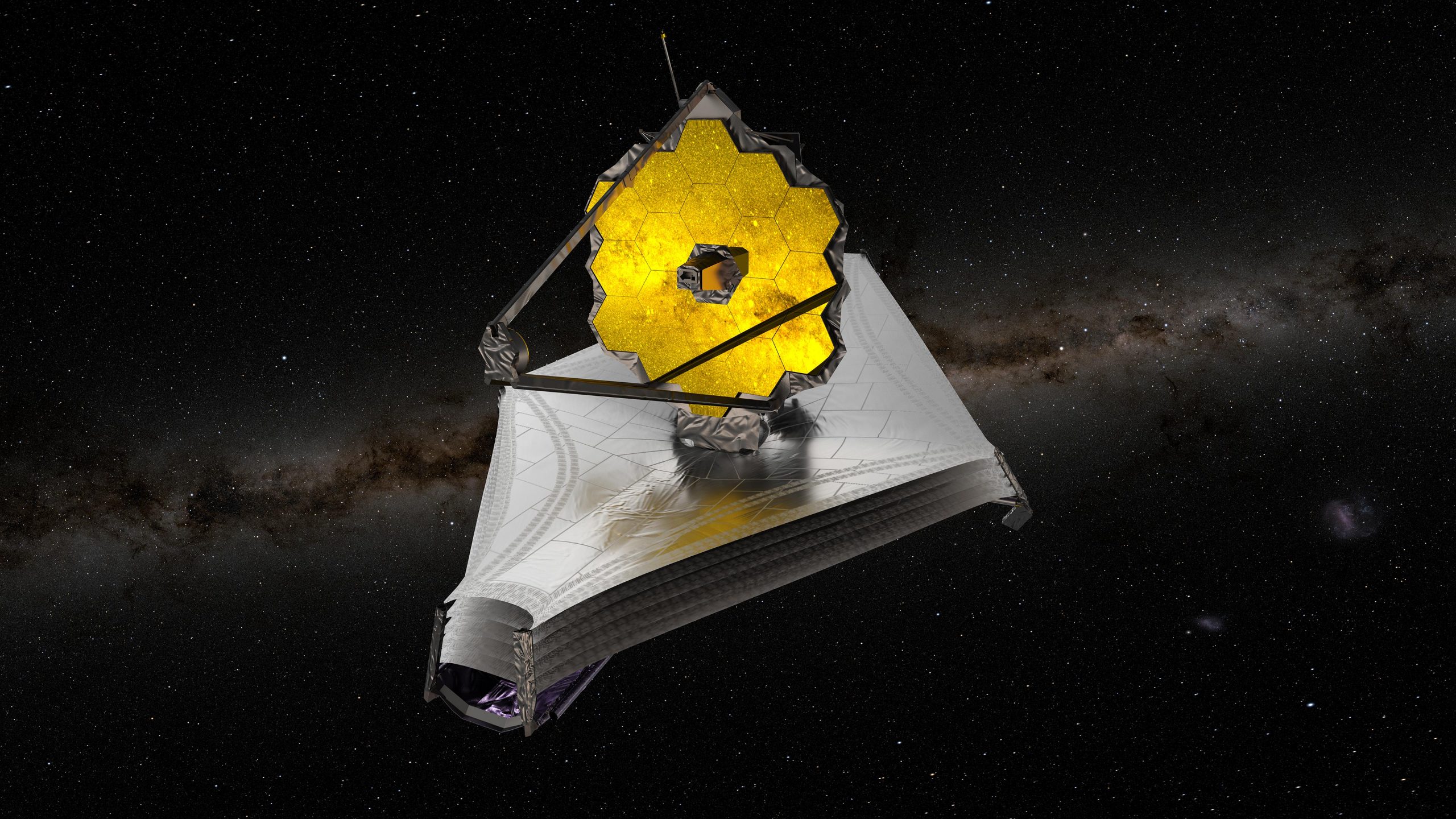
    The James Webb Space Telescope is the next great space science observatory following Hubble, designed to answer outstanding questions about the Universe and to make breakthrough discoveries in all fields of astronomy. Webb will see farther into our origins: from the formation of stars and planets, to the birth of the first galaxies in the early Universe. Credit: ESA/ATG medialab

    After launch, the James Webb Space Telescope traveled to its orbital destination. Webb will perform its science mission while orbiting a location in space, called the second Lagrange point, or L2 for short. L2 is located one million miles from Earth.

    As Webb orbits L2, the telescope stays in line with Earth as it travels around the Sun. L2 is a point where the gravitational influences of the Earth and Sun balance the centripetal force of a small object orbiting with them.

    The telescope’s optics and instruments need to be kept very cold to be able to observe the very faint infrared signals of very distant objects clearly. This location is perfect for Webb’s sunshield to block out light and heat from the Sun, Earth, and Moon. Unlike the Hubble Space Telescope, Webb’s orbit keeps the spacecraft out of the Earth’s shadow making L2 a thermally stable location for the observatory to operate at.

    Webb will operate within its field of regard. The “field of regard” refers to the angles the telescope can move while staying in the shadow of the Sun. Each of Webb’s instruments has its own field of view. The field of view is the area of sky an instrument can observe. Webb’s fine steering mirror is moved so that an object can be observed by the different instruments. This prevents the whole telescope from having to repoint itself to do so.

    The Webb Telescope’s commissioning process will be complete approximately six months after launch, at which time Webb start its science mission. Helping to uncover more of the mysteries of our Universe.

    Never miss a breakthrough: Join the SciTechDaily newsletter.
    Follow us on Google and Google News.

    Astronomy James Webb Space Telescope NASA NASA Goddard Space Flight Center
    Share. Facebook Twitter Pinterest LinkedIn Email Reddit

    Related Articles

    NASA’s Webb Telescope Reveals an Eerie Nebula That Looks Like a Giant Brain

    Webb Telescope Uncovers Star Birth Struggles in a Magnetic Maze at the Milky Way’s Core

    Webb Space Telescope Uncovers Star Birth Secrets at Galaxy’s Edge

    NASA’s James Webb Space Telescope Completes First Full Systems Evaluation

    NASA Gravity Assist: Puffy Planets and Powerful Telescopes

    NASA’s James Webb Space Telescope Fully Stowed in Launch Configuration

    NASA’s New $10 Billion Space Telescope Successfully Deploys Massive Mirror

    NASA’s New Star-Watching Technology Has Thousands of Tiny Shutters

    NASA’s Webb Telescope Will Penetrate Space Dust to Reveal Milky Way’s Center

    Leave A Reply Cancel Reply

    • Facebook
    • Twitter
    • Pinterest
    • YouTube

    Don't Miss a Discovery

    Subscribe for the Latest in Science & Tech!

    Trending News

    Sitting Up Straight Could Actually Help You Make Better Decisions

    Never-Before-Seen Vortices Are Swirling Across the Sun

    This Common Amino Acid May Help the Body Fight Cancer and Viruses

    Low-Protein “Longevity Diet” Linked to Fat Loss, Muscle Preservation, and Healthy Aging

    How Prehistoric Poop Changed Earth’s Ecosystems Forever

    This Fossil Upends a Decades-Old Debate About Snake Evolution

    A Blood Test Years Before Cancer May Reveal a Hidden Warning Sign

    Starlink Satellites Reveal a Hidden Atmosphere 300 Miles Above Earth

    Follow SciTechDaily
    • Facebook
    • Twitter
    • YouTube
    • Pinterest
    • Newsletter
    • RSS
    SciTech News
    • Biology News
    • Chemistry News
    • Earth News
    • Health News
    • Physics News
    • Science News
    • Space News
    • Technology News
    Recent Posts
    • Astronomers Caught a Star Exploding Almost the Instant It Began
    • Empty Space May Not Be Empty After All: Magnetar Reveals a Bizarre Quantum Effect
    • Humanity May Soon Have the Technology To Reach Other Star Systems
    • A “Double Punch” Nanoparticle Could Reveal and Destroy Brain Cancer Cells
    • Popular GLP-1 Weight-Loss Drugs Linked to 30% Lower Breast Cancer Risk
    Copyright © 1998 - 2026 SciTechDaily. All Rights Reserved.
    • Science News
    • About
    • Contact
    • Editorial Board
    • Privacy Policy
    • Terms of Use

    Type above and press Enter to search. Press Esc to cancel.