
Close Menu
    Facebook X (Twitter) Instagram
    SciTechDaily
    • Biology
    • Chemistry
    • Earth
    • Health
    • Physics
    • Science
    • Space
    • Technology
    Facebook X (Twitter) Pinterest YouTube RSS
    SciTechDaily
    Home»Biology»Synthetic Molecule Destroys Key Allergy-Inducing Complexes
    Biology

    Synthetic Molecule Destroys Key Allergy-Inducing Complexes

    By SciTechDailyOctober 30, 2012No Comments3 Mins Read
    Facebook Twitter Pinterest Telegram LinkedIn WhatsApp Email Reddit
    Share
    Facebook Twitter LinkedIn Pinterest Telegram Email Reddit
    mast-cells
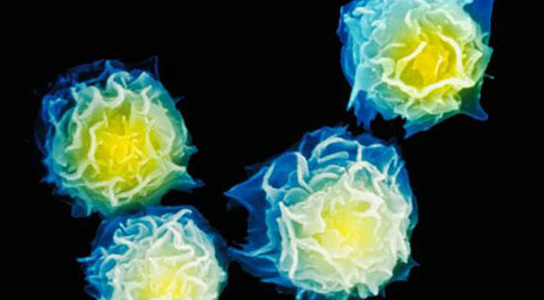
    Scanning electron microscope image of mast cells.

    A new synthetic molecule has been used to destroy the complexes that induce allergic responses, a discovery that could lead to highly potent, rapidly-acting interventions for a host of acute allergic reactions.

    The scientists published their findings in the journal Nature. The new inhibitor disarms IgE antibodies, which are pivotal players in acute allergies, by detaching the antibody from a molecule called FcR.

    Many allergens can set off IgE antibodies, resulting in allergic reactions within seconds. This new inhibitor destroys the complex that tethers IgE to the mast cells responsible for the reaction. The first time potential allergens enter the body, allergen-specific IgE antibodies are produced, which stay around long after the initial allergen is cleared from the body. Most of the antibodies are caught by FcRs, which are IgE-specific receptors that are exposed on the surface of mast cells. These cells are then primed to react the next time the body encounters the allergen.

    The dissociation of this IgE-FcR interaction has been the goal of allergy treatment for a while, since IgE-coated mast cells contain histamine, and re-encountering the allergen can be dangerous because it will trigger the release of inflammatory mediators, including histamine, that promote the allergic response.

    The key to disabling the allergic response lies in the separation of IgE from FcRs, which has been difficult since their interaction is extremely stable. The new engineered protein inhibitor, called DARPin E2-79, strips IgE from the mast cell receptor in a matter of seconds.

    DARPin E2-79 is part of a family of engineered inhibitors containing the protein-binding regions called ankryin repeats. After E2-79’s structure was solved, the information was used to model its interaction with the IgE-FcR pair. Then, sensitive biochemical techniques were used to detect the binding interactions between the molecules. The team was able to tease out the mechanism that the inhibitor uses to break the IgE-FcR bond.

    Large macromolecules like E2-79 are expected to be less potent than smaller molecule inhibitors, which is why the fact that E2-79 works so well came as a surprise. The goal now is to find a smaller molecule with the same effect, which could be easier to manufacture and amenable to oral administration in patients.

    Reference: “Accelerated disassembly of IgE–receptor complexes by a disruptive macromolecular inhibitor” by Beomkyu Kim, Alexander Eggel, Svetlana S. Tarchevskaya, Monique Vogel, Heino Prinz and Theodore S. Jardetzky, 28 October 2012, Nature.
    DOI: 10.1038/nature11546

    Never miss a breakthrough: Join the SciTechDaily newsletter.
    Follow us on Google and Google News.

    Allergy Antibodies Popular Structural Biology
    Share. Facebook Twitter Pinterest LinkedIn Email Reddit

    Related Articles

    “Unheard of in Structural Biology” – New Research Unveils Enzymatic Keys to Immune System Regulation

    When the Cure Becomes the Killer: The Surprising Turn of Antibodies in Snake Venom Research

    30-Year-Old Eye Mystery Solved – Ion Channel Structure Deciphered

    The Extraordinary “Rapunzel” Virus: An Evolutionary Marvel

    What Drives the Circadian Rhythms: Unlocking Complex Workings of the Biological Clock

    Cryo-EM Reveals How “911” Molecule Helps Repair DNA Damage

    Here CRISPR Kitty? Progress in Developing a Hypoallergenic Cat

    Clever Human Antibodies Neutralize Ebola Virus – And Its Deadly Relatives

    Velvet Worms Secrete Stiff Fibers Spun from Slime

    Leave A Reply Cancel Reply

    • Facebook
    • Twitter
    • Pinterest
    • YouTube

    Don't Miss a Discovery

    Subscribe for the Latest in Science & Tech!

    Trending News

    “Crawzilla” – Scientists Just Found North America’s Biggest Known Crayfish

    Scientist Reveals 7 of the Strangest Things Coffee Does to Your Body

    Great News From Enceladus: Saturn’s Icy Moon Just Became Even More Promising for Life

    Scientists Just Built the World’s Most Accurate Clock

    Scientists Find a “Pain Switch” That Could Shut Down Arthritis Pain

    Scientists Reveal What Could Happen if Yellowstone Erupted Now

    Scientists Discover a Molecular “Memory” That Could Make Lost Weight Come Back

    This Strange Planet Is Going Backwards – and Scientists Don’t Know Why

    Follow SciTechDaily
    • Facebook
    • Twitter
    • YouTube
    • Pinterest
    • Newsletter
    • RSS
    SciTech News
    • Biology News
    • Chemistry News
    • Earth News
    • Health News
    • Physics News
    • Science News
    • Space News
    • Technology News
    Recent Posts
    • A Century-Old Archaeological Mystery in Florida May Finally Be Solved
    • These Feline Brothers Are the First Cats Ever Documented With Marfan Syndrome
    • Spinosaurus May Have Spent Most of Its Life Underwater, New Study Finds
    • The Secret to Better Magnetic Memory May Be the Light, Not the Material
    • Einstein Probe Discovers a Secret Phase of Neutron Star Collisions
    Copyright © 1998 - 2026 SciTechDaily. All Rights Reserved.
    • Science News
    • About
    • Contact
    • Editorial Board
    • Privacy Policy
    • Terms of Use

    Type above and press Enter to search. Press Esc to cancel.