
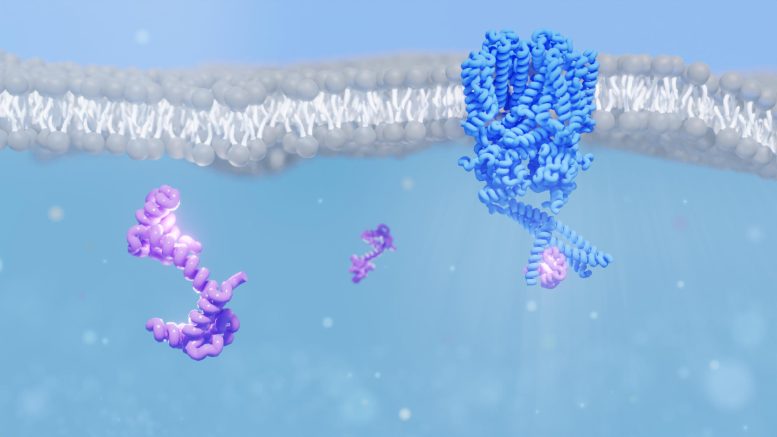
Exciting new findings shed light on the interaction between the protein calmodulin and an ion channel in the eye, potentially unlocking the secret behind our eyes’ exceptional sensitivity to low light conditions.
Utilizing cryo-electron microscopy and mass spectrometry, a team of researchers from PSI has successfully unraveled the structure of an ion channel in the eye as it interacts with the protein calmodulin – a puzzle that has stumped scientists for 30 years. This interaction could explain how our eyes can achieve such remarkable sensitivity to dim light. The findings have been published in the journal PNAS.
When you gaze at the bright screen of your phone or computer, the ion channels in your eyes react to the light by closing. This action marks the culmination of a biochemical chain reaction initiated by light exposure. As a result, calcium ions can no longer traverse the channels situated in the cell membrane, which leads to the transformation of the biochemical signal into an electrical one. This signal then travels through the nervous system, ultimately reaching your brain for processing.
The same process occurs when you stand outside at night and looks up at the sky. Now, the rod cells perform this trick. These are the cells that make our eyes sensitive to low levels of light, enabling us to look at the night sky and detect just a few photons of light from a distant star. We take this for granted, but this is a remarkable feat.
A team led by PSI scientist, Jacopo Marino, has now improved our understanding of how a tiny protein called calmodulin helps to achieve this, by interacting with ion channels in the rod cells. Calmodulin is a calcium sensor. It enables the cell to respond to calcium fluctuations – one of the cell’s universal means of communication. The team, a collaboration between groups at PSI, ETH Zurich, and University of Bonn, has illuminated for the first time the three-dimensional structure of the rod cyclic nucleotide-gated (CNG) ion channel as calmodulin binds.
An Important Function for Calmodulin in the Eye
One year ago, the researchers succeeded in deciphering the structure of this same ion channel, found in the rod cells of a cow retina and identical to the ion channel found in the rod cells of our eyes. Rod CNG consists of four subunits, a structure shared with many other ion channels. Yet a peculiarity of the channel is that three subunits – known as subunit A – are identical, whilst a fourth – subunit B – is different.
Scientists have known for a long time that this subunit binds calmodulin. Throughout the animal kingdom, this feature is found. Yet, the exact nature of its role has remained unclear. “If something is conserved through evolution, it’s a very strong indicator that it’s important in some way,” explains Marino. “We knew that calmodulin modulates the activity of the channel through subunit B, but which kind of structural changes were occurring has been a big mystery for about thirty years, essentially because people were unable to solve the structure of the ion channel.”
Now, the researchers can provide a three-dimensional view of what is really happening. Through a combination of cryo-electron microscopy and mass spectrometry, they could observe that as calmodulin binds, the ion channel becomes a bit more compact.
The researchers believe that this is nature’s way of holding the channels closed. What would the purpose of this be? “We think it’s a way to reduce spontaneous channel openings that would cause background noise so that our eyes can be sensitive to dim light,” says Marino.
Mass Spectrometry Helps Researchers Solve a Wriggly Structure
Obtaining the structure of calmodulin and the ion channel binding was not easy. The interaction between calmodulin and Rod CNG occurs in a highly flexible region of the channel, where it is free to swing about. In cryo-electron microscopy, this makes it very difficult to obtain high-resolution structural information. Here, Marino offers an analogy, “Imagine you have a room of people dancing. You take a photo and want to work out from this what the human body shape is. You might be able to work out what a head looks like, but with limbs waving all over the place the legs and arms will be blurred.”
It was thanks to a chance meeting, that the team could pin down this wriggly structure. Ph.D. student Dina Schuster heard a presentation of Marino. “We were ready to publish based on the cryo-electron microscopy data alone, which left much of the interaction ambiguous, when Dina approached me and said ‘I think I can help you’“, he remembers.
Schuster is developing novel mass spectrometry-based strategies to study protein interactions. These techniques use enzymes to chop proteins into pieces, either in native conditions within parts of the retinal membrane or when chemically crosslinked. The protein fragments, some of which are joined together, are identified by mass spectrometry. This reveals information on which parts of the protein were close together in three-dimensional space – equivalent to piecing together a 3D jigsaw puzzle. “These techniques enabled us to narrow down some of the possibilities that were ambiguous with cryo-electron microscopy,” explains Schuster, who is joint first author of the publication together with PhD student, Diane Barret.
From the Wonder of Vision to Implications in Human Health
Calmodulin regulates ion channels not only in the eye but throughout the body, controlling electrical signals that are essential to the correct functioning of diverse muscles and organs. In recent years, it has become apparent that when this interaction goes wrong due to mutations in the calmodulin gene, there can be severe health implications, such as cardiac failure: something that is not yet fully understood.
As well as helping our understanding of a most fundamental wonder – how we can see the stars – the findings of this study, and methods used, may aid our understanding of the interaction of calmodulin with ion channels in other parts of the body.
Reference: “Structural basis of calmodulin modulation of the rod cyclic nucleotide-gated channel” by Diane C. A. Barret, Dina Schuster, Matthew J. Rodrigues, Alexander Leitner, Paola Picotti, Gebhard F. X. Schertler, U. Benjamin Kaupp, Volodymyr M. Korkhov and Jacopo Marino, 3 April 2023, Proceedings of the National Academy of Sciences.
DOI: 10.1073/pnas.2300309120
Never miss a breakthrough: Join the SciTechDaily newsletter.
Follow us on Google and Google News.